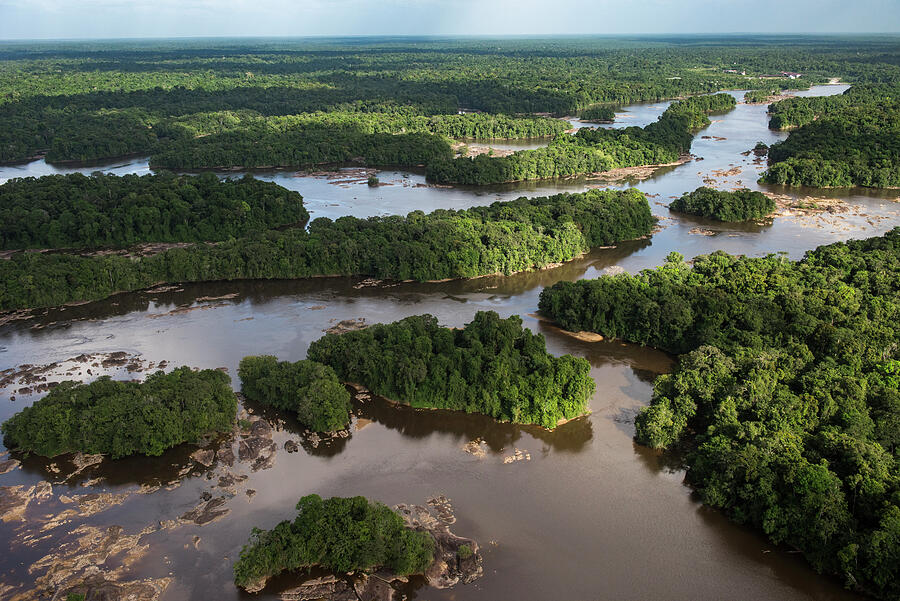
Photo: Pete Oxford / naturepl.com, via Department of Public Information, Guyana.
Guyana is developing a national information system intended to show not only where its forests stand, but which species and ecosystems exist beneath the canopy and how that biodiversity changes over time.
The National Biodiversity Information System, or NBIS, is being positioned as a Guyana-owned platform that can connect existing research, agency records and continuing environmental monitoring.
Environmental Protection Agency Executive Director Kemraj Parsram described the system during the second Global Biodiversity Alliance conference in Georgetown. According to the official November 2 account, the platform is expected to cover Guyana’s rainforests, highlands, savannahs, wetlands, mangroves and marine environment.
The development matters to investors because credible environmental decisions depend on credible evidence. Site selection, environmental assessment, conservation planning and nature-related financing all require a defensible understanding of what is present, what is at risk and whether an intervention produces a measurable result.
NBIS could strengthen that foundation. It should not, however, be presented as a completed biodiversity market or an immediately available investment product.
From forest cover to living ecosystems
Guyana already monitors forest cover from above. That type of system can show where forest exists and where land-cover change occurs, but a satellite image alone cannot provide a complete account of the species, ecological relationships or habitat conditions beneath the canopy.
The NBIS concept expands the information layer.
The EPA says the system will draw on existing work by Iwokrama, the Field Museum, Map of Life and other research partners while incorporating continuing monitoring. Iwokrama, where rangers have collected biodiversity information over many years, has been identified as the first site in the developing system.
The long-term vision described by the EPA includes satellite information, acoustic monitors, environmental sensors and a digital representation of Guyana’s ecosystems. The agency already operates water- and air-quality sensors, but the official update does not say that every proposed NBIS technology is installed or operating nationally.
That distinction is important. The announcement establishes the system’s intended direction and identifies an initial site. It does not confirm that a complete national database, real-time monitoring network or publicly accessible dashboard is already available.
A partnership with Yale and Map of Life
The NBIS stems from a memorandum of understanding signed in July 2025 between the Government of Guyana and the Yale Center for Biodiversity and Global Change.
At the original Global Biodiversity Alliance summit, the Office of the President said that Yale, through Map of Life, would help Guyana develop a national information system containing maps, dashboards and data layers. The partnership was also intended to support the application of biodiversity science to public decision-making and Guyana’s conservation commitments.
Map of Life is a Yale-led platform that integrates species-distribution and monitoring information. Its work includes indicators used to assess whether conservation areas adequately represent the habitats species need.
That is a more demanding question than measuring the number of hectares placed within a boundary. A protected area may add to national coverage while still failing to safeguard particular species or ecological systems. Evidence about species distribution and habitat condition can help decision-makers evaluate conservation quality as well as geographic quantity.
The Convention on Biological Diversity’s Target 3 calls for at least 30 per cent of terrestrial and inland-water areas and 30 per cent of marine and coastal areas to be effectively conserved and managed globally by 2030. The target also stresses ecological representation, connectivity, equitable governance and respect for Indigenous and traditional territories.
A national information system can support decisions made toward that goal, but data collection by itself does not establish that land or marine areas are effectively conserved.
Why measurement matters to nature finance
Guyana is attempting to extend its environmental-finance experience beyond forest carbon and into the wider field of biodiversity, an ambition previously examined by Invest Guyana ahead of the country’s October biodiversity-finance summit.
That shift increases the measurement challenge. A carbon programme can focus on quantified greenhouse-gas outcomes under a defined methodology. Biodiversity encompasses species, habitats, ecosystem functions, genetic diversity and locally important natural values. The relevant evidence can vary significantly between a rainforest, wetland, savannah and marine area.
A credible project therefore requires a baseline: what exists before an intervention begins. It also requires an agreed method for showing whether conditions improve, deteriorate or remain stable.
NBIS could help establish that evidence. A connected national information system may support the identification of ecologically important areas, the design of monitoring plans and the comparison of results over time.
It could also assist Guyana’s reporting under the Convention on Biological Diversity. Guyana’s older National Biodiversity Strategy and Action Plan already identified stronger national monitoring, a better knowledge base and consolidation of biodiversity data as strategic priorities.
The current NBIS initiative can be understood as a more technologically developed continuation of that institutional need.
It does not yet solve every requirement of nature finance. A financing instrument would still need to define the asset or activity being supported, responsible parties, rights, safeguards, payment mechanism, verification arrangements and treatment of failure or reversal.
What the system could mean for businesses
The most immediate commercial significance is better environmental intelligence rather than a new security or credit.
Developers may eventually be able to use stronger biodiversity information during early site screening. That could help identify sensitive habitats before substantial capital is committed to land acquisition, design or engineering.
Environmental consultants and project sponsors could also benefit from more consistent baseline information when preparing assessments. Regulators may gain a stronger evidence base for comparing project information with known ecological conditions.
Financial institutions are increasingly examining nature-related risks within lending and investment portfolios. A credible national dataset could help investors distinguish between unsupported environmental claims and projects grounded in verifiable evidence.
There may also be demand for local capabilities in field surveying, species identification, geospatial analysis, remote sensing, acoustic monitoring, sensor installation, data engineering, environmental auditing and community-based monitoring.
These are potential implications, not announced contracts. The official update does not identify a procurement schedule, approved service-provider list or private application process connected with NBIS.
Businesses should also not assume that information from the future platform will replace project-specific fieldwork. A national system may identify known conditions and data gaps, but a proposed mine, road, resort, farm or industrial facility can still require location-specific studies and regulatory review. Invest Guyana’s guide to preparing an EPA environmental-authorisation application explains the project-level evidence businesses should expect to assemble.
Data ownership is commercially important
The EPA says Guyana will own the information within the system and that participating agencies will retain control of their respective datasets while NBIS brings the information together.
That principle addresses an important concern for biodiversity-rich countries: biological information collected domestically should not automatically be controlled elsewhere simply because an international institution supplies technology or analytical expertise.
Operational details will still matter.
Investors, researchers and communities will need to know which information is public, which is restricted and how commercially or culturally sensitive information is protected. Precise locations of rare species may require safeguards against poaching or disturbance. Traditional knowledge may carry separate questions of consent, ownership, attribution and benefit sharing.
The system will also need clear procedures for data quality, correction, access and use. Connecting datasets does not make them automatically comparable. Records may have different formats, collection dates, geographic accuracy and levels of scientific verification.
A credible platform should disclose enough about its methods for users to understand the limits of the information they are viewing.
What has not yet been announced
The latest official material does not provide a complete implementation timetable, development budget or date for national public access.
It also does not identify:
- the statutory or administrative framework governing the system;
- mandatory data standards for participating agencies;
- the treatment of Indigenous and traditional knowledge;
- terms for commercial and academic use;
- public access, licensing or user fees;
- the independent verification process;
- the relationship between NBIS data and EPA permitting decisions;
- the methodology for any future biodiversity credits; or
- a mechanism through which investors can presently finance or purchase verified outcomes.
Those gaps do not negate the value of the initiative. They define the work needed to turn a promising technical collaboration into dependable national infrastructure.
What investors should watch next
The next meaningful milestones will be publication of the NBIS operating model, initial datasets and monitoring methods; confirmation of the geographic and ecological scope of the Iwokrama pilot; and a schedule for expansion beyond the first site.
Businesses should also watch for rules governing data access, community participation, biodiversity safeguards and the use of NBIS evidence in environmental assessments or financial instruments.
Guyana’s biodiversity-finance ambitions depend on more than demonstrating that the country possesses exceptional natural assets. They require evidence that those assets can be measured, governed and protected without excluding the people and institutions responsible for them.
NBIS is intended to build part of that evidence base. Its investment significance will ultimately depend on the quality, accessibility and independence of the system that emerges.