Photo: Department of Public Information / Global Biodiversity Alliance
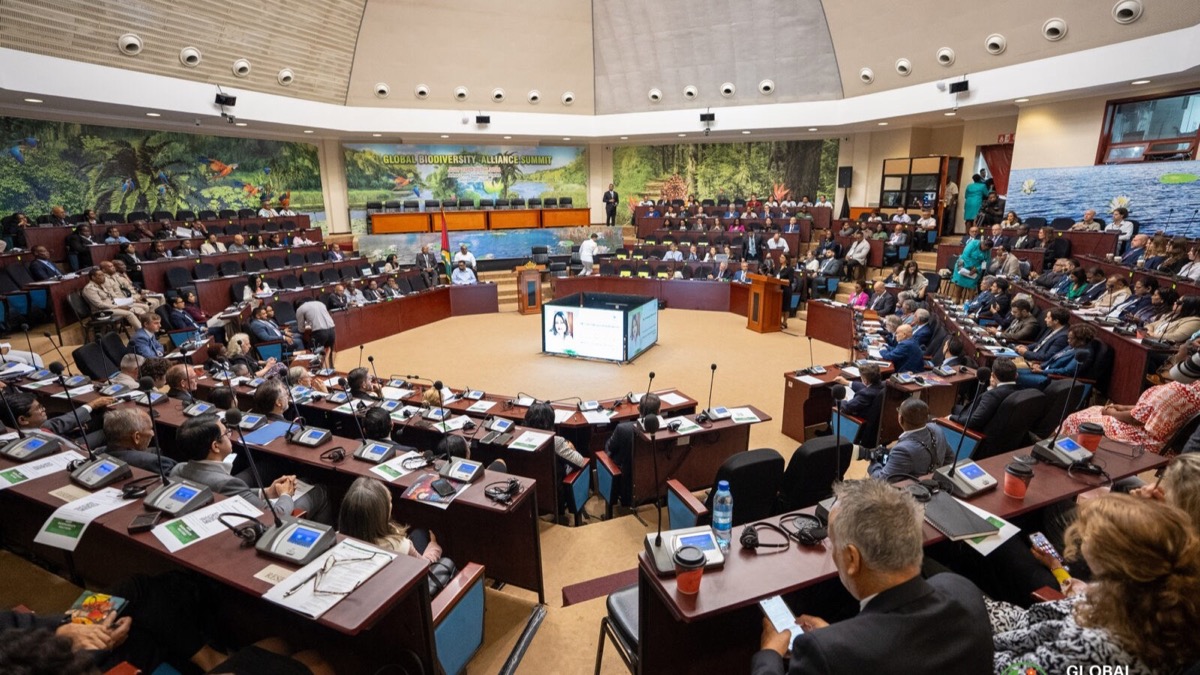
Guyana will host the second Global Biodiversity Alliance Conference and Financing Forum in Georgetown on October 30 and 31, placing the question of how to finance nature protection at the centre of an international meeting expected to attract more than 140 representatives.
The two-day event at the Arthur Chung Conference Centre is being held under the theme “Investing in Nature: From Global Commitments to Practical Action.” The official conference platform describes the alliance as a mechanism connecting leadership, knowledge and finance so that countries and communities can advance biodiversity action.
An October 20 government update said the meeting will focus on financial mechanisms that recognise the value of biodiversity while allowing participating countries to pursue economic and development priorities.
For investors, the central question is not whether biodiversity has value in principle. It is whether that value can be translated into projects with defined rights, measurable outcomes, reliable revenue or payment mechanisms, transparent governance and fair participation by the communities responsible for managing natural assets.
From environmental commitment to financial architecture
The Global Biodiversity Alliance was launched in Georgetown in 2025. Its inaugural summit adopted the Georgetown Declaration and established an open, voluntary platform intended to bring governments, scientists, communities, financial partners and other stakeholders into a shared process.
The 2026 forum moves the discussion toward implementation. President Dr Mohamed Irfaan Ali said the next stage is to create a viable financial framework capable of generating sustained investment for the protection of natural assets.
That objective reflects a wider challenge in climate and nature finance. Conservation programmes often depend on grants or public budgets, while private investment generally requires clearer information about cash flows, risk allocation, time horizons and enforceable obligations. Biodiversity outcomes can also be difficult to measure consistently because ecosystems differ and the value being protected may include water regulation, habitat, cultural significance and livelihoods as well as carbon.
The conference can help narrow that gap if it clarifies which financial mechanisms are being considered and how they would operate. Those mechanisms might ultimately include public funding, blended finance, performance-based payments, insurance, conservation-linked instruments or other structures. No specific fund, security or investable product had been announced in the official conference material reviewed for this article, however, and the meeting should not be presented as a completed financing deal.
Guyana’s practical case
Guyana brings substantial forest resources and experience with forest-based climate finance to the discussion. The government is positioning its Low Carbon Development Strategy and international work on tropical forests as evidence that environmental stewardship can be connected with economic development.
That experience gives the country a credible platform from which to convene a biodiversity-finance discussion, but biodiversity is broader than forest carbon. Any scalable model will need robust scientific baselines, agreed indicators, continued monitoring and rules that avoid counting the same environmental outcome more than once.
It will also need to recognise the role of Indigenous and local communities. In many countries, those communities live in or manage areas of high ecological value. Investors and governments therefore need clear arrangements for consent, participation, benefit sharing, land and resource rights, and access to information.
These are not secondary social considerations. They are central to project durability, legal certainty and reputational risk.
What could make a project investable
For a biodiversity-finance pipeline to attract serious capital, prospective projects must move beyond general environmental ambition. Investors will need to understand the activity being financed, the party responsible for delivery, the method used to measure results and the source from which payments or returns will be made.
Transparent governance will be equally important. A financing mechanism must explain who receives funds, how they are distributed, which standards apply and what happens if promised outcomes are not achieved. Independent verification, accessible reporting and credible safeguards can reduce the risk of overstated environmental claims.
Different sources of capital will also have different expectations. Philanthropic and public funds may be prepared to finance early technical work or accept below-market returns. Development-finance institutions can absorb or reduce certain risks. Commercial investors are more likely to participate when projects have dependable cash flows, contractual certainty and a risk profile that matches their mandate.
This makes blended finance potentially relevant, but blending public and private capital is not automatically effective. It must mobilise additional investment, allocate risk transparently and demonstrate that public resources are producing measurable public value.
Why the forum matters to Guyana’s investment story
The summit gives Guyana an opportunity to influence the design of an emerging market rather than simply participate after standards have been set elsewhere. It can also create connections among government, research institutions, communities and financial organisations that are needed to move projects from concept to due diligence.
For domestic companies, the opportunity extends beyond financial products. Biodiversity projects may require ecological assessment, mapping, remote sensing, legal services, community engagement, data systems, auditing, sustainable tourism, restoration and specialised project management.
However, the conference’s value should be judged by the work that follows it. Declarations can establish political direction, but investable outcomes require named programmes, accountable institutions, financing terms, implementation schedules and measurable results.
What to watch at the conference
The strongest signals would include clearly defined financing instruments, pilot projects with identified sponsors, credible measurement standards, commitments from financial institutions and arrangements that give communities a substantive role in decision-making and benefits.
Investors should also watch for the relationship between biodiversity finance and existing climate or carbon mechanisms. Clear boundaries will be needed to prevent double counting and to show which environmental outcome a buyer or investor is actually supporting.
The October meeting will not resolve every technical and legal question surrounding nature finance. It can nevertheless move the conversation forward if participants use Guyana’s convening role to replace broad commitments with practical structures that countries, communities and responsible investors can evaluate.