
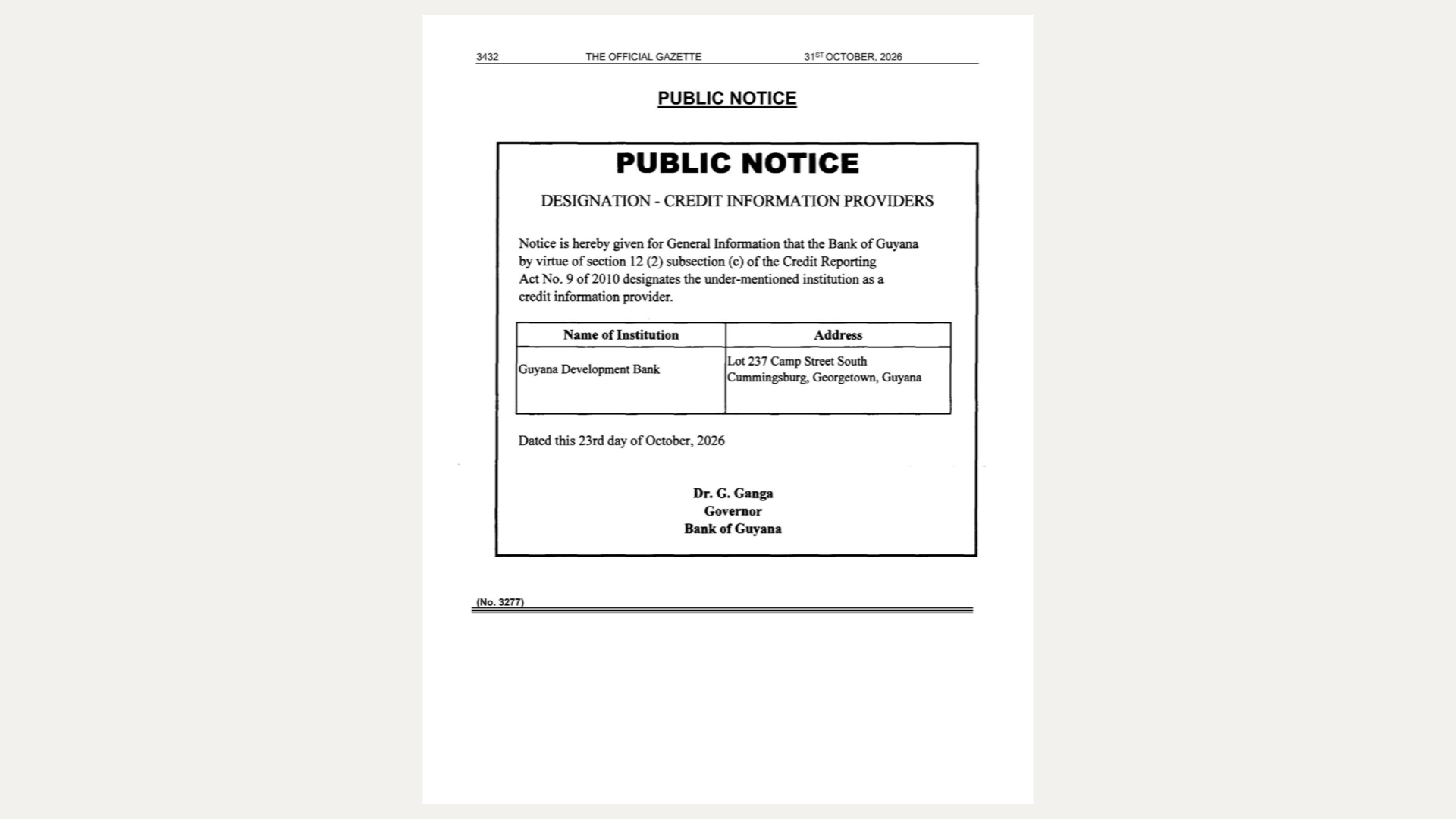
Image: Official Gazette of Guyana.
A zero-interest loan is still formal credit. The Bank of Guyana’s latest designation places the Guyana Development Bank within Guyana’s national credit-reporting framework, connecting the institution’s lending mandate to credit-risk checks, repayment records, data-quality obligations and borrower rights.
The designation appears in the 31 October Official Gazette and was signed by Bank of Guyana Governor Dr G. Ganga on 23 October. Acting under section 12(2)(c) of the Credit Reporting Act 2010, the central bank named the Guyana Development Bank, of Lot 237 Camp Street South, Cummingsburg, Georgetown, as a credit information provider.
The notice is a regulatory milestone rather than a new loan-product announcement. It does not alter the Development Bank’s stated zero-interest products, raise or lower its published loan limits, guarantee that an applicant will receive financing, or confirm that the institution’s technical connection to a credit bureau is already operating.
What it does is place the new public lender inside the legal architecture through which credit providers obtain reports for risk evaluation and submit reliable information about loans in their portfolios.
A provider is not a credit bureau
The distinction between a credit information provider and a credit bureau is important.
Under the Credit Reporting Act, a credit information provider furnishes credit information to a bureau. A credit bureau is separately licensed to collect and process that information, create credit histories and issue credit reports to authorised users for legally permitted purposes.
The Bank of Guyana’s regulatory overview identifies CreditInfo (Guyana) Inc., licensed in August 2013, as Guyana’s credit bureau. The Gazette notice does not license the Development Bank as a bureau, authorise it to sell credit reports or announce that it will operate a separate credit database for the market.
Instead, the Development Bank joins the reporting side of the system. That role is consequential because the institution was established to reach entrepreneurs and small businesses that may have limited access to conventional finance. Repayment performance under its loans can become part of a more formal financial record, while the bank can use authorised credit information when evaluating risk.
The Act defines a consumer broadly as a natural or legal person whose data is included in a credit bureau. The framework can therefore be relevant both to individual entrepreneurs and to incorporated businesses borrowing from the Development Bank.
How the credit-reporting sequence is intended to work
The 2016 amendment to the Credit Reporting Act added two central obligations for credit information providers.
First, a provider must request a credit report before granting or renewing a credit facility in order to evaluate credit risk. The amended consent provision separately requires the provider to obtain the consumer’s prior written consent before submitting that request to the bureau.
Second, once a provider extends credit, it must share credit information on all persons in its credit portfolio with a credit bureau. The Bank of Guyana’s regulatory overview explains that the 2016 amendment removed the need for prior consent for this portfolio-reporting step, while preserving the written-consent requirement before a provider pulls a consumer’s report.
Those are different stages. Consent to obtain a report allows a lender to evaluate an application or renewal. Portfolio reporting records the credit facilities that the lender actually extends and the subsequent performance of those obligations.
For a Development Bank applicant, the practical sequence should therefore be read as:
- the applicant submits information and, where a report is to be requested, gives prior written consent;
- the Development Bank requests a report for credit-risk evaluation before granting or renewing a facility;
- the bank makes its own lending decision under its applicable rules;
- if credit is extended, the facility enters the provider’s reportable portfolio; and
- payment performance and other permitted credit information can contribute to the consumer’s formal credit history.
The designation notice does not publish the Development Bank’s internal workflow, consent wording, reporting frequency or technical go-live date. Applicants should rely on the bank’s current forms and privacy notices rather than assume every step has already been integrated into the online portal.
Why the designation matters for SME finance
The Development Bank began operations on 5 October with two government-stated zero-interest products: a Quick Loan of up to G$300,000 and an SME Loan of up to G$3 million. The government also says the facilities require no collateral. Those terms lower two common entry barriers, but they do not remove the need for underwriting or repayment.
Invest Guyana reported on 21 October that the institution had received an estimated 15,000 to 20,000 applications after launch. That figure measured demand at the top of the pipeline, not approved loans or money disbursed. The credit-reporting designation adds an important operating layer to that volume: a large application pool must be assessed against consistent risk rules, and any resulting portfolio must produce reliable data.
For policymakers, the system can support the stated objective of helping borrowers build a credit record that may later be useful when approaching commercial lenders. For businesses, a documented history of meeting obligations can reduce the information gap that often affects young or lightly capitalised enterprises.
That outcome is possible, not guaranteed. A positive Development Bank repayment history does not compel another lender to approve a loan, determine a particular credit score or override that lender’s own income, cash-flow, security, sector and risk criteria. Late or missed payments can also form part of a credit history. Borrowers should therefore treat the facilities as enforceable obligations, even though the published interest rate is zero.
For the wider financial market, more complete data can improve risk assessment when it is accurate and timely. It may help lenders distinguish between an applicant with no formal record and one who has demonstrated repayment discipline. Poor-quality or delayed reporting would produce the opposite effect, which is why the Act places weight on reliability, correction and security.
Data quality is part of the regulatory obligation
Section 12 of the principal Act says a credit information provider should not furnish information unless it has made reasonable enquiries and is satisfied that the information is reliable. The Act describes reliable information as accurate in all material respects and presented in a fair and balanced manner.
The 2016 amendment adds a specific response where a provider cannot verify information it is required to supply. The provider must take immediate steps to verify the data and report to the bureau within three months, or explain in writing to the Bank of Guyana why verification was not possible. It must then follow any direction given by the Governor in relation to that report.
The credit bureau has parallel responsibilities. The Act requires operational and security systems designed to keep information accurate and current and protect it against loss, unauthorised access, misuse, modification or disclosure. It may refuse to create a file from information it considers unreliable.
These provisions matter because the Development Bank’s target market may include first-time formal borrowers, micro-enterprises and applicants whose business records are still developing. A mistaken identity, duplicated facility or incorrectly recorded repayment can affect later decisions. The quality of the data pipeline is therefore part of the economic value of the programme, not merely a back-office compliance issue.
Borrowers retain access and correction rights
Designation as a provider brings consumer-rights obligations as well as reporting duties.
The Act requires a provider to tell consumers the name and contact details of the bureau collecting and processing their information, the purpose of that activity, and their rights to check their credit history and correct errors.
If a credit provider takes an adverse action based wholly or partly on a bureau report, it must inform the consumer and identify the bureau. The consumer may obtain a free copy of the report on which the action was based.
Consumers are also entitled to a copy of their credit report once a year without charge. The report should include the source of the information and a list of users who accessed the data during the previous six months, and the bureau is required to respond within 14 days of the request.
Information believed to be illegal, inaccurate, erroneous or outdated can be disputed in writing with supporting evidence. The Act gives the bureau 30 days to investigate and resolve the matter. Where a dispute is not resolved, the consumer may submit a brief statement for notation on subsequent reports and has access to the further complaint and legal remedies set out in the Act.
These are statutory rights, but an individual case can depend on the facts and current procedures. Applicants or borrowers with a dispute should use the bureau’s and provider’s official channels and seek qualified advice where necessary.
What the designation does not establish
The regulatory notice should not be read as proof of outcomes that have not been published.
It does not disclose how many Development Bank applications have been approved, how many loans have been disbursed, the value of the outstanding portfolio, the level of arrears or the average decision time. It does not change the published product terms or create an automatic entitlement to financing.
It does not make the Development Bank the licensed credit bureau, nor does it by itself confer a deposit-taking licence or any additional product authority. It also does not make borrower records public. Credit information is subject to permissible-purpose, confidentiality, security and consumer-rights provisions; the Act expressly prohibits credit information held by the bureau from being used for marketing.
Finally, the Gazette notice confirms the legal designation but not the date on which data exchange becomes operational.
What investors and applicants should watch next
The next useful evidence will be operational rather than ceremonial: the Development Bank’s published consent and privacy language; confirmation of bureau integration; decision and disbursement volumes; reporting frequency; data-correction procedures; and portfolio performance.
The bank’s annual reporting and Auditor General review should eventually provide a broader basis for assessing whether public capital is being converted into viable enterprises while preserving repayment discipline. Sector, regional and borrower-profile data would show whether the programme is reaching its intended market without weakening underwriting.
For applicants, the immediate message is straightforward. Zero interest and no collateral do not mean no credit assessment, no repayment obligation or no credit record. For investors, the designation is an institutional-development signal: Guyana is linking a new inclusion-focused lender to the same information infrastructure intended to support responsible credit decisions across the wider financial system.
The value of that link will depend on implementation. Reliable data can help capable small businesses build a financial history and progress towards more conventional finance. Inaccurate data, weak consent practices or opaque decisions would undermine that objective. The Gazette establishes the framework; the next test is whether the system works fairly, securely and at the scale the Development Bank’s application pipeline may require.