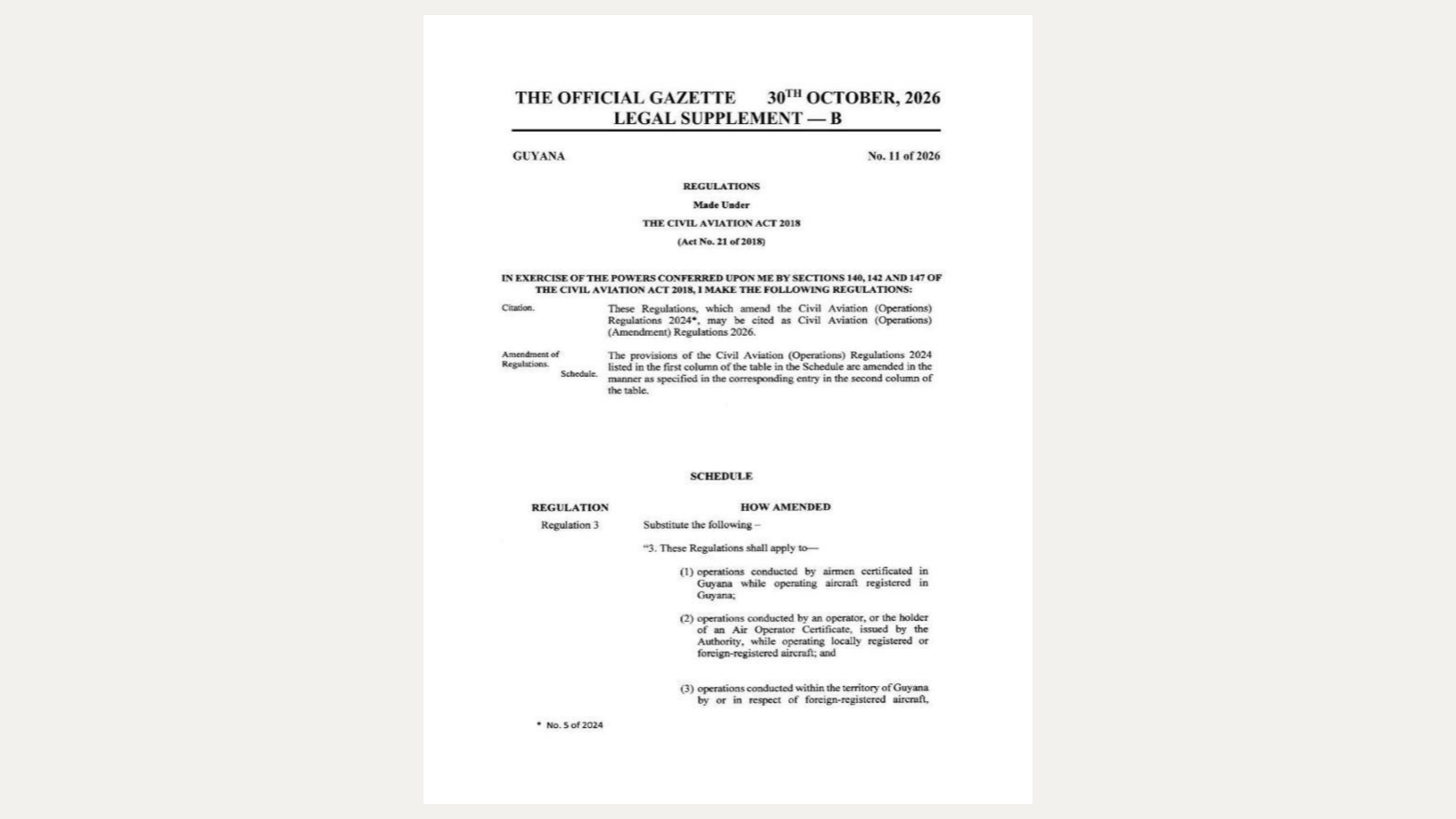
Image: Official Gazette of Guyana.
A shipment can enter the aviation-safety chain long before it reaches an aircraft. It may pass through a packer, freight forwarder, warehouse, screening company, ground handler and airline. Guyana’s latest aviation amendments make clear that compliance responsibility can follow that shipment through several of those businesses—not only the carrier that eventually flies it.
Two regulations and five sets of requirements were published in the Official Gazette on 30 October and added to the E-Gazette on 2 November. Together, they amend Guyana’s 2024 framework for aviation operations, airworthiness, air-traffic services, air-navigation-service-provider administration and air-operator certification.
The changes are technical, but some have commercial significance. They prescribe competency-based dangerous-goods training for operators and other businesses involved in accepting, processing, handling, storing or transporting cargo and mail intended for air carriage. They also add maintenance-programme evidence for certain leased aircraft, define export airworthiness certificates and set reporting rules for dangerous-goods incidents and undeclared or misdeclared cargo.
The instruments do not announce a new airline, route or airport project. Their significance lies in the operating framework beneath those investments: the systems, training, records and approvals that companies may need before aviation capacity can be used safely and lawfully.
Seven instruments, but not seven equal changes
The Gazette package contains the Civil Aviation (Operations) (Amendment) Regulations 2026 and the Civil Aviation (Airworthiness) (Amendment) Regulations 2026. It also contains five amendments to requirements covering air-traffic services, operations, air-navigation-service-provider administration and air-operator certification.
Some provisions are substantive. Others update dates, references or a prescribed interval. Businesses should therefore avoid treating the package as either a routine clerical update or a complete replacement of Guyana’s aviation rules. The amendments must be read with the underlying 2024 instruments and any earlier 2025 and 2026 amendments.
This distinction matters for compliance planning. A company looking only at the latest Gazette may see the words being inserted without the full surrounding obligation. Conversely, a company relying only on an older consolidated manual may miss a new reporting deadline, approval requirement or category of covered personnel.
The Guyana Civil Aviation Authority maintains a legislation page containing the principal regulations, requirements and earlier amendments. The Official Gazette remains the authoritative publication record for the seven new instruments reviewed for this article.
Dangerous-goods responsibility extends beyond the airline
The most consequential changes concern dangerous goods. The amended Operations Regulations state that a person must not transport, or cause to be transported, dangerous goods by air outside the requirements prescribed by the GCAA Director General, Annex 18 to the Chicago Convention and the applicable ICAO Technical Instructions.
The provision is wider than an instruction to an airline. The phrase “cause to be transported” can matter to a shipper or intermediary arranging air carriage. The regulations also address fuel carried on domestic flights outside the ICAO instructions: written approval from the Director General is required, subject to any safety and security conditions imposed. Contravention of the dangerous-goods rule or that domestic-fuel provision carries a stated fine of G$3 million.
The accompanying Requirements for Operations describe the businesses and personnel drawn into the training system. Operators must establish and maintain a competency-based dangerous-goods training and assessment programme approved by the Authority. Named entities include shippers and packers, ground-handling agencies dealing with cargo, mail or passengers, off-airport check-in agencies, freight forwarders, security-screening agencies and designated postal operators.
Requirement No. 13 states that recurrent training must be completed every 24 months and that records must be retained where the relevant personnel perform their duties. It also requires training manuals to address the acceptance, handling and carriage of hazardous materials; shipping names and hazard classes; packaging, marking and labelling; shipping documents; compatibility; loading; storage; and restrictions on carriage.
The same instrument also replaces “24 hours” with “7 days” in paragraph 8.10.1.46(a). Because the amendment does not reproduce the subject of that paragraph, an operator should apply the longer interval only after reading it in the consolidated Operations Requirements rather than treating it as a general seven-day dangerous-goods deadline.
Requirement No. 16 adds a closely related approval and recordkeeping layer. It requires Air Operator Certificate holders to establish, maintain and obtain approval for competency-based dangerous-goods training and assessment. It also reaches designated postal operators, freight forwarders, cargo agents, ground handlers, security-screening providers and other persons engaged in accepting, processing, handling, storing or transporting dangerous goods or mail intended for air carriage.
The two requirements should be read together rather than reduced to a single checklist. Requirement No. 13 specifies a 24-month recurrent-training interval for the entities listed there, while Requirement No. 16 ties recurrent training to intervals prescribed in the ICAO Technical Instructions for the personnel it covers. Businesses should confirm with GCAA which provisions apply to their operation, workforce and contracted service chain.
Reporting and emergency information become a management issue
The amendments also change what must happen when something goes wrong. An Air Operator Certificate holder carrying dangerous goods as cargo must provide information without delay to emergency services and the Authority after an aircraft incident or accident, based on the written information supplied to the pilot-in-command.
Dangerous-goods incidents and accidents must be reported to the Authority within 72 hours unless exceptional circumstances prevent it, in which case the report must be submitted as soon as possible. The same 72-hour rule applies to undeclared or misdeclared dangerous goods in cargo.
That creates responsibilities beyond an emergency response at the airport. A defensible system may require accurate shipment data, escalation procedures, incident ownership, access to records outside normal office hours and coordination between the operator and contractors. A freight forwarder or handling agent that cannot identify what it accepted may create risk for the carrier even if the package was prepared elsewhere.
The amendments also say that when dangerous goods intended for air transport move to or from an aerodrome by surface transport, applicable national or modal transport requirements should be met in addition to the air-transport requirements. The compliance chain therefore does not necessarily begin or end at the airport boundary.
Other text-specific changes in Requirement No. 16 address infected live animals, references to containers containing radioactive material and the treatment of items removed for replacement. These details may matter to specialist shippers and operators even though they do not carry the same broad commercial reach as the new training and reporting provisions.
Foreign and leased aircraft receive clearer treatment
The amended Operations Regulations define their scope to include operations by Guyana-certificated airmen using locally registered aircraft; operators or Guyana Air Operator Certificate holders using local or foreign-registered aircraft; and operations in Guyana involving foreign-registered aircraft, foreign-certificated airmen or foreign-state Air Operator Certificate holders.
That scope is commercially relevant in a market where carriers, specialist operators and project businesses may use aircraft registered or certified in another jurisdiction. It does not eliminate the need to determine which approvals attach to a particular flight, lease or operating model. It establishes that foreign registration does not, by itself, place an operation outside Guyana’s framework when the activity falls within the stated territorial or certification links.
The air-operator-certification amendment also expands the content to be addressed in an aircraft maintenance programme. It adds mandatory continuing-airworthiness requirements, airworthiness limitations, certification maintenance requirements, mandatory life limitations, inspection requirements, structural-inspection programmes, corrosion-prevention and control requirements, applicable airworthiness directives and maintenance arising from approved modifications and repairs.
Where an aircraft is leased and registered in another state, the operator must provide evidence to GCAA that the maintenance programme has been approved by the State of Registry. For a prospective operator or lessor, that makes regulatory document alignment part of transaction and mobilisation planning—not an issue to resolve after the aircraft arrives.
Export airworthiness certificates are defined
The Airworthiness Regulations introduce a detailed provision for Export Certificates of Airworthiness. GCAA may issue a certificate for a complete aircraft, engine or propeller; a major component; or another aircraft part, component or material, provided the product meets the applicable design or technical standard and is in an acceptable condition for export.
An applicant must apply in the prescribed form, pay the required fee and supply the documents and evidence required by GCAA. A certificate may be issued for no more than 60 days and may carry conditions imposed by the Director General.
The amendment makes an important boundary explicit: an Export Certificate of Airworthiness does not give the holder permission to operate or fly the aircraft. A buyer, seller, maintenance organisation or financier should therefore avoid treating the export certificate as a substitute for registration, an operating approval, a flight permit or an importing state’s acceptance requirements.
The provision may be most relevant to businesses involved in aircraft sales, export, maintenance and component transactions. Its practical effect will also depend on GCAA’s prescribed form, fee, evidence requirements and processing arrangements.
The same instrument corrects a cross-reference in regulation 14 from regulation 22 to regulation 12. That correction should be carried into any internal or consolidated working copy used by airworthiness and maintenance personnel.
Air-navigation amendments require a consolidated reading
The remaining amendments are narrower. The Air Traffic Services instrument replaces several 2024 references with 2026. The Air Navigation Service Provider Administration amendment changes one prescribed interval from at least annually to every two years, updates a year reference and adds ICAO Doc 10157 on Procedures for Air Navigation Services—Meteorology to its listed documents.
The latest amendments alone do not reproduce the full surrounding provisions. Air-navigation service providers should read them against the principal requirements before changing any review, audit, reporting or document-control cycle. Invest Guyana has not interpreted the unidentified activity governed by that changed interval because the amendment text by itself does not restate its subject.
That cautious treatment is deliberate. An investor-grade regulatory report should identify what the Gazette actually changes without guessing at operational consequences that require the consolidated instrument or regulator guidance.
What aviation businesses should do next
Air operators should map each amendment against their approvals, operations manuals, maintenance programmes, reporting procedures and contracted services. Cargo and logistics businesses should identify whether they act as shipper, packer, freight forwarder, cargo agent, handler, screening provider or another covered participant—and whether their personnel and subcontractors are inside an approved training programme.
Companies should also verify four practical questions with GCAA:
- which amended provisions apply to their precise operating model;
- whether existing training programmes and manuals require fresh approval or revision;
- what records and reporting channels GCAA expects; and
- whether implementation guidance, forms or transition arrangements will accompany the Gazette instruments.
The instruments reviewed do not publish a general industry transition period or a consolidated compliance guide. Absence of a stated grace period should not be interpreted as permission to wait. Equally, businesses should not assume that every amendment creates a new application for every aviation participant.
For investors, the wider signal is that Guyana is continuing to align the regulatory base supporting a larger aviation market. The country has recently expanded private fleet capacity, cargo services and international market-access arrangements. Those assets and agreements create commercial options; rules governing training, airworthiness, maintenance and incident reporting determine whether the system can scale with credible safety oversight.
The immediate task is less dramatic than announcing a new route or aircraft, but no less important. Each company in the aviation chain needs to know where its responsibility starts, which evidence proves compliance and how quickly it can respond when a shipment, aircraft or operating arrangement falls outside the expected path.