
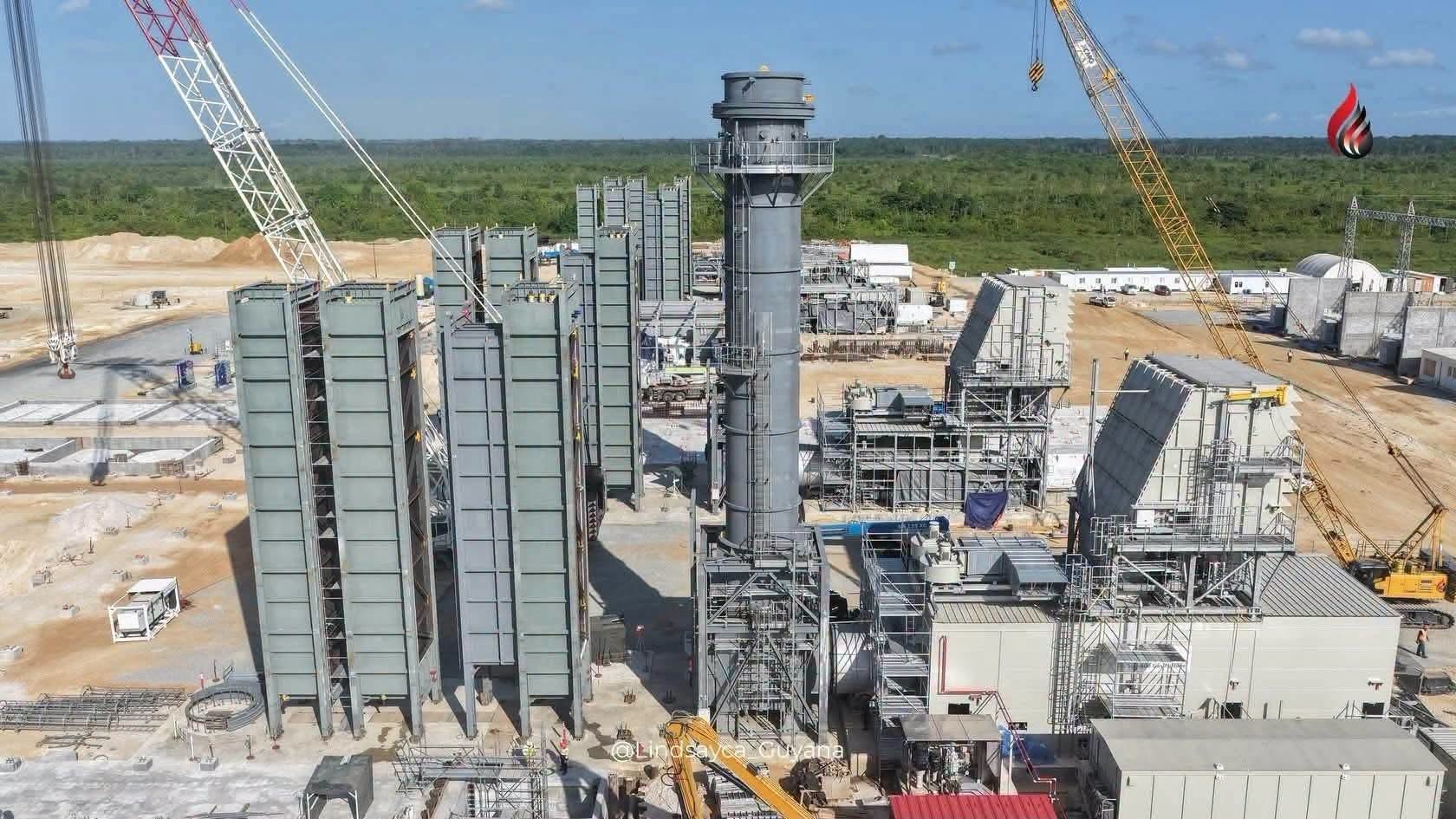
Photo: Department of Public Information, Guyana.
Guyana’s Gas-to-Energy Project at Wales, Region Three, is moving toward a new technical milestone, with the first turbine expected to undergo initial firing and testing in December. The project is central to the government’s strategy for meeting rising electricity demand while adding new generating capacity to the national grid.
According to an official DPI project update, the first unit is being prepared to receive natural gas, alongside associated infrastructure including the gas-liquefaction plant, sludge catcher and piping systems. Once commissioned, the turbine is expected to add about 57 megawatts of generation capacity to the national grid.
The wider first phase of the project is designed to deliver 300 megawatts through four gas turbines and two steam turbines. A substation is also being established to carry the power into the national network. These connected elements show that the project is not simply about a single generating unit: it involves the equipment and systems required to move additional power reliably from the Wales site to customers across Guyana.
The timing is significant as demand grows across residential, commercial and industrial sectors. Approximately 1,300 workers are currently engaged at the Wales site, according to the Ministry of Public Utilities and Aviation. The upcoming turbine-testing stage is an important technical checkpoint, moving the project closer to demonstrating that its equipment, supporting infrastructure and operating systems can perform as planned.
For the wider investment climate, the project has significance beyond the power sector. The availability and price of electricity influence where companies invest, how they size their operations and which processes they can run locally. More dependable generation can support industrial activity, new services and increased use of technology across the economy.
Government is also building about 425 kilometres of new transmission lines to improve distribution and ease pressure on the existing network. This broader work to reinforce the grid is essential: new generation has the greatest economic effect when the transmission and distribution system can deliver it where it is needed.
The December target for turbine testing will be closely watched by businesses and consumers alike. It is a practical marker of progress on a project that has become central to discussions about energy security, competitiveness and Guyana’s capacity to support continued economic expansion.