
The email looked simple enough. After months of planning, meetings and feasibility studies, an overseas company had finally decided to establish operations in Guyana. The directors expected the next step to be straightforward: submit an application to the government, receive the necessary approvals and begin work.
Instead, their local consultant replied with a list of organisations they would need to contact. Some would deal with taxation. Others would handle environmental approvals. Land administration involved one agency, planning approvals another, while customs procedures and investment support led to entirely different institutions.
The company’s chief executive read through the list twice before looking up.
“Which one of these actually regulates us?”
The consultant smiled, having heard the same question many times before.
“That’s the wrong question,” he said. “Your business isn’t regulated by one organisation. Different parts of your project are regulated by different specialists.”
It is a conversation that takes place every day. Many investors arrive expecting to find a single government office responsible for everything connected with their project. What they discover instead is a network of specialist agencies, each responsible for a different aspect of public administration. At first that can seem unnecessarily complicated, but once you understand why the system is organised this way, it becomes far easier to navigate.
Different Responsibilities Require Different Expertise
Imagine asking one organisation to collect taxes, protect the environment, administer land records, regulate mining, oversee banking, approve building plans and inspect workplaces. Even the largest ministry would struggle to perform all of those responsibilities effectively because each requires completely different knowledge, professional skills and administrative systems.
Tax administration depends on financial expertise. Environmental regulation requires scientific and technical knowledge. Land administration involves surveying, mapping and property records. Financial supervision calls for specialists who understand banking, risk and monetary systems.
Modern governments therefore divide responsibilities according to expertise rather than convenience. Instead of expecting one institution to do everything, they create specialist organisations capable of focusing on particular areas of public administration.
The principle is familiar in almost every profession. A hospital has surgeons, radiologists, pharmacists and physiotherapists. They all contribute to the care of the same patient, but each performs a different role. Government works in much the same way. Different agencies exist because different public responsibilities demand different expertise.
One Business Can Involve Many Regulators
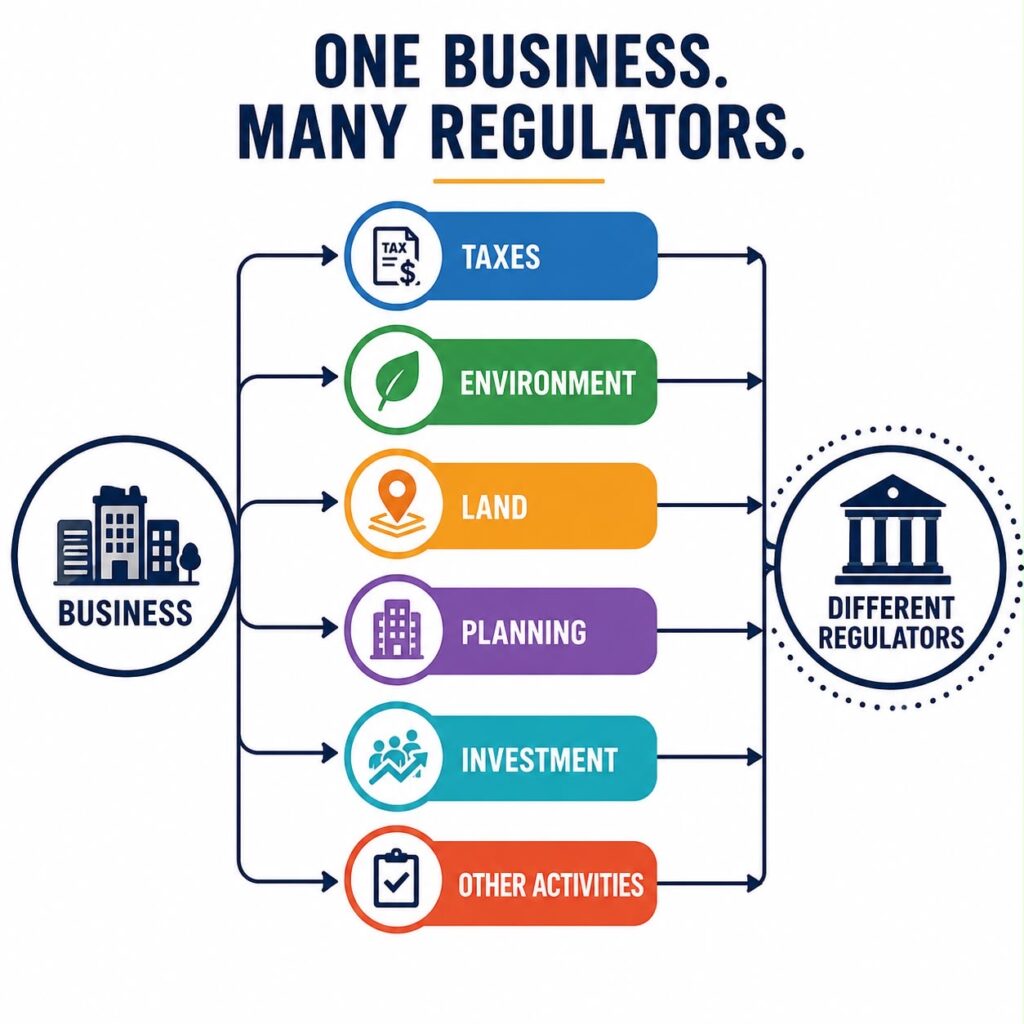
Once businesses understand this principle, another common misconception begins to disappear. Many people assume their company has a regulator. In reality, regulators usually oversee activities, not businesses. Consider a company planning to build a new hotel.
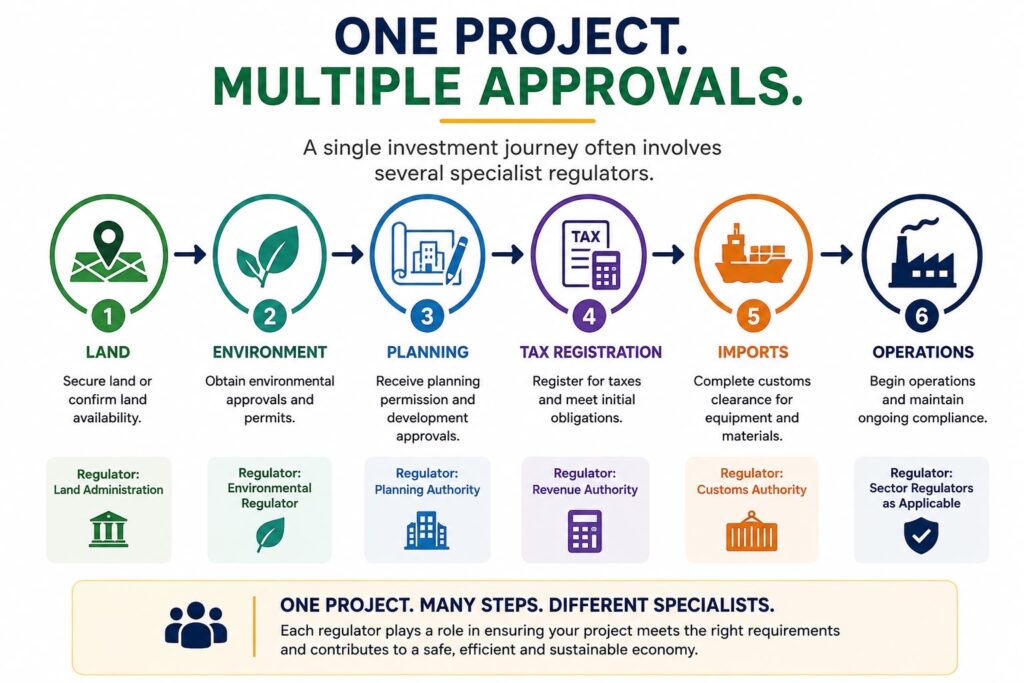
The project may require land administration before construction can begin. Environmental approvals may be necessary because of the project’s location or scale. Tax registration will almost certainly be required before commercial operations start. Imported equipment may involve customs procedures, while planning approvals may be needed before the first foundation is poured.
Although it is one investment, each part of the project falls within a different area of government responsibility. That is why a single business often finds itself working with several agencies during the life of one project. Each organisation is responsible for a particular part of the journey rather than the project as a whole.
Understanding this changes the way investors approach government. Instead of searching for one office that can approve everything, they begin identifying the different activities involved in their project and the institutions responsible for each.
The Agencies Businesses Commonly Encounter
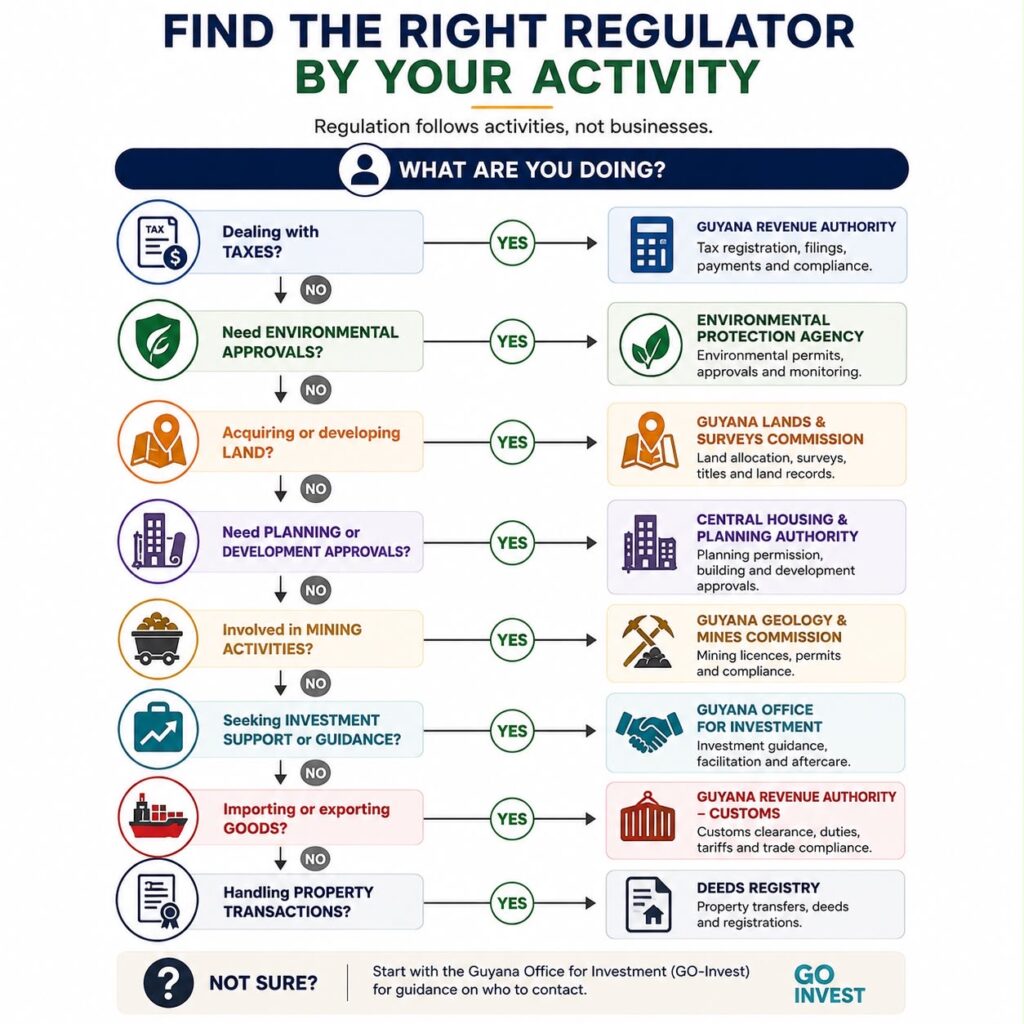
For many companies, the first practical interaction with government begins with taxation. Registering a business and meeting tax obligations usually brings them into contact with the Guyana Revenue Authority because taxation is part of almost every commercial activity.
A developer planning a significant construction project may also engage with the Environmental Protection Agency where environmental approvals are required before work can begin. If the project involves acquiring or developing land, the Guyana Lands and Surveys Commission may become another important point of contact.
Businesses entering the mining sector are likely to encounter the Guyana Geology and Mines Commission because mining activities require specialist oversight that differs significantly from other industries. Investors who are still exploring opportunities may first engage with the Guyana Office for Investment, which provides guidance and facilitates investment opportunities across the economy.
Planning and development projects may involve the Central Housing and Planning Authority, while certain property transactions require interaction with the Deeds Registry.
At first glance these organisations can appear unrelated. In reality, each exists because government has divided complex responsibilities into manageable areas of expertise. Rather than performing the same job, they work alongside one another to support different parts of the same economic system.
How Regulators Work Together
Returning to our overseas investor, the consultant’s email now looks very different. What first appeared to be a confusing collection of government offices has become something much more logical.
The environmental agency is not concerned with collecting taxes because that responsibility belongs elsewhere. The revenue authority does not administer land records because another institution specialises in that work. Planning authorities focus on development approvals while other agencies oversee investment facilitation or sector-specific regulation.
Each organisation performs a different task, yet together they contribute to the successful delivery of the same project. Seen this way, government resembles a relay team rather than a single runner. Each participant takes responsibility for one stage before passing the project to the next specialist. The strength of the system lies not in asking one organisation to do everything, but in allowing each institution to concentrate on the responsibilities it understands best.
For businesses, recognising this cooperation removes much of the uncertainty that often accompanies investment in a new country. Multiple regulators do not necessarily mean unnecessary complexity. More often, they reflect the reality that modern economies require specialist oversight in different areas.
A Better Way to Navigate Government
The consultant closed the meeting with one final piece of advice.
“Don’t ask which agency regulates your business,” he said. “Ask what your business is trying to do.”
That simple change in perspective transformed the way the directors viewed the approval process. If the project involved importing equipment, they knew customs procedures would become part of the journey. If it involved land, they knew land administration would be relevant. If environmental impacts needed to be assessed, the appropriate environmental regulator would become part of the process. Each activity naturally pointed towards the agency responsible for that particular responsibility.
Instead of memorising the names of government organisations, the company learned to identify the activities first. Once those activities were understood, the relevant regulators became much easier to identify. It is a practical way of navigating government because it reflects how the system itself is organised.
Seeing the System Instead of the Agencies
By the end of the week, the investor’s checklist no longer looked overwhelming. Nothing on it had changed. The same agencies remained involved, and the same approvals would still be required. What had changed was the company’s understanding of why those organisations existed and how they fitted together.
The directors no longer saw a collection of disconnected agencies. They saw a coordinated system in which each institution contributed specialist expertise to different parts of the same project.
That understanding is valuable far beyond one investment. Whether establishing a new business, expanding an existing operation or simply trying to understand how government works, recognising that regulation follows activities rather than businesses makes the entire system easier to navigate.
Government no longer feels like a maze of unrelated organisations.It becomes a network of specialists, each responsible for one piece of a much larger picture.
In the next article in the Invest Guyana Explains series, we’ll build on that understanding by exploring Business Licensing Explained, following one of the most common regulatory journeys that entrepreneurs and investors encounter when turning an idea into an operating business.