

Photo: Invest Guyana
An international equipment company has identified an opportunity in Guyana. Its head office wants to move quickly and register a branch. The finance team prefers a local subsidiary so that the new operation has its own accounts and funding. A Guyanese distributor proposes a joint venture, arguing that local relationships and market knowledge would make the business stronger.
All three routes could support the same commercial opportunity. They do not create the same legal relationships, control rights, liabilities, tax flows or exit choices.
This is an illustrative scenario, not a reported investment. Its central question is one that many investors face: what should the business become before it starts signing contracts, hiring staff and committing capital in Guyana?
The answer begins with what the investor intends to do. “Branch”, “subsidiary” and “joint venture” are not labels to choose for appearance. Each is a different way of allocating ownership, authority, risk and economic return.
The structure changes who is acting
In business language, a branch is usually an extension of an existing foreign company. A subsidiary is a separate company owned or controlled by a parent. A joint venture is a relationship in which two or more parties combine resources for an agreed purpose, often through a jointly owned company but sometimes through another legal arrangement.
Guyana’s Companies Act uses the term external company for a body formed under the laws of another country. The Act says an external company may not begin or carry on an undertaking in Guyana until it is registered. Registration recognises the foreign body so that it may operate in Guyana; it does not incorporate a second company.
A Guyana-incorporated subsidiary is different. The Government’s company-incorporation service describes incorporation as creating a separate legal body under the Companies Act. The parent may own the shares and appoint directors, but the local company holds its own rights and obligations.
A joint venture adds another layer. Guyana’s Investment Act recognises joint ventures between domestic investors, foreign investors, or both. It says their organisation, management and relationships are governed by the parties’ contract and the venture’s articles, in accordance with Guyana law. Read together with the Act’s list of legal forms, that means a joint venture describes the commercial relationship but does not eliminate the need to choose its legal vehicle.
A branch keeps the enterprise in one legal body
A branch can appeal to an investor that wants the Guyana operation to remain visibly part of its international company. Group policies, technical systems and contractual authority may stay close to head office. The overseas company can point to one corporate history rather than a newly formed local balance sheet.
That continuity has consequences. Because the branch is not a separate incorporated subsidiary, obligations undertaken through the Guyana operation are obligations of the external company itself. The parent cannot assume that risk ends at a separately capitalised local entity.
Registration also brings local requirements. The Companies Act addresses the registration, authorised attorney, certificate and accounts of external companies. The Commercial Registry’s current external-company service lists an application, registered power of attorney, declarations and certified corporate instruments among the required documents.
A branch may work where central control and a direct parent commitment are commercial advantages. It can be less attractive when the investor wants a distinct local shareholder base, ring-fenced project funding, a local equity partner or a clean sale of the Guyana business through a share transfer.
The word “branch” should therefore not be mistaken for “temporary” or “light-touch”. The activity still determines the tax, employment, licensing, land, environmental and sector requirements that follow.
A subsidiary creates a local corporate platform
A subsidiary gives the Guyana operation its own legal identity. It can hold contracts, employ staff, acquire permitted rights, open accounts, receive equity or debt and maintain its own governance records in the company name.
That separation can make an investment easier to measure. Management can see the local operation’s capital, assets, liabilities and performance without combining them directly with the parent’s books. A lender or future investor can examine a defined company, while the parent can govern it through share ownership, board appointments and reserved decisions.
Separate legal identity does not mean every risk remains inside the subsidiary. A parent may provide guarantees, technical undertakings or funding commitments. Directors and officers have their own duties. Tax, environmental, employment and regulatory obligations attach according to the applicable law, not simply according to the shareholder’s intention to limit exposure.
The local company must also remain current after incorporation. The Government service page identifies annual returns, financial statements, beneficial-ownership declarations and notices of corporate changes as continuing obligations. Incorporation is therefore the beginning of a governance system, not the end of an establishment task.
A subsidiary may suit an investor planning a durable local platform, local equity participation, project-level finance or a future share sale. It also requires the group to decide how the parent will fund, supervise and contract with the local company.
A joint venture is a negotiated system of control
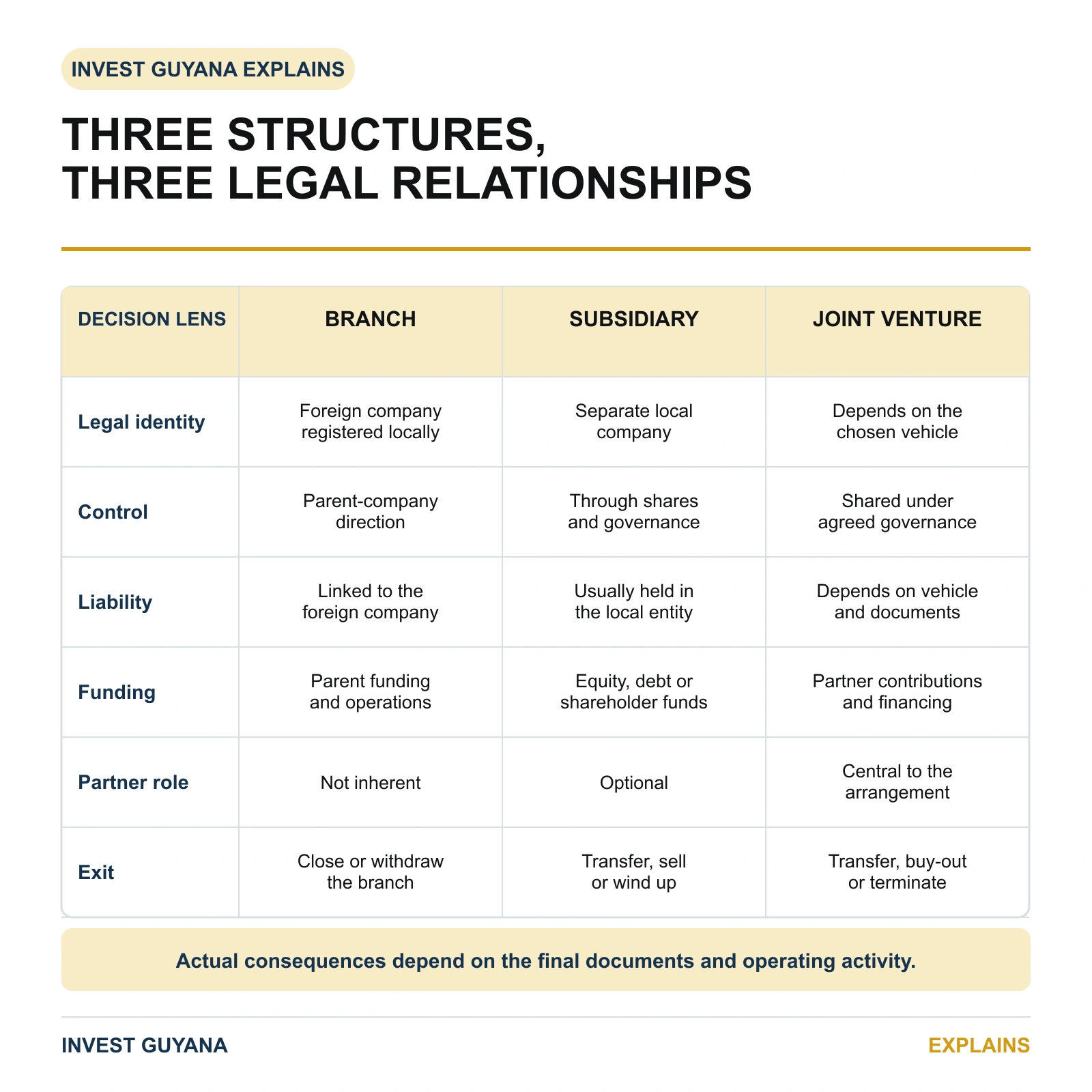
A joint venture is often proposed because each party contributes something different. One may bring capital, technology or international customers. The other may bring land rights, a distribution network, operating knowledge or an established workforce.
The Investment Act permits foreign and domestic investors to invest together and states that an investment enterprise may be wholly foreign or domestically owned; it does not establish a general requirement for domestic share ownership. Separate sector, licence, land, procurement or local-content rules may still affect a particular project.
The critical question is not whether a local partner is present. It is whether the parties have agreed how the venture will work when their interests differ.
They must determine which decisions follow ordinary voting rights and which require special consent; who appoints management; how capital calls are made; what happens if one party does not fund; how related-party contracts are approved; who owns technology and customer data; and how a party may exit.
A 50:50 shareholding can look balanced while producing deadlock. A majority shareholder can control routine votes while still accepting minority protections over major decisions. A local partner can provide genuine capability, or the arrangement can fail if its promised contribution is never defined or verified.
GO-Invest’s official profile says the agency helps coordinate joint ventures between local and overseas interests, but it does not negotiate private deals for the parties. Facilitation does not replace commercial, legal and financial due diligence.
Tax and cash flow must be modelled, not assumed
The legal form influences how money enters, moves through and leaves the Guyana operation, but the label alone does not determine the tax outcome.
The Guyana Revenue Authority administers corporation tax, withholding tax, property tax, VAT and other obligations. Its Income Tax Act revised 1 April 2026 includes a specific rule for profits remitted or deemed remitted by a Guyana office, branch or agency of a non-resident company. A subsidiary may instead move value through dividends, interest, fees, purchases or other transactions, each requiring its own analysis.
A joint venture adds the economics agreed between the parties: equity contributions, shareholder loans, management charges, distributions and any priority return. Tax residence, source, transfer pricing, withholding, incentives and applicable agreements all require current professional review.
The structure comparison should therefore use after-tax cash flows rather than a headline tax rate. It should also test whether the investor can actually fund, repatriate, reinvest or distribute money in the manner assumed.
The activity map often decides the structure
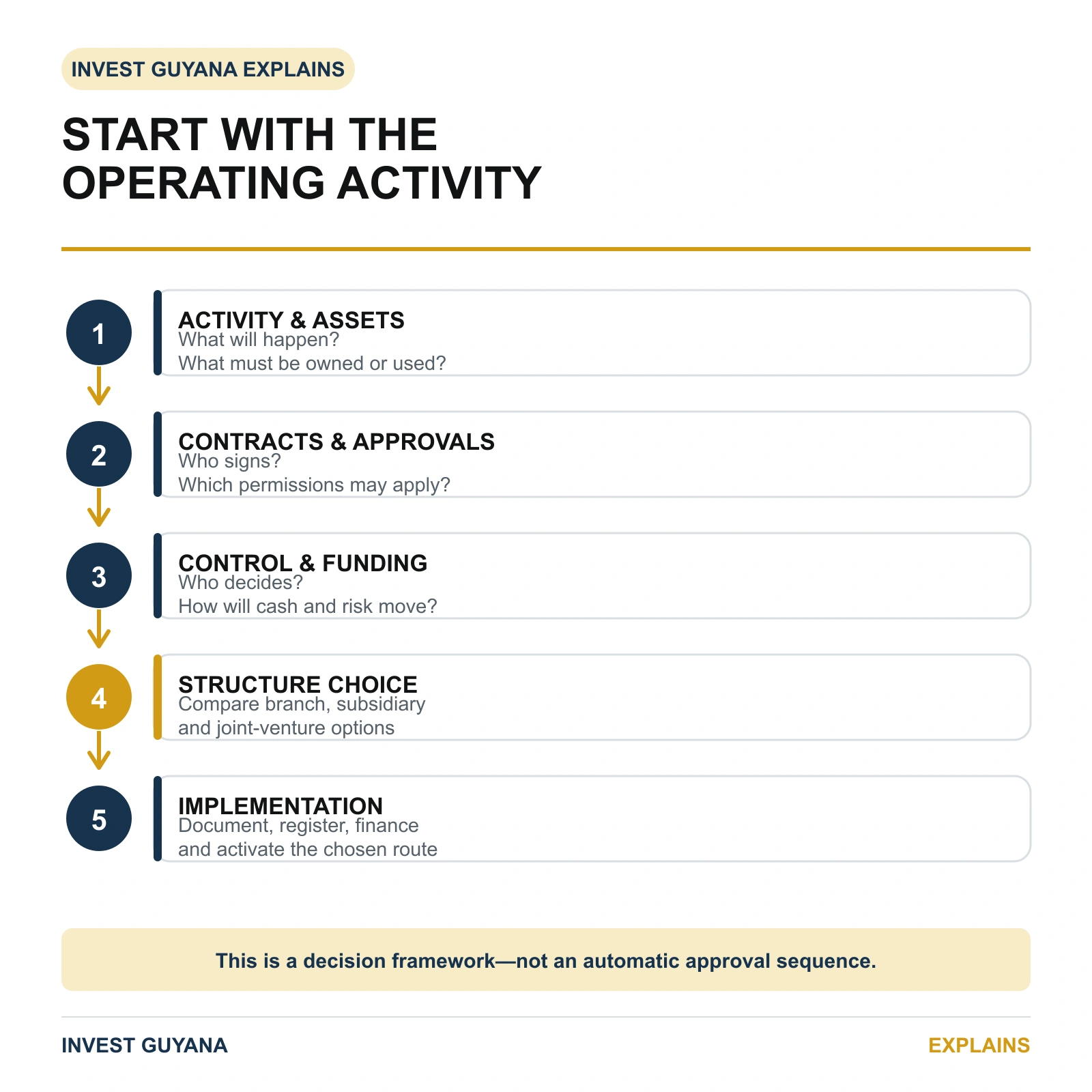
The company in the opening scenario should not select its structure before defining its operating model.
Will it only market equipment, or import and hold inventory? Will it sign long-term service contracts, employ technicians, lease a warehouse, process customer data or bid for government and petroleum-sector work? Will land, licences, environmental authorisations or regulated assets need to sit in the operating entity’s name?
Those questions identify which rights, contracts and approvals the chosen structure must hold. They also reveal whether the proposed joint-venture partner is contributing something that the business genuinely needs.
Guyana’s official investment-facilitation service can guide investors through regulatory processes, but the investor still needs advice tailored to its activity. Registration with the Commercial Registry is not a substitute for tax registration, licences, environmental decisions, immigration arrangements or sector approvals.
The best structure must work during disagreement and exit
Investors naturally design for launch and growth. A sound structure must also work when the plan changes.
A branch decision should consider whether the parent is comfortable bearing the operation’s obligations directly and how the registration would be ceased if the market entry ends. A subsidiary should be designed for additional capital, new investors, parent guarantees and a future share or asset sale. A joint venture must address deadlock, default, dilution, transfer restrictions and exit before those subjects become disputes.
Back at the equipment company, none of the three proposals is automatically correct. The answer depends on the activity, desired control, risk allocation, partner contribution, funding model and exit plan.
The structure is not the investment strategy. It is the legal and economic system through which that strategy will operate.
The companion Invest Guyana Guide, How to Prepare a Guyana Market-Entry Brief, turns those questions into an evidence-led internal decision document.
Editorial note: This article provides general information, not legal, tax, accounting or investment advice. Entity, tax, licensing and ownership requirements depend on the investor, activity, sector, transaction and laws in force at the relevant time.