
The tender notice arrived in the company’s inbox on a Tuesday morning.
A government agency was seeking a supplier for equipment that the local business had sold and serviced for years. The opportunity looked ideal, but the managing director hesitated. Government tenders, he assumed, were mainly for large companies with specialist bidding teams, and the contract would probably go to whoever submitted the cheapest price.
His operations manager opened the tender documents and reached a different conclusion. The agency had described what it needed, the qualifications bidders had to demonstrate, the documents they had to submit, the deadline they had to meet and the criteria that would be used to evaluate the offers.
The company was not looking at an informal request for a quotation. It was looking at a structured process for spending public money.
That process is public procurement. It is how public bodies acquire the goods, works and services needed to operate, from medical equipment to road construction and professional advice. Understanding the system can turn a confusing tender notice into a commercial opportunity that can be assessed and pursued intelligently.
Public Procurement Begins With a Public Need
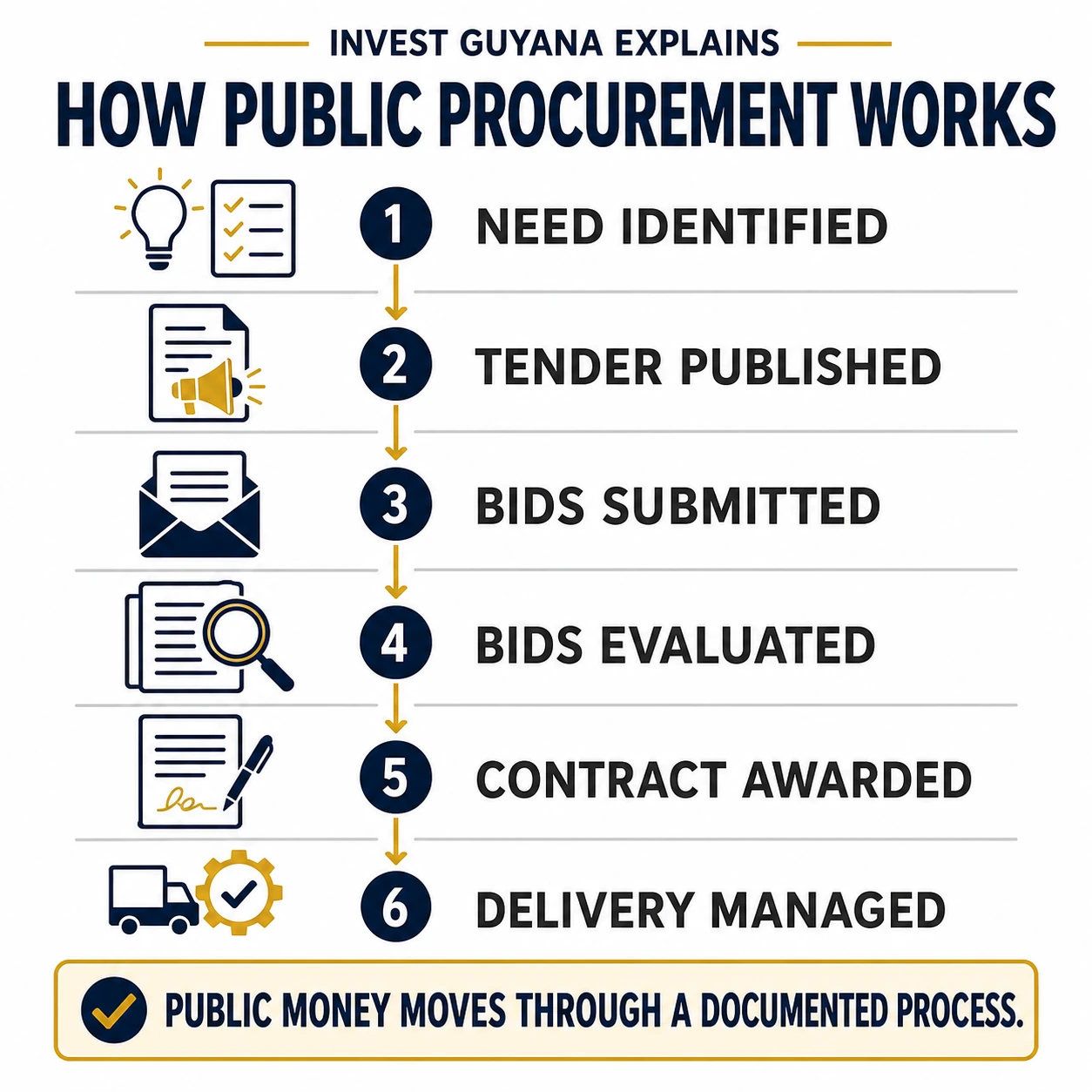
Every procurement starts before the advertisement appears. A public body identifies a need, estimates the cost, determines how the purchase should be approached and prepares the specifications and bidding documents.
That planning stage happens inside the procuring entity, yet it shapes everything that follows. Whether the need is vehicles, bridge repairs or consulting services, the documents must describe the requirement and the basis on which offers will be assessed.
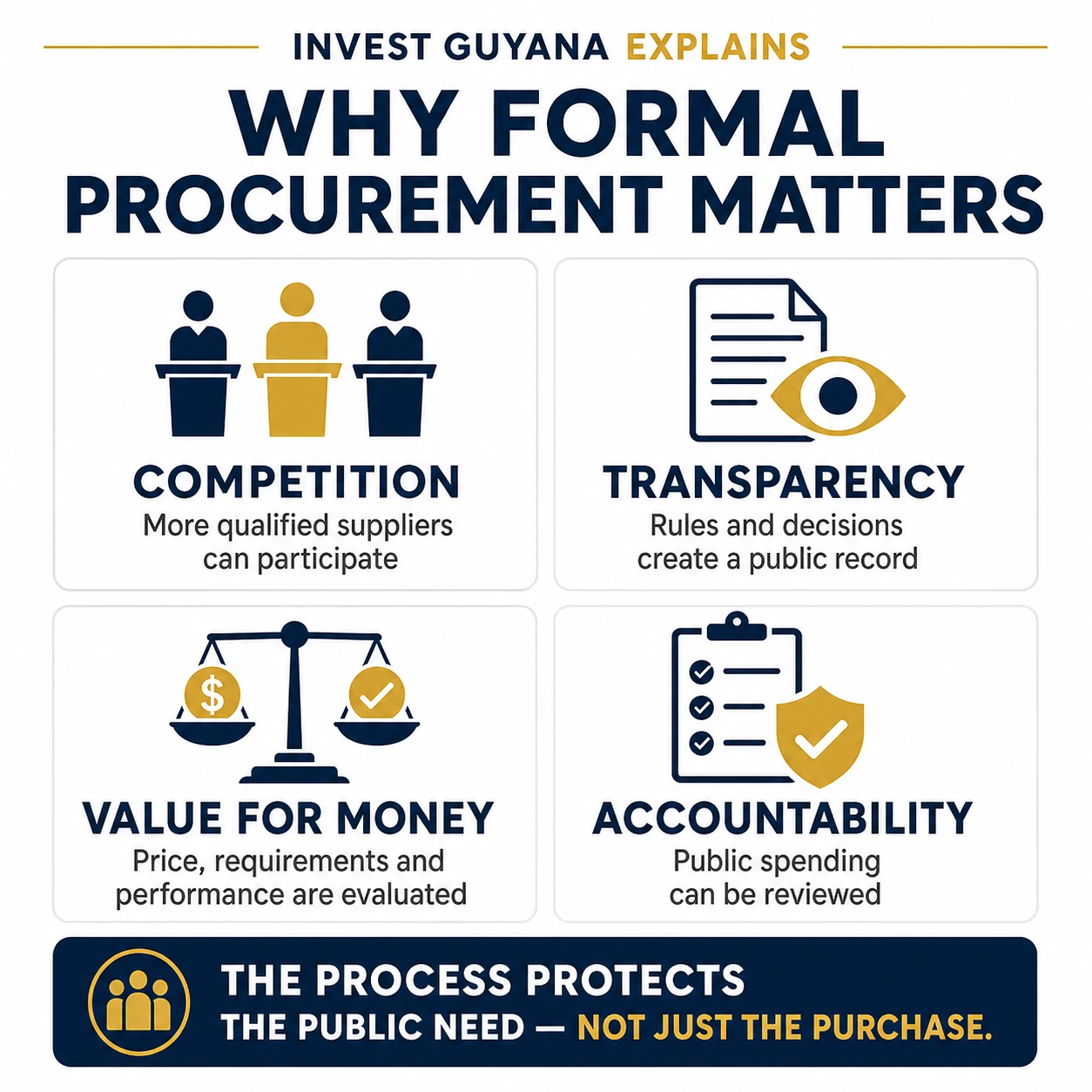
Guyana’s Procurement Act regulates the acquisition of goods and services and the execution of works. Its stated objectives include economy and efficiency, competition, fair treatment, integrity, public confidence and transparency. Those principles explain why public purchasing uses formal procedures that may feel more demanding than an ordinary private sale. Procurement Act 2003
The buyer is not spending private money on its own behalf. It is using public funds to meet a public need, so the process must create a record of what was required, how suppliers were invited, how offers were evaluated and why a contract was awarded.
From Requirement to Tender
Once the need has been defined, the procuring entity selects the method permitted for that purchase and prepares the solicitation. Open tendering is the general rule under the Act, although the legislation also provides other methods for circumstances in which they are authorised.
For businesses, the tender notice is the visible doorway into the process. It tells the market that an opportunity exists and directs interested suppliers or contractors to the documents containing the full requirements.
Those documents deserve more attention than the advertisement. They may set out eligibility and qualification requirements, technical specifications, delivery schedules, forms, securities, contract terms, submission instructions and evaluation criteria. The National Procurement and Tender Administration publishes standard bidding documents and reference materials for goods, works and services, supporting a more consistent approach across public entities. NPTA Procurement Documents
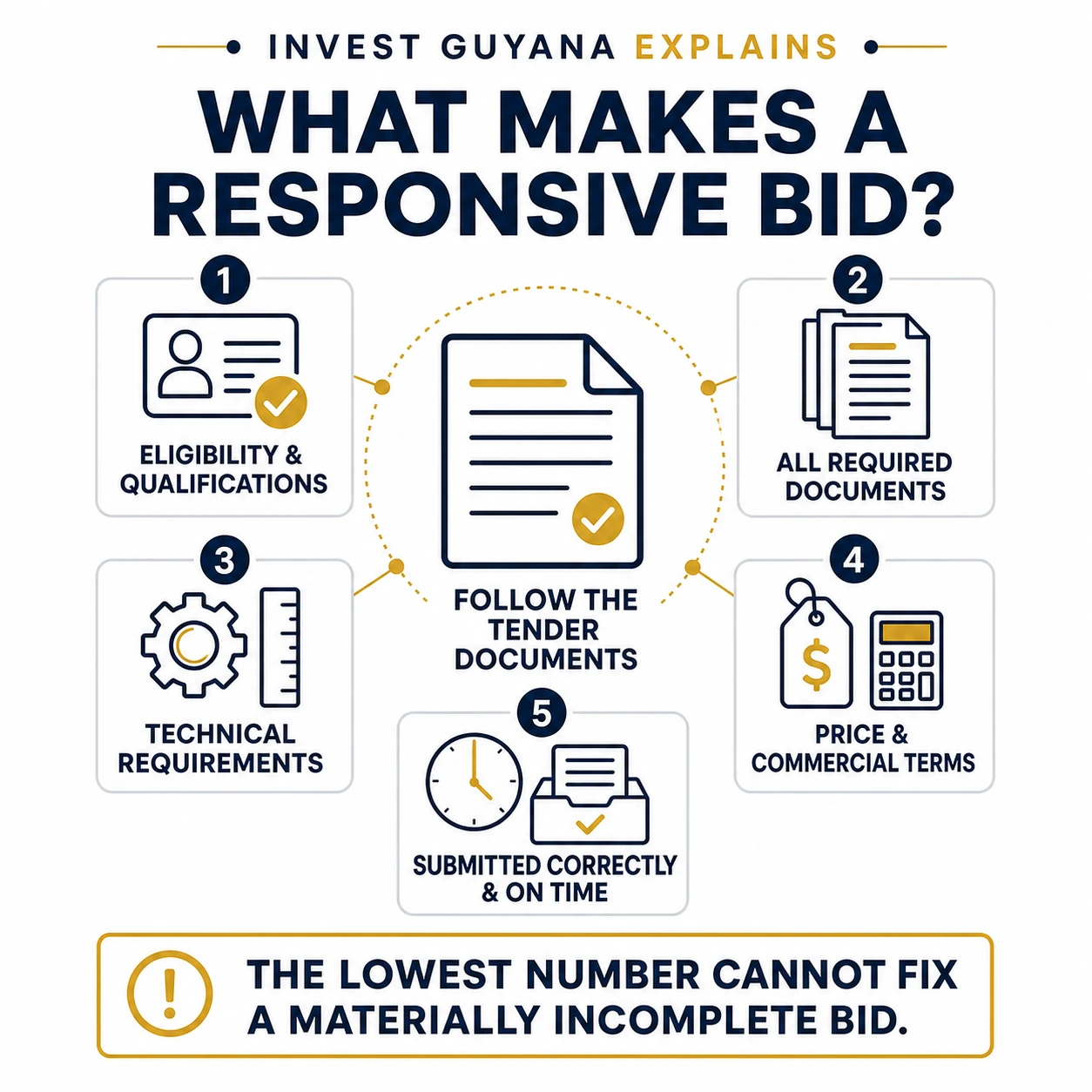
A capable company can still lose an opportunity by treating the tender documents casually. A missing form, an unsigned declaration, an expired document or a late submission may make a bid non-responsive even when the supplier could perform the contract well.
Public procurement rewards discipline. The bidder must understand the requirement, follow the instructions and demonstrate its ability in the form the tender requests. Confidence in the product is not a substitute for a complete bid.
The Lowest Price Does Not Tell the Whole Story
The managing director’s second assumption was that the smallest number automatically wins. Guyana’s law uses a more precise concept: the lowest evaluated tender.
The difference matters. Before price can decide the outcome, evaluators determine whether a tender is responsive and whether the bidder satisfies the stated qualifications. The Procurement Act requires the evaluation committee to use only the criteria outlined in the tender documents. It also provides that evaluation criteria in addition to price are to be quantified in monetary terms for goods, works and services, leading to the lowest evaluated tenderer.
In plain language, a low price does not repair a bid that fails a material technical requirement, ignores the delivery schedule or comes from a bidder that cannot demonstrate the required qualifications. Evaluation is not supposed to introduce a secret preference after bids have been opened. The published documents establish the rules that evaluators and bidders are expected to follow.
This is why suppliers should resist the temptation to begin with price. The first question is whether the company can submit a responsive offer. The second is whether it can perform the contract. Only then does competitive pricing become meaningful.
For consulting services, technical quality may carry particular weight. The wider principle remains the same: the method and criteria must be read from that procurement’s documents, not guessed from a different tender.
Opening, Evaluation and Award Are Different Stages
When the submission deadline arrives, tenders are opened in accordance with the stated procedure. Under the Act’s open-tendering provisions, bidders or their representatives may attend, and information including the bidder’s identity and tender price is announced as provided by the bid documents.
Opening does not mean evaluation has already occurred. It records what was received by the deadline. The detailed examination comes afterward, when the evaluation committee reviews the bids against the disclosed requirements and prepares its recommendation.
Once the appropriate decision has been made, the successful bidder is notified and the contract is completed in the required form. The Act also requires publication of contract awards, while NPTA maintains tender-opening and award information online. This creates a public trail beyond the original invitation. NPTA Tender Information
Unsuccessful bidders can use the result to judge whether their pricing, documentation or technical offer needs improvement. The legal framework also provides review and complaint mechanisms where a supplier believes the procurement rules were breached.
Who Does What in the System?
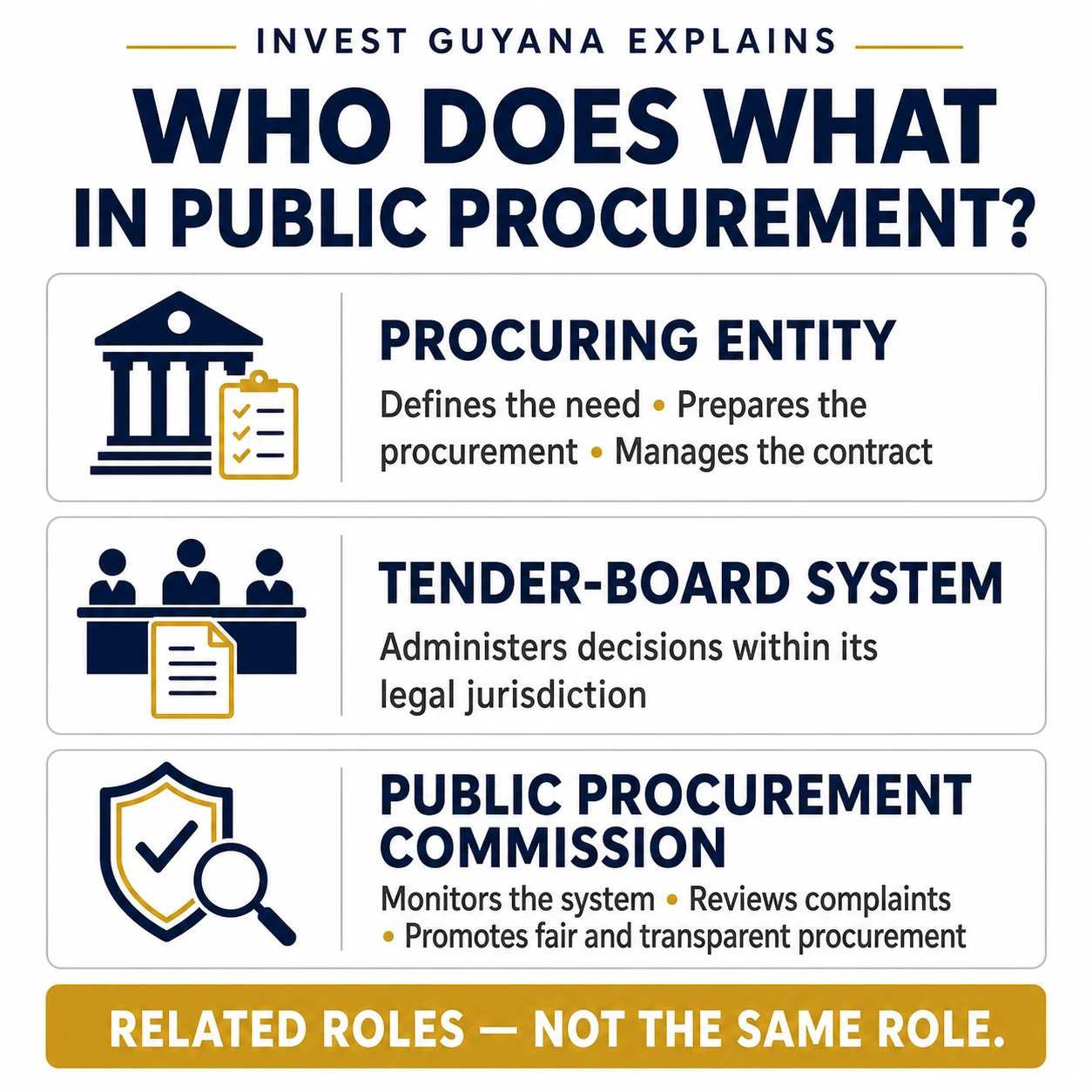
Public procurement is not run by one purchasing office for the entire country. The public entity that needs the goods, works or services remains central to the process. Its team helps plan the procurement, prepare the requirement and manage the resulting contract.
Tender boards operate at different levels according to the legal framework and value of the procurement. The National Procurement and Tender Administration and its National Board perform functions assigned under the Act, including jurisdiction over tenders above prescribed thresholds. Suppliers need not memorise every boundary, but they should identify the procuring entity and submission point named in the documents.
The Public Procurement Commission performs a different role. It is an independent constitutional body that monitors public procurement systems to promote procurement that is fair, equitable, transparent, competitive and cost-effective. Its functions include investigating complaints from contractors and suppliers through administrative review, promoting awareness and training, and monitoring the effectiveness of procurement systems. Public Procurement Commission
These roles are related but not interchangeable. The entity identifies and manages its need, the tender-board structure administers decisions within its jurisdiction, and the Commission provides independent monitoring and review functions established by law.
Winning the Tender Is the Beginning of Delivery
For the local equipment supplier, the tender initially looked like a contest ending with an award notice. In fact, the award creates a new phase: contract performance.
The supplier must deliver according to the agreed specifications, price and timetable. The procuring entity administers the contract and verifies performance, while securities, inspections, milestones or reporting may apply depending on the agreement.
This stage matters because value for money is not achieved when a bid is opened or even when a contract is signed. It is achieved when the public body receives what it contracted for at the required standard and the supplier is paid according to the agreement.
Businesses should treat delivery planning as part of bid preparation. A company that prices aggressively without understanding logistics, staffing or cash flow may win work it cannot perform profitably.
Reading the Opportunity Properly
By the end of the week, the managing director had stopped asking whether his company was “big enough” for government work. The better question was whether it met the qualifications and could submit a complete, responsive and competitive bid.
His team created a compliance checklist directly from the tender documents. Technical staff reviewed the specifications, finance examined securities and cash flow, administration checked every form, and a separate person confirmed the submission arrangements before the deadline.
That preparation did not guarantee the contract, nor should it. It did something more useful: it allowed the company to compete on the published terms with a bid that represented its real capability.
Public procurement can appear procedural because the process must balance several interests at once. Government needs timely delivery and value for money. Suppliers need a fair opportunity and clear rules. Citizens need confidence that public funds are being used through an accountable system.
The tender notice in the company’s inbox was therefore more than a sales lead. It was an invitation to enter a regulated marketplace where the requirement, the evidence and the process matter as much as the price. Once businesses understand that, government contracting becomes less mysterious and far more practical to navigate.
The next article in Invest Guyana Explains will look more closely at tax administration, following the journey from registering a business to understanding the public institutions and recurring obligations that support compliant operations.
Editorial note: This article provides a general explanation of public procurement in Guyana. Procurement methods, thresholds, documents and review procedures can change and vary by tender; suppliers should rely on the current solicitation documents, legislation and official guidance for each opportunity.