The production line was ready, the installation team had been booked and the factory’s new equipment was approaching Guyana by sea. The importer expected the shipment to move from the wharf to the project site as soon as the vessel was unloaded.
Then the customs broker asked for the commodity codes, invoices, freight details, licences and origin documents.
The company had focused on buying and shipping the machinery. It had not yet treated customs clearance as its own project, with information that had to be accurate before the goods could be assessed and released.
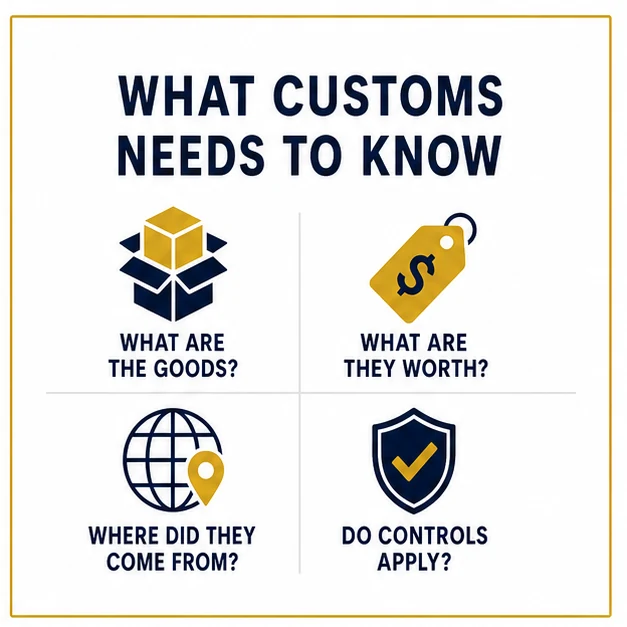
That is the central lesson of commercial importing. The physical arrival of cargo is only one stage. Customs must also know what the goods are, where they came from, what they are worth, whether any restriction or concession applies and whether the duties and taxes have been properly addressed.
Customs Begins Before the Shipment Arrives
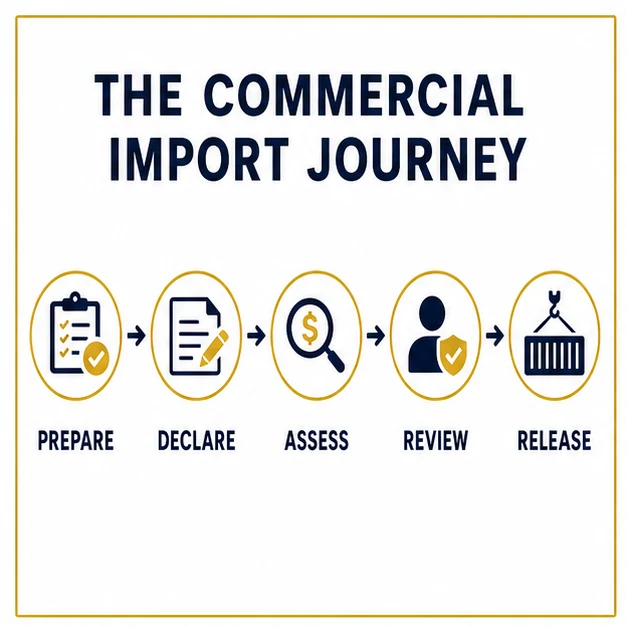
Efficient clearance is usually prepared before the vessel or aircraft reaches Guyana. The importer gathers the commercial invoice, transport document and any licences, certificates or exemption letters that may apply to the goods.
GRA’s current guidance states that commercial cargo is processed by the importer or a licensed customhouse broker through ASYCUDA World. The declarant completes an electronic Single Administrative Document, commonly called an eSAD, and attaches the supporting documentation required for the shipment. GRA Imports
The precise documents depend on the goods and transaction. A CARICOM certificate of origin may be relevant to qualifying regional goods, while controlled products can require approval from another authority. The existence of an invoice and bill of lading does not mean every possible requirement has been satisfied.
This is why purchasing teams should involve customs expertise before dispatch. A missing permit discovered after arrival can turn a documentation problem into storage costs and production delay.
Classification Tells Customs What the Goods Are
Customs systems rely on commodity classification because a description such as “machine parts” may be too vague to determine the applicable treatment. Goods are assigned tariff codes that identify them within the customs nomenclature.
The code can influence the duty rate, taxes, restrictions, statistical reporting and documents required. Two products that look commercially similar may fall under different classifications because of their materials, functions or technical characteristics.
Classification should therefore be based on the goods themselves rather than on the code that appears most convenient. Product literature, composition, specifications and intended function may all be necessary to support the declaration.
For a business importing repeatedly, a reliable product master can reduce inconsistency. The same item should not acquire a different description or code each time a new employee, supplier or broker prepares the shipment without a defensible reason.
Value Is More Than the Supplier’s Price
Customs also needs a value on which duties and taxes can be assessed. The commercial invoice is central, but the customs value may include more than the price paid to the supplier.
GRA’s ASYCUDA guidance explains that customs value for imports is based on the invoiced amount in a sale and can include relevant transport and insurance costs outside Guyana’s customs territory. The declaration must therefore reflect the valuation rules rather than a number selected only for internal accounting convenience. GRA ASYCUDA eSAD Overview
Where Customs disputes the declared value, GRA describes procedures involving additional valuation forms and review. The practical protection for the importer is a clear transaction record: invoice, payment evidence, freight, insurance, contract and any information explaining the relationship between buyer and seller.
An unrealistically low value may appear to reduce duty in the short term, but it can trigger questions, delays, reassessment and penalties. Accurate valuation is part of planning the landed cost honestly.
Duties, Taxes and Concessions Shape Landed Cost
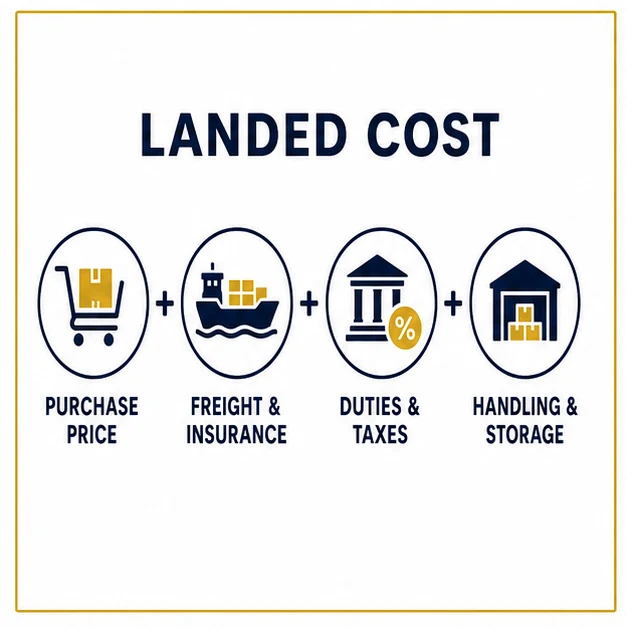
The purchase price is not the final cost of imported goods. Freight, insurance, handling, customs duties, VAT or excise taxes, brokerage and storage can all affect the amount required to place the item into operation.
The exact treatment depends on the classification, value, origin, use and current tariff or tax rules. Some goods may qualify for zero-rating, exemption or an approved concession, but the importer should not assume that a commercial promise or investment plan automatically changes the customs assessment.
Where a concession or exemption applies, the supporting approval must be reflected in the customs process. GRA’s import guidance lists tax-exemption letters, import licences and certificates of origin among the documents that may accompany the electronic declaration.
Investors should model these costs before purchasing. A machine that appears affordable at the supplier’s gate may be unsuitable once the full landed cost and clearance requirements are included.
Submission Leads to Selectivity, Not Always Inspection
After the declaration is submitted and the assessed duties and taxes are addressed, ASYCUDA assigns the shipment to a selectivity lane. This allows Customs to determine the level of review appropriate to the declaration.
Some shipments may be released with limited intervention, while others receive documentary review or physical examination. GRA notes that Customs does not physically inspect every import. Selectivity allows attention to be directed according to the system’s controls and risk indicators. GRA Commercial Imports
Importers should not interpret examination as proof of wrongdoing or assume that previous fast releases guarantee identical treatment in the future. The correct preparation is the same for every lane: submit an accurate declaration and keep the goods and documents available for the review assigned.
When Customs asks a question, rapid access to product specifications, valuation evidence or licences can make the difference between a manageable review and a prolonged delay.
Release Requires Several Participants to Align
Customs clearance is central, but cargo release also involves the custodian, wharf or shipping arrangements. The carrier or agent controls transport documents and charges, the terminal holds the cargo and Customs controls release under the law.
The importer or broker must therefore coordinate more than one timetable. A customs declaration may be ready while an original transport document, delivery order or terminal charge remains outstanding. Conversely, shipping arrangements may be complete while Customs still requires clarification.
This is why the arrival date should not automatically be treated as the delivery date for a construction or manufacturing schedule. Responsible planning includes time for discharge, declaration processing, possible examination and physical removal from the facility.
GRA has also reminded importers that goods left uncleared can become want-of-entry cargo under the Customs Act. Delayed action is not an unlimited storage strategy. GRA Want-of-Entry Cargo Notice
A Broker Helps, but the Importer Remains Invested in Accuracy
Licensed customhouse brokers provide valuable specialist support. They understand the electronic system, documentation and communication involved in clearance.
Using a broker does not make the importer’s commercial knowledge irrelevant. The importer knows what was purchased, how it functions, what was paid and whether any special permit or investment approval was expected. The strongest declaration combines the broker’s customs expertise with the company’s accurate product and transaction information.
Businesses should therefore avoid sending a broker an invoice at the last moment and expecting every missing detail to be inferred. A structured pre-shipment file gives the broker time to identify questions before the cargo begins accumulating costs.
Repeated importers can improve further by reviewing each shipment after release. Classification questions, document gaps and unexpected charges should become lessons for the next order rather than recurring surprises.
Plan the Clearance Alongside the Purchase
The factory from our opening scene eventually received its equipment, but the experience changed its procurement process. Customs review was added to the purchase timetable before orders were confirmed.
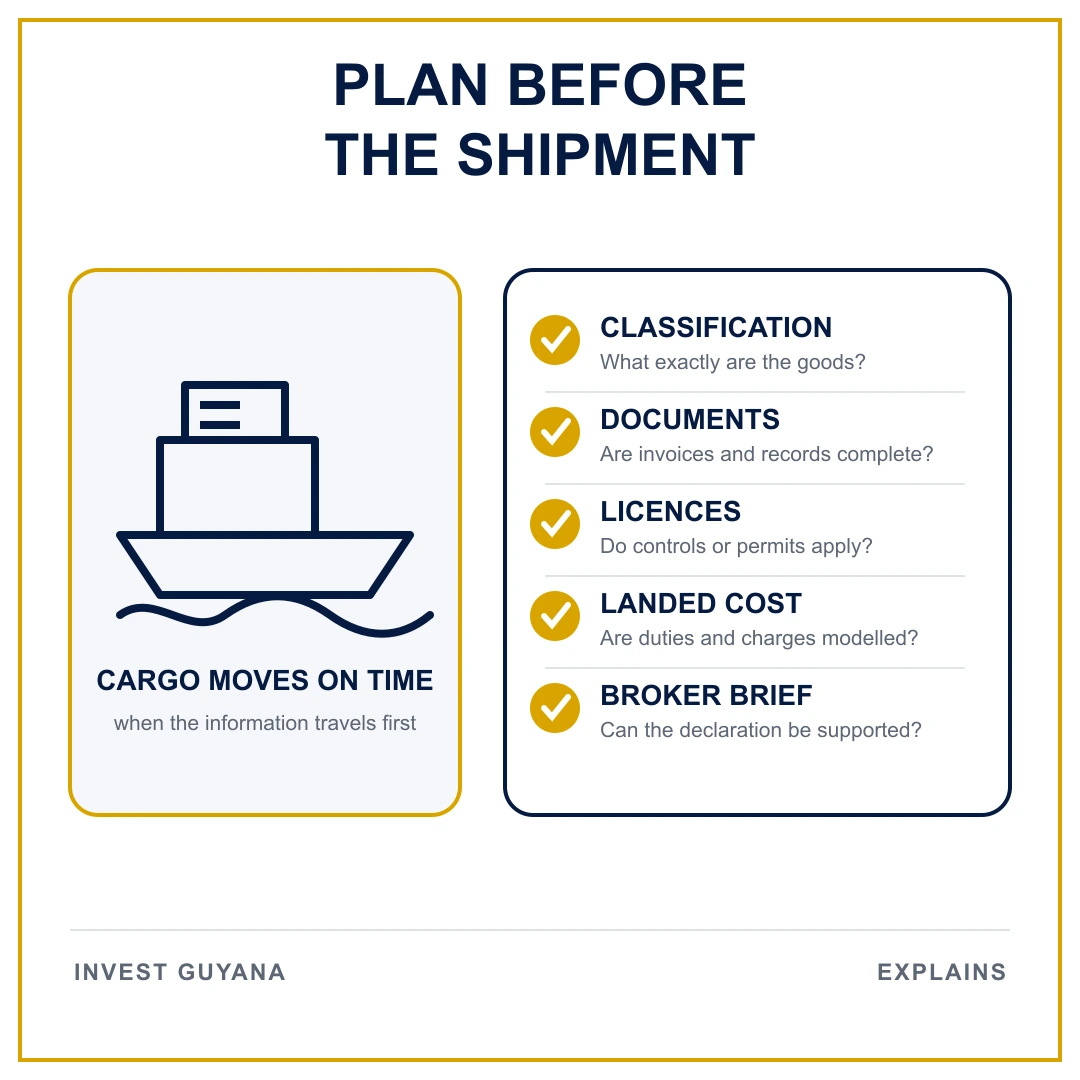
The company began asking five questions early: What exactly are the goods? How should they be classified? What is the correct customs value? Which licences, origin documents or concessions apply? Who will prepare and support the declaration?
Those questions connected purchasing, finance, logistics and the customs broker before the vessel sailed. They also produced a more accurate landed-cost estimate and a delivery date that reflected the full import journey.
Customs clearance is sometimes described as the final barrier after an international purchase. A better view is that it is part of the purchase itself. The goods, documents, value and permissions travel together, even when only the cargo is visible on the ship.
Once businesses plan on that basis, importing becomes less dependent on last-minute intervention and more like any other controlled operating process: define the requirement, prepare the evidence, submit accurately and respond quickly until the goods are released.
Editorial note: This article provides a general explanation of commercial importing and customs clearance in Guyana. Tariff classifications, values, licences, concessions, taxes, documents and procedures depend on the shipment and current rules. Importers should rely on the Guyana Revenue Authority, relevant licensing bodies and qualified customs professionals.