
Drone photograph from Invest Guyana’s media archive; contextual image, not the hypothetical project described.
Imagine a small manufacturer with a full order book, enough workers and a production line ready to run. A modest replacement component has not arrived, however, and the machine cannot operate without it. The missing item is worth far less than the orders waiting behind it, yet it now determines when the business can deliver.
The problem illustrates why a supply chain is more than a list of suppliers. It is a connected system through which materials, information and commitments must move in time for a business to perform. The weakest point may be an inexpensive item rather than the largest purchase.
For Guyanese businesses using imported machinery, packaging or inputs, these connections can extend across several countries before reaching the final customer. Understanding the chain helps explain how an apparently remote delay becomes a local operational problem.
Production depends on connected activities
A business may buy from a local distributor whose own stock comes from an overseas manufacturer. That manufacturer may depend on other producers for components or materials. The immediate supplier is therefore one visible part of a wider system, not necessarily the origin of everything being purchased.
The World Bank’s work on global supply-chain stress describes production and logistics connections across economies. It provides context for understanding dependencies, but a global indicator does not establish the delivery prospects of an individual Guyana shipment. World Bank supply-chain analysis.
In our hypothetical factory, the local purchase order might be perfectly clear while an upstream component shortage remains unresolved. The buyer’s direct relationship cannot make a missing input appear earlier in the chain. Understanding that dependency changes the conversation from who accepted the order to what must happen before delivery is possible.
The same principle applies to services. An installation team may depend on equipment arriving, a site being ready and the right specialist being available. These activities can be linked even though only some involve moving physical goods.
Lead time covers the complete interval
Lead time is the interval between a relevant starting point and the point when something is available for its intended use. The starting and ending points need to be clear. A supplier’s dispatch estimate is not necessarily the same as the buyer’s ready-for-production date.
For a replacement component, the interval might include production, preparation, transport and local delivery, followed by installation or testing. The exact sequence depends on the transaction. Concentrating only on the journey between ports can leave other important periods outside the business’s expectation.
Guyana’s Budget 2026 discussion identifies capital goods and intermediate inputs among the country’s imports. That provides local context for why imported equipment and materials can connect domestic investment to wider delivery networks. It does not establish a standard lead time for any particular product. Budget 2026, external trade discussion.
Our manufacturer’s customer is interested in when finished goods will arrive, not merely when the component leaves its supplier. A realistic operational view therefore follows the item through to the point where production and delivery can actually resume.
Reliability matters alongside speed
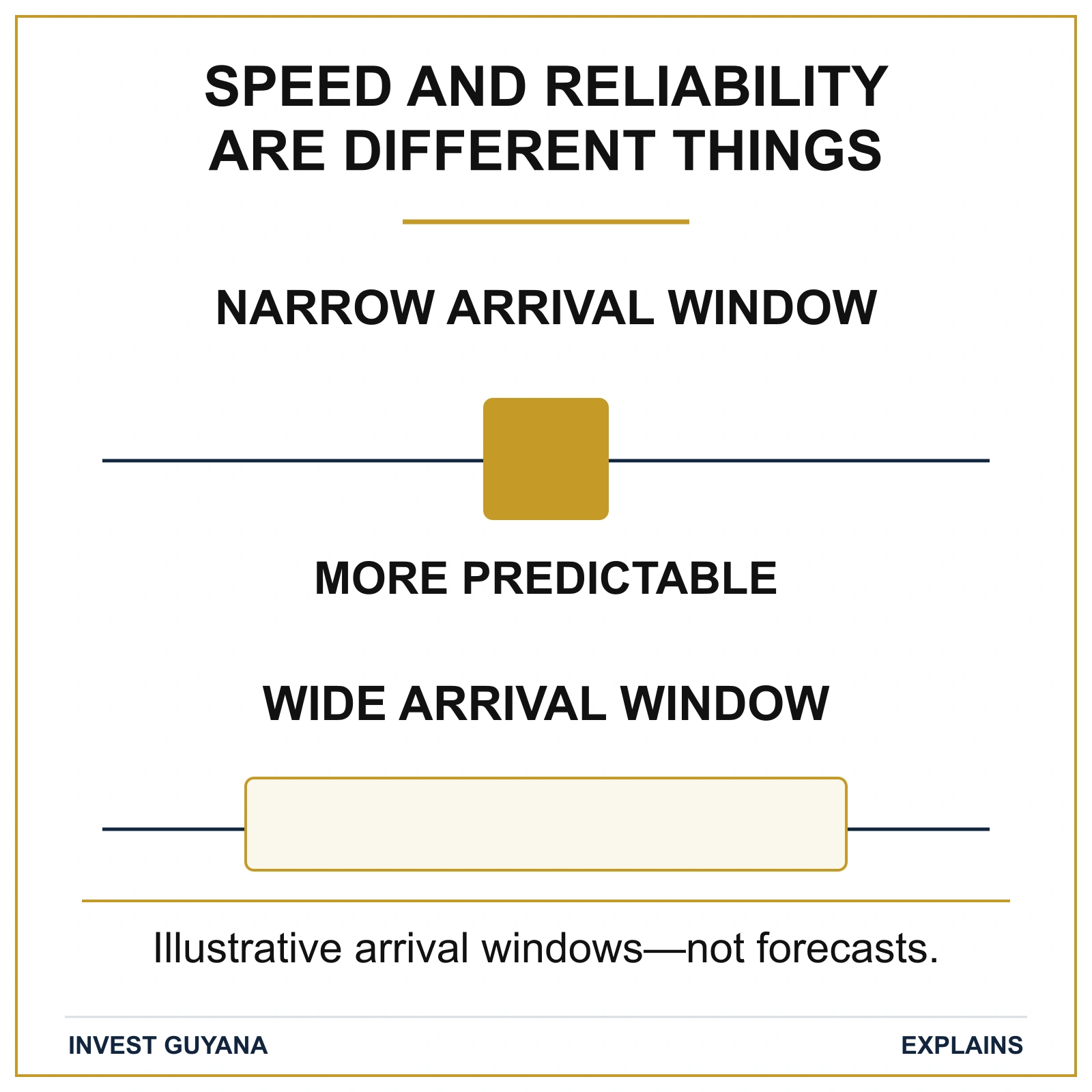
A short average delivery time can conceal considerable variation. If one order arrives quickly and another much later, planning around the average may still leave the business exposed. The practical problem is often uncertainty about arrival, not simply the number of days in a typical shipment.
The World Bank’s Logistics Performance Index analysis emphasises reliability and the disruptive effects of unexpected delays. Its findings concern logistics generally and should not be converted into guaranteed Guyana delivery benchmarks. World Bank, Connecting to Compete 2023.
Imagine two hypothetical supply arrangements. One regularly delivers within a narrow window; the other is faster on some occasions but much less predictable. Which arrangement suits the business depends partly on the consequences of a late arrival, not just the shortest possible transit time.
For the factory with a stopped machine, predictability can influence commitments made to customers and the amount of contingency built into operations. For a less critical item with easy substitutes, the same variability may be less disruptive.
The smallest item can become the constraint
The importance of an input is not measured only by its purchase price. A low-cost component can constrain a high-value process when no suitable alternative is immediately available. The relevant question is what stops if the item is missing.
Consider a manufacturer with ample raw material but no packaging suitable for delivery. Production may continue briefly, but dispatch cannot proceed as planned. Alternatively, a specialised maintenance item may prevent the entire production line from running despite its small share of the equipment budget.
This is why supply-chain understanding involves relationships among activities. Buying more of the largest input does not necessarily protect the business against the item that creates the most serious bottleneck. The issue is functional dependence rather than expenditure ranking.
It also explains why substituting an item can require more than finding something that looks similar. Compatibility, quality or customer requirements may matter. A proposed substitute is useful only if it can perform the relevant role without creating a different problem.
More suppliers do not always mean more resilience
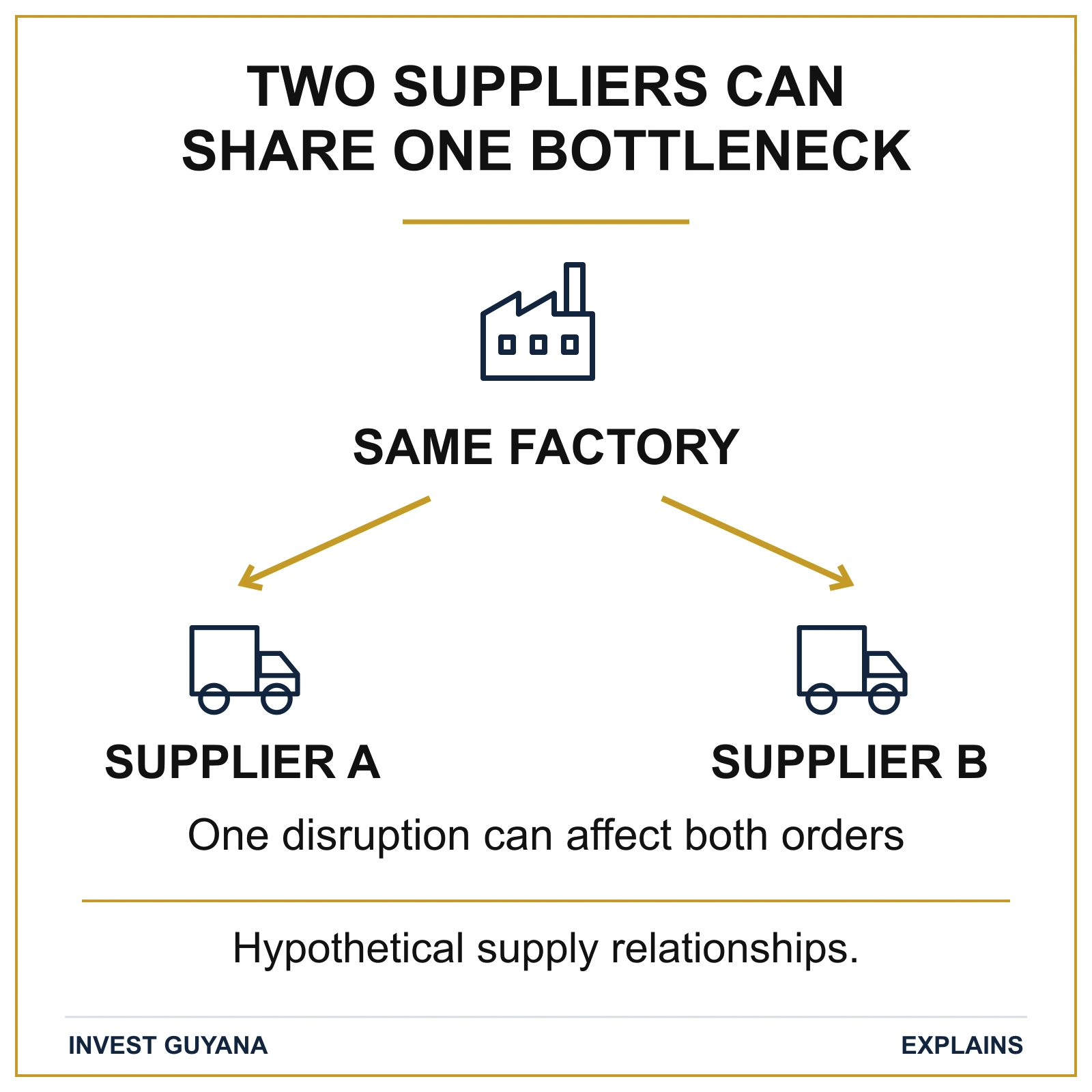
Using more than one supplier can reduce some forms of dependence, but the result depends on whether their underlying risks are genuinely different. Two distributors might draw stock from the same factory or use the same vulnerable route. A longer supplier list can therefore conceal a shared point of failure.
WTO analysis describes both the risks of concentration and the costs of developing alternative supply relationships. Finding suitable partners, coordinating requirements and establishing reliable performance take resources. Diversification is a commercial trade-off rather than a costless cure. WTO discussion of supply-chain diversification.
For our manufacturer, an alternative source might be useful for a critical component but unnecessary for an easily replaced routine item. The value depends on the disruption it can actually address. Adding a supplier that shares the same upstream bottleneck may do little to shorten a stoppage.
This reasoning avoids the simplistic conclusion that every business should continually add suppliers. The more useful concept is targeted resilience: understanding the specific dependency and the practical value of an alternative under the conditions that matter.
Buffers have benefits and costs
Holding additional stock can provide time when deliveries are delayed. However, inventory uses cash, occupies space and may deteriorate or become obsolete. The cash-flow article explains why goods on a shelf are not equivalent to money immediately available for other obligations.
Suppose our manufacturer keeps a spare component that is expensive but essential. Its value as protection depends on the likelihood and consequences of needing it, its useful life and the alternatives available. A warehouse full of spare items is not automatically a well-designed response to uncertainty.
IMF research on supply-chain diversification similarly identifies trade-offs between resilience and the costs of different sourcing arrangements. Its modelling should not be treated as a numerical prescription for Guyanese businesses, but it supports examining both protection and cost. IMF research on supply-chain resilience.
The broader point is that a supply chain is a design problem as well as a purchasing function. Speed, reliability, inventory, cash and flexibility interact. Improving one dimension without understanding the others can shift the problem rather than resolve it.
The distinction becomes especially useful for businesses bidding to supply public bodies. The NPTA bidder-registration Guide addresses entry into the relevant administrative register; it does not establish that a bidder can meet a proposed delivery date. A supplier’s practical readiness also depends on the chain supporting its offer. Understanding that chain helps explain why the delivery promise deserves independent attention after registration is complete. A future sourcing Guide can turn this conceptual understanding into a task-specific assessment without repeating the customs process or implying that any particular supply route is always reliable.
Information can become another constraint when a supplier cannot confirm where an order stands. An uncertain status makes customer commitments harder to manage, even before the eventual delay is known. Visibility therefore has operational value alongside the physical movement of goods.
Returning to the waiting orders
The manufacturer can now describe the stoppage more accurately. It is not merely waiting for a parcel; it depends on a chain of production and delivery activities whose timing determines when customer commitments can be met. The inexpensive component is important because of the work it enables.
This perspective complements the earlier customs explainer without repeating it. Customs concerns a particular regulatory part of moving goods. Supply-chain understanding follows the wider operational connections before and after that stage.
The next article applies a related idea to participation in Guyana’s petroleum economy. Local content concerns how Guyanese businesses and people participate in that sector’s value chain, while commercial readiness still matters when an opportunity must become successful delivery.