

Photo: Department of Public Information, Guyana (archive image).
More visitors are coming to Guyana. For a local tour operator, that raises a decision bigger than the next booking: add another vehicle, offer more departures or make it easier for customers to buy the trips already available?
The answer can differ even when the national tourism figures are encouraging. A fuller airport does not automatically mean a fuller tour, and an extra booking can have a very different value depending on how much it costs to serve.
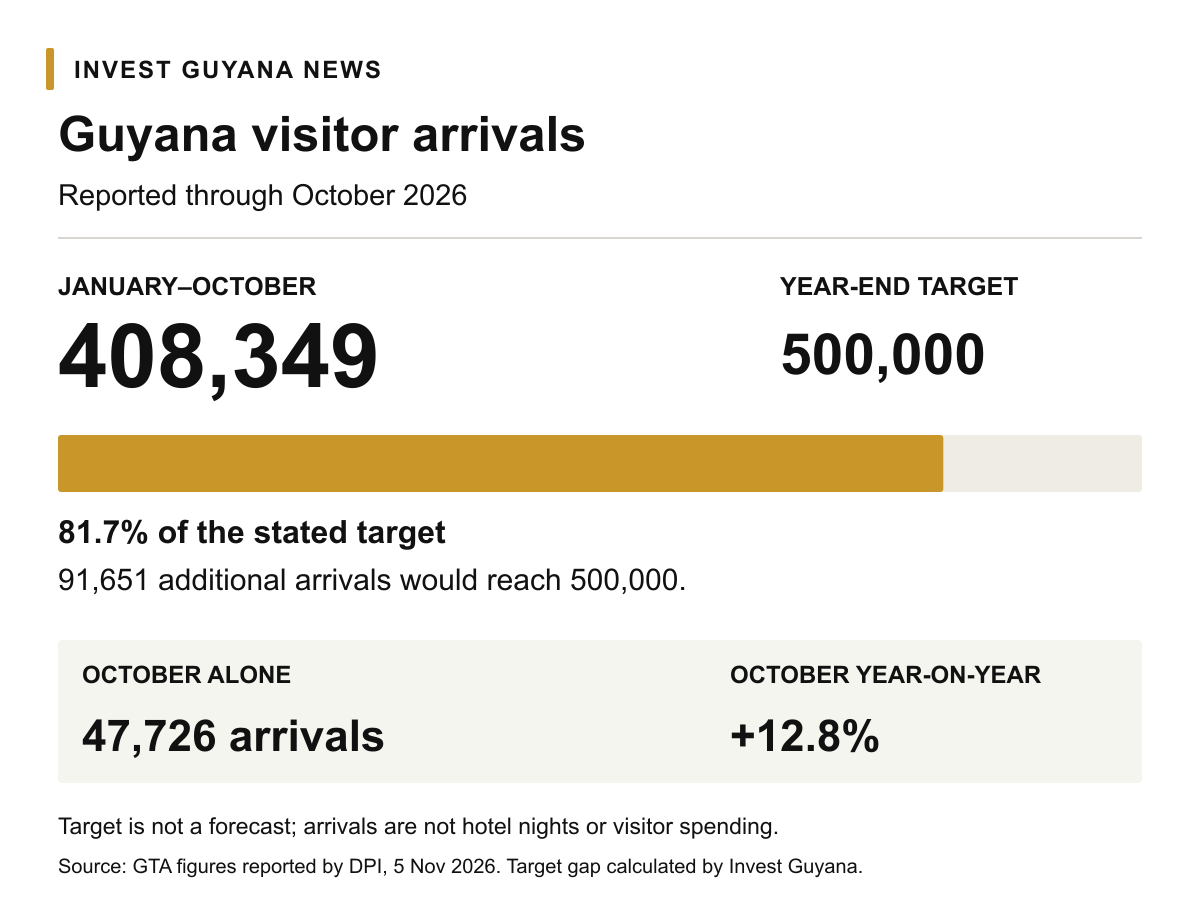
The Department of Public Information reported on 5 November that the Guyana Tourism Authority recorded 47,726 arrivals in October 2026, up 12.8 per cent year-on-year. The January–October total reached 408,349, against an anticipated 500,000 for the year.
Those figures give businesses a fresh demand signal. The next commercial task is to identify which part of that demand an enterprise can reach, what the visitor needs and whether serving it produces a sustainable return.
National growth needs a business-level explanation
The new cumulative total reconciles with the earlier official January–September figure of 360,623, reported on 7 October. Adding the latest monthly result produces the new ten-month total exactly.
That consistency is useful, but the measure remains arrivals. It does not establish how many hotel nights were sold, how much each traveller spent, which communities received the business or what any individual operator earned. It should not be relabelled as a count of distinct people without the relevant statistical definition.
For a tourism business, the route from an arrival to revenue can be quite specific. Someone attending a conference may have only a free afternoon. A returning visitor staying with relatives may want a family outing rather than accommodation. A nature traveller may need a multi-day itinerary whose transport and lodging have to fit together.
These are possible customer situations, not a measured breakdown of the latest results. Their significance is practical: the same national growth can support different products, booking windows and partnerships. A business that understands its own customer is better placed to judge which opportunity actually fits.
More capacity is useful when it solves the right problem
Consider a deliberately simplified example, not an actual operator's results or a market forecast. A business offers four departures a month with eight guest places on each. It has 32 available places. If it sells 16, it fills half its capacity.
Adding two departures would increase the available places to 48. If sales remained at 16, the fill rate would fall to about one-third. The operator would have created more capacity without securing another customer.
That calculation says nothing by itself about profit: prices, transport, guides, fuel, commissions and other costs would still have to be assessed. It shows why an expansion decision should identify the constraint first. A business turning away confirmed customers faces a different question from one whose existing departures are difficult to find or buy.
An investor should therefore examine actual booking records and lost-sales reasons. Are guests unable to travel on the available dates? Are enquiries being answered too slowly? Is the trip unattractive at its current price? Is the main constraint an available guide, a vehicle or customer access? Each diagnosis points towards a different use of capital.
Overseas exposure has to reach the booking desk
The demand report coincides with Guyana's participation in World Travel Market London, held from 3 to 5 November. DPI's account identifies a delegation involving the tourism ministry, GTA, THAG and operators, with attention to new markets and commercial relationships.
For a small operator, the useful outcome of such exposure is a route to a suitable customer. That could involve an overseas travel seller understanding the product, a destination-management company including it in an itinerary or a hotel knowing when a guest can reliably join a departure. None of those relationships becomes valuable merely because a meeting took place.
The practical work is in the product behind the conversation: a clear experience, current availability, an understandable price, agreed responsibilities and a booking route that works. A visitor weighing an unfamiliar destination needs confidence about what happens between payment and the experience itself.
Commercial terms matter too. The amount paid by the traveller is not necessarily the amount retained by the operator after a selling partner's commission or distribution costs. More bookings can improve a business while still requiring closer attention to its net receipt and cost per trip.
The exhibition is therefore relevant as a distribution opportunity. It is not evidence that contracts, visitor spending or profitable bookings have already followed from the delegation's participation.
Local suppliers can participate without selling the whole holiday
The opportunity is wider than owning a hotel or operating a complete tour. Transport providers, food businesses, guides, artisans and other suppliers can examine where their product fits within a visitor's itinerary.
For a food producer, for example, reliable quantities and delivery timing may matter more to a hospitality buyer than a broad national growth headline. A transport supplier needs to know the collection time, route, group size and responsibility when a flight or event runs late. An artisan supplying a retailer must distinguish a one-off showcase from repeat orders on workable payment terms.
Those relationships can make growth more accessible to smaller businesses. They can also create working-capital pressure where a supplier pays for inputs before collecting from the buyer. A credible commercial arrangement needs to address ordering, delivery, quality and payment together.
Seasonality should be part of that assessment. A busy event period can justify temporary staffing or extra departures without necessarily supporting a permanent increase in fixed costs. Conversely, repeat business across quieter periods may be more valuable than a single crowded week. The relevant evidence is the business's own sales pattern, not an assumed national occupancy rate.
The year-end target still requires another trading period
The distance from the published ten-month count to the stated year-end ambition is 91,651 arrivals. That is an Invest Guyana calculation: roughly 45,826 a month over November and December would close the gap. It is arithmetic, not a forecast or proof that the target will be reached.
For businesses, the remaining period is an opportunity to test a product and collect better evidence. Enquiries, paid bookings, cancellations, referral sources and repeat customers can reveal whether interest is turning into a dependable market. Revenue retained after distribution and delivery costs provides a further test of its commercial value.
The opening operator's decision becomes clearer when those records are available. If demand is constrained by capacity, expansion may deserve examination. If customers are not yet finding or choosing the existing product, a better sales route or a different offer may be the more useful intervention.
Guyana's latest visitor results strengthen the case for taking tourism seriously as a business opportunity. The next test is local and operational: turning a growing flow of travellers into experiences customers can book, suppliers can deliver and enterprises can sustain.
Editor's note: This analysis uses official information reviewed on 6 November 2026. The operator scenarios and capacity example are illustrative, not reported businesses or investment recommendations.