Photo: Department of Public Information, Guyana.
A delivery can reach Georgetown on time and still run into difficulty in the last few metres. Roadside excavation may change where the driver can stop, how stock reaches a shop entrance and whether pedestrians can pass.
That is the business relevance of Georgetown's road-shoulder improvement programme. The Ministry of Public Works says contracts have been awarded and some work has begun, while a separate official account reports an execution warning to contractors. Together, the two 5 November statements place attention on how the work is delivered, not simply whether the verge is resurfaced.
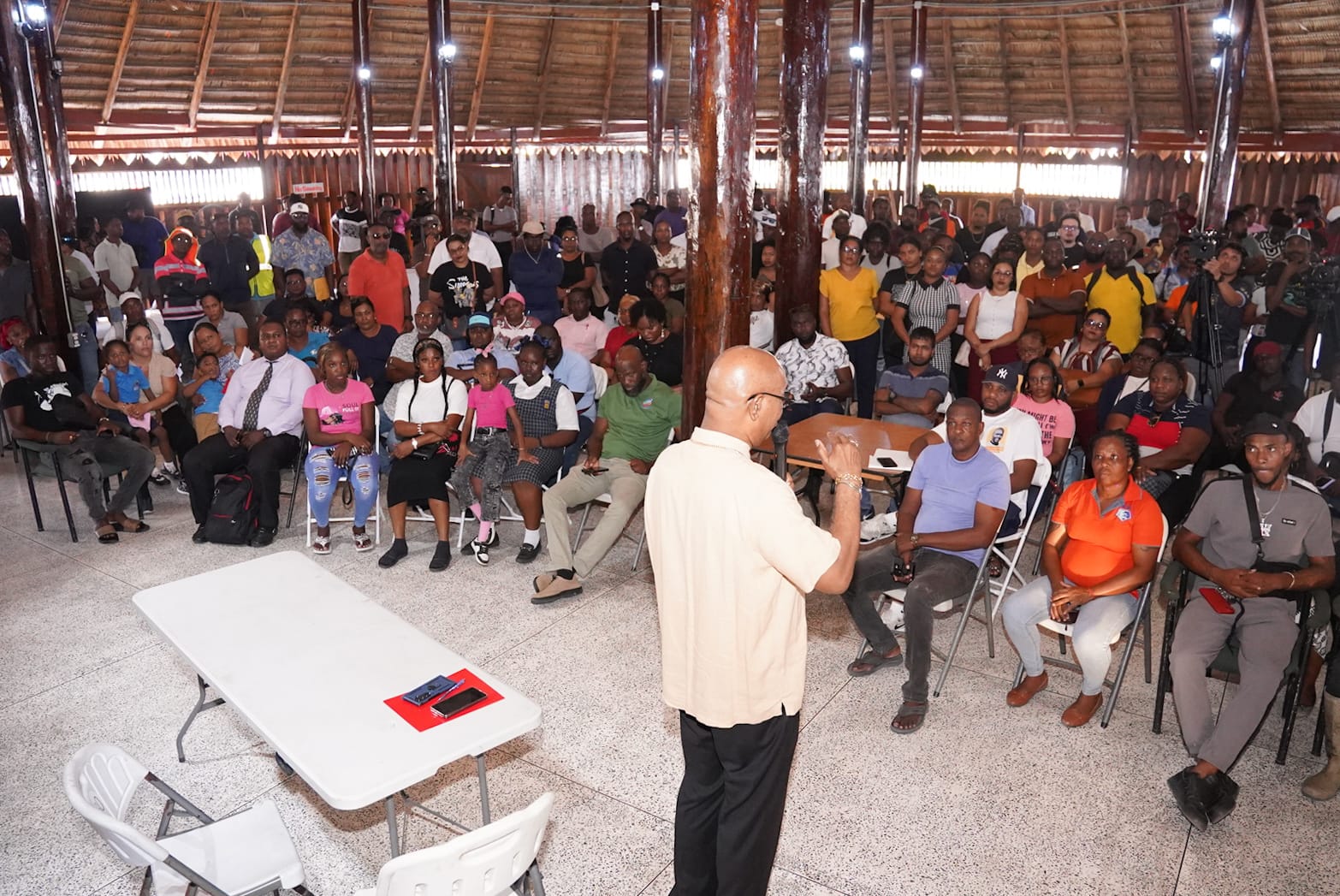
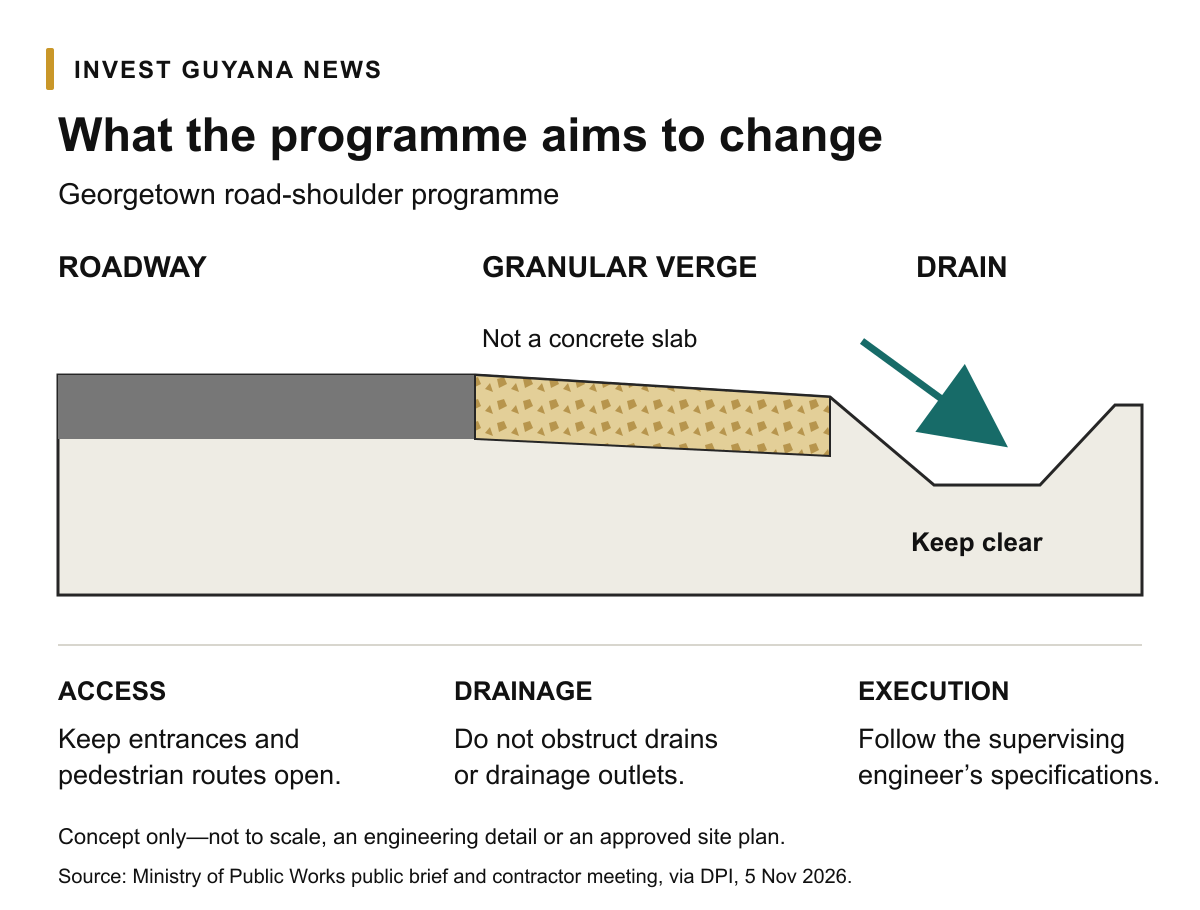
The ministry's public brief describes reshaped verges finished with compacted granular material rather than concrete, intended to improve runoff and usable roadside space. At an Umana Yana meeting that day, Minister Juan Edghill warned contractors about disruptive and poor-quality execution, including excavation, dumped materials, road damage and broken water pipes. His warning that continued breaches could lead to termination is not an announcement that a contract has been terminated.
The roadside is part of a business's operating frontage
For a shop, restaurant or service business, the boundary between the premises and the traffic lane is part of daily operations. Customers approach on foot or by vehicle, suppliers unload stock and employees move between the entrance and the street. A change to that connection can affect several parts of the business at once, even when the construction takes place outside its building.
The useful question is therefore not whether a firmer shoulder looks better. It is whether the arrangement leaves an intelligible route for each activity without allowing one to obstruct the others. A delivery position that blocks the entrance, or parking that displaces pedestrians into traffic, can transfer a problem rather than solve it.
Businesses should distinguish everyday convenience from an entitlement to control the adjoining verge. The ministry has asked users to remove obstructions from road reserves and keep work areas accessible. That request should not be expanded into an unverified claim about every occupier's legal position, a new national parking rule or permission to create private parking bays.
A drainage objective must be assessed at street level
The programme links the level and shape of the shoulder to the route water takes away from the carriageway. This makes the junction between the road, verge, entrances and drain important to the eventual result. A finished surface should be assessed as part of that connection, not as an isolated strip of newly placed material.
For a property owner, a sensible record starts before work reaches the frontage. Photographs of existing access points, visible drains and any pre-existing defects can help distinguish the original condition from later changes. Such a record is a basis for a specific discussion with the supervising team; it is not proof of a defect or an instruction to redesign public works independently.
The same care is needed after construction. A business noticing persistent ponding or a blocked outlet should describe the location and observed condition rather than assume the cause. Establishing whether a concern arises from levels, an obstruction, another drainage constraint or incomplete work requires the relevant technical assessment.
The announced drainage objective should not be reported as demonstrated performance across Georgetown. Equally, an excavation photographed before completion does not establish that the finished design has failed. Investors and residents need to distinguish construction-stage conditions, completed work and evidence from operation over time.
Keep the last few metres of delivery under review
The most immediate commercial adjustment may be coordination rather than capital expenditure. A business can establish when access will be affected, who is supervising the work and how a delivery or customer collection will be handled during that period. Those are site-specific operating questions, not a blanket reason to suspend trading or a guarantee that disruption can be avoided.
A restaurant receiving perishable goods may need a different temporary arrangement from a store receiving building materials. The relevant discussion is about the particular load, vehicle, entrance and timing, rather than an assumption that every property can use the same workaround. Any arrangement must remain consistent with the responsible authority's safety and access directions.
Communication inside the business matters as well. Staff taking orders should know whether the usual collection point is available, while the person coordinating suppliers should receive the same update. Promising normal vehicle access before it has been checked can turn a manageable works issue into an avoidable customer-service problem.
Edghill called for coordination with technical supervisors, advance community contact and prompt filling of excavations. He also said existing bridges would be handled separately rather than broken in the current phase. That assurance should be read within its stated scope, not as a general promise that every property's access arrangement will remain unchanged throughout all later works.
Contractor performance includes managing the interface
For contractors, the story highlights the difference between completing a measured construction item and managing its effect on a functioning street. Excavation, material storage, access, utilities and public communication interact during execution. Treating each as somebody else's responsibility can create gaps between an otherwise adequate work method and the conditions experienced outside a business.
The practical commercial response is to make responsibility visible. A clear site contact, an agreed route for escalating concerns and records of instructions help a contractor distinguish an outstanding task from a misunderstanding or a change requiring approval. Those records can support accountability without turning routine coordination into a dispute by default.
This is also relevant to suppliers and subcontractors. Delivering material to an inconvenient position can create a problem for the main contractor even if the quantity is correct. The value of a supply arrangement therefore includes timing, placement and communication—not merely the delivered price.
Better frontage is not a property valuation
The ministry places the programme within a phased approach and identifies a wider rollout in Regions Two to Six. It says some locations could support future widening only after further assessment and design. Neither statement establishes a new budget allocation, a guaranteed widening scheme for a particular street or a timetable for every community.
A landlord or prospective tenant should therefore assess the actual premises rather than capitalise an assumed improvement into a rent or purchase decision. Access, drainage and customer movement are relevant operating considerations, but the value of a particular change depends on the property and its use. The ministry's announcement does not establish higher rents, increased sales or a measured increase in asset values.
For Georgetown businesses, the immediate opportunity is practical: engage early, document the frontage and keep delivery and customer arrangements aligned with the works. For the programme itself, the commercial test will be whether the improved roadside remains usable without shifting costs and inconvenience onto neighbouring premises. That result must be established through execution and observation, not assumed from the announcement.