

Photo: Department of Public Information, Guyana.
A jobseeker finds a vacancy that looks promising until one requirement changes the calculation: the role involves driving. For someone hoping to deliver goods, visit customers or support a small business, acquiring that skill can expand the work they are able to consider.
An employer approaches the same question from the other side. A shop may have a vehicle and customers waiting for deliveries, but it still needs someone who can handle the work responsibly. Neither a completed lesson nor a digital result, on its own, answers every question about readiness for that job.
Guyana's Ministry of Education announced on 6 November that Minister Sonia Parag had launched a Driver's Licence Portal through the Guyana Digital School, in collaboration with the Ministry of Home Affairs and the Guyana Police Force. The service offers theory training and online examinations to the public, including Grade 11 and 12 students. Its significance is the move in how people prepare and demonstrate theoretical knowledge—not the disappearance of the other demands involved in becoming a driver.
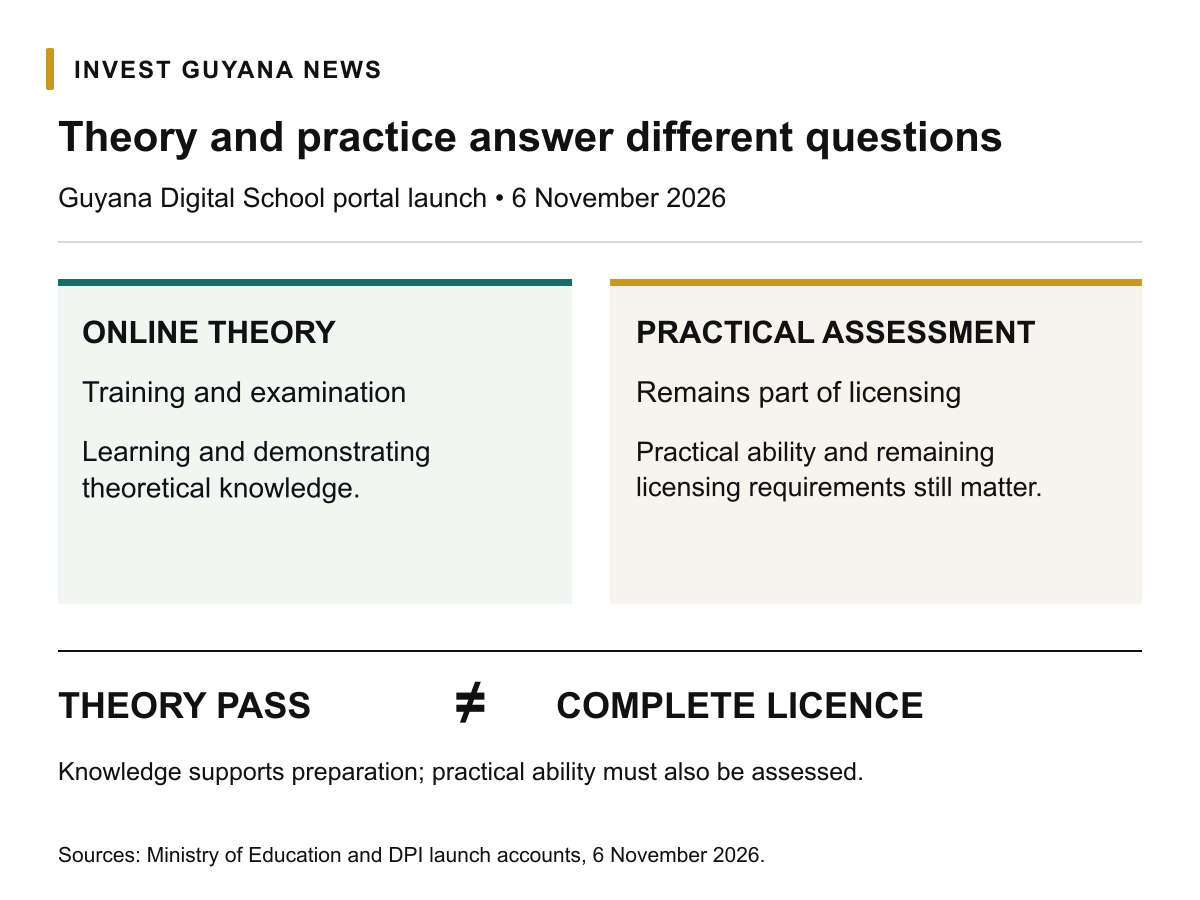
Online knowledge assessment is not a practical driving test
The distinction matters because a digital service can be useful without replacing an entire administrative process. The Department of Public Information's account of the launch states that practical assessments remain part of licensing. Moving the theory examination online therefore should not be read as permission to obtain a licence without demonstrating practical ability.
Knowing what a road sign means and responding safely when a pedestrian steps into the road are connected abilities, but they are not identical. A person can learn a rule, recognise the right answer in an examination and still need supervised practice before applying it confidently under pressure.
A potential workforce benefit needs a route into real work
For a small Guyanese enterprise, driving is often part of another job rather than a separate department. An employee may collect supplies in the morning and visit customers later. A supervisor may need to travel between sites. A growing retailer may be deciding whether its deliveries can be organised reliably with the staff and vehicles it already has.
These are illustrative business situations, not measured results of the portal. They show why access to driver education has an economic dimension: the ability to travel and carry out a task can influence the roles an individual can perform and the way a business organises its work.
However, an employer should not confuse a new training channel with a ready-made recruitment pipeline. The commercial requirement is someone suited to the actual assignment. That includes relevant driving competence, understanding the employer's expectations and the ability to deal calmly with conditions outside an examination setting.
For businesses investing in staff development, the opportunity is to connect learning with a clear purpose. Paying attention to preparation, practical experience and the demands of the role is more useful than treating an online pass as the end of the investment.
The school pathway has a separate timetable
There is a second audience for the initiative: students approaching the transition from school into employment or further study. DPI reports that the planned curriculum component is expected to benefit students from 2027. That expectation is distinct from the portal launch itself and should not be translated into automatic licensing eligibility for every pupil.
Introducing a subject earlier can change the setting in which young people encounter it. Road use can be discussed as a responsibility involving passengers, pedestrians and other drivers, rather than only as an examination hurdle to clear when a vacancy or family need makes driving urgent.
The challenge for any school-linked programme is to turn exposure into understanding. Students may arrive with very different familiarity with vehicles, study habits and opportunities to practise. A lesson being available is a starting point; learning requires time, explanation and a way to resolve mistakes.
For parents and employers considering the future workforce, the relevant distinction is between a stated educational direction and demonstrated outcomes. The announcement creates a reason to follow the programme's implementation. It does not yet establish how many students will complete it or how well the learning will carry into everyday road behaviour.
Trust in assessment requires more than automated marking
At the launch, Public Service Minister Zulfikar Ally described AI-based scoring as a means of reducing discrimination; Home Affairs Minister Oneidge Walrond emphasised competence and integrity. Those are officials' claims and objectives, not independent evidence that the system is free from error or that misconduct has been eliminated.
For a candidate, confidence in a digital assessment involves straightforward questions. Were the instructions understandable? Did the session function as expected? Could the candidate distinguish a wrong answer from a technical problem, and know where to raise a concern? These are reasonable tests of service quality, not descriptions of features already verified on this portal.
An assessment can be consistently marked while still being difficult to access or poorly explained. Conversely, a convenient interface is not enough if users cannot trust the identity checks or the result. Reliability has to cover both the examination and the experience surrounding it.
This is where public-service reform becomes tangible. People judge it through the point at which they need assistance, not just the moment of launch. Clear responsibilities and credible responses when something goes wrong can matter as much to confidence as the technology used to calculate a score.
The next test is whether the service works for its users
The question now is how the portal performs beyond the launch venue. A candidate sharing a device, a working adult studying after a shift and a student using a school connection may face different constraints. These are potential access issues to examine, not evidence that any particular group has been excluded.
Useful measures would distinguish people who begin learning from those who complete an assessment. They would also examine whether candidates understand the next stage and whether technical difficulties are resolved. Counting visits alone would say little about the quality of preparation or the experience of reaching the end of the service.
The immediate opportunity is practical: make the learning and assessment component dependable enough that candidates, educators and employers can understand what it demonstrates.
Return to the jobseeker weighing that vacancy. The portal may offer a new way to begin preparing, but the aim is not simply to add an online result to an application. It is to acquire knowledge that supports competent driving and can be carried into real work. For the employer, that is the distinction worth preserving as a new digital service takes its place in the licensing system.
Editor's note: Information was reviewed on 7 November 2026. The jobseeker and business situations are illustrative. This article examines the announcement and its implications; it is not a licence-application procedure.