
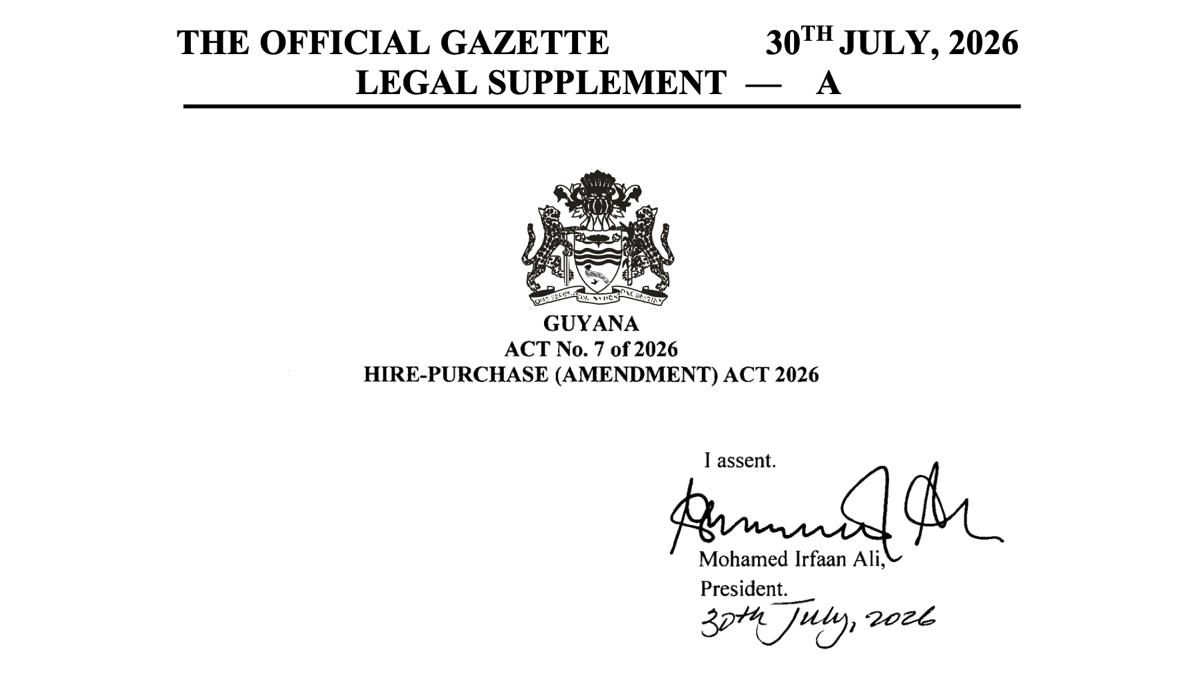
Guyana’s Hire-Purchase (Amendment) Act 2026 clarifies that claims arising under the country’s hire-purchase law may be filed in either the High Court or a magistrate’s court, regardless of the value of the claim.
The National Assembly passed the amendment on July 27, 2026. President Irfaan Ali assented to it on July 30, and the Official Gazette is dated July 30. The Gazette page was posted online on July 31.
What the amendment says
Act No. 7 of 2026 replaces section 32 of the principal Act. The new provision states that, notwithstanding any other written law—including section 24 of the Act—any claim or proceeding arising under the Act may be made or instituted in the High Court or a magistrate’s court, irrespective of value.
The principal legislation regulates hire-purchase, conditional-sale and credit-sale agreements.
What the change does—and does not—do
The amendment addresses court jurisdiction. It does not decide the merits of a dispute, guarantee a refund, create an automatic right to compensation or replace the need to establish a legal claim.
Government’s explanation of the bill said the change was intended to improve access to justice by removing uncertainty over which court may hear a matter.
Existing protections remain relevant
The broader Hire-Purchase Act 2022 includes rules governing agreements, disclosure and repossession. DPI’s account of the amendment highlighted protections requiring notice before repossession and court approval in specified circumstances.
Consumers and businesses should retain signed agreements, payment receipts, notices and correspondence. Anyone facing repossession or considering court action should obtain legal advice based on the facts of the agreement and dispute.
This article provides general information and is not legal advice.