

Photo: Department of Public Information, Guyana (conference archive; no allegation is made about those pictured).
For a shipping agent arranging services in Guyana, a vessel's certificate can look reassuring: the country's name, an official-looking seal and a registration number. Yet the commercially important question is not how convincing it looks, but whether the authority entitled to issue it actually did so.
That distinction is central to MARAD's statement published on 5 November, welcoming US sanctions against people and associated entities accused of facilitating false registration claims. The administration says the network misrepresented vessels as Guyanese through the purported International Maritime Safety Agency of Guyana, or IMSAG.
The underlying US Treasury action was announced on 4 November. Treasury designated India-based Suniel Kumar Sharma, his wife Jaspreet Preeti Shahid and associated entities, alleging a network supplied false flags and certifications to vessels transporting Iranian petroleum. Those are the US government's allegations supporting sanctions designations, not criminal convictions established by this announcement.
For legitimate businesses, the significance extends beyond the people named. The case draws attention to the reliability of documents used to establish a ship's commercial identity—and to the difference between a country's name appearing on a certificate and that country authorising its use.
The flag claim is not the same as the flag authority
An allegation that someone impersonated a Guyanese registry is materially different from an allegation that Guyana's authorised administration registered the vessel. Conflating the two would reverse the essential point of the official response: the country says its identity was being misused.
MARAD's published registration notice identifies the department as Guyana's sole ships-registration authority. It describes a closed registry, limited to qualifying ownership by Guyanese nationals, residents, CARICOM citizens and companies established under Guyanese law. It directs registration through its Georgetown headquarters and says it has not authorised outside entities to transact flag business on its behalf.
That institutional boundary gives a commercial enquiry a definite starting point. An intermediary's description of its own authority is not a substitute for confirmation from the administration it claims to represent. A familiar national name, professional presentation or apparently extensive service offering cannot independently establish that relationship.
There is also a history to the dispute. A retained MARAD notice says arrangements with Aryavart Corporation and its named subsidiaries were terminated effective 13 August 2021. Its warning concerns registrations subsequently undertaken through those channels. The historical notice should not be mistaken for a new registration policy introduced this week.
A document problem can become a commercial problem
For a business supplying provisions, arranging a service or considering a shipping contract, the apparent distance between paperwork and payment can be misleading. Before the supplier earns anything, it may commit stock, labour, transport or credit. If a basic assumption about the contracting parties or vessel proves unreliable, the business may already have incurred costs.
The commercial issue is not simply whether a document looks suspicious. It is which decision depends on it. A certificate presented to establish nationality does not, by itself, establish who owes the invoice, who has authority to order work or which organisation stands behind a promise to pay.
Those distinctions matter particularly where several parties appear in a transaction. The vessel, its registered owner, its operator and the party ordering supplies are not interchangeable descriptions. A business needs to understand the relationships relevant to its own contract rather than assume that recognising one name resolves every other question.
This is not a finding that any Guyanese supplier has suffered a loss in the present case. Neither official announcement supplies such a figure. It is the business implication of the identity problem: a document can influence a decision well before anyone discovers that its claimed authority is disputed.
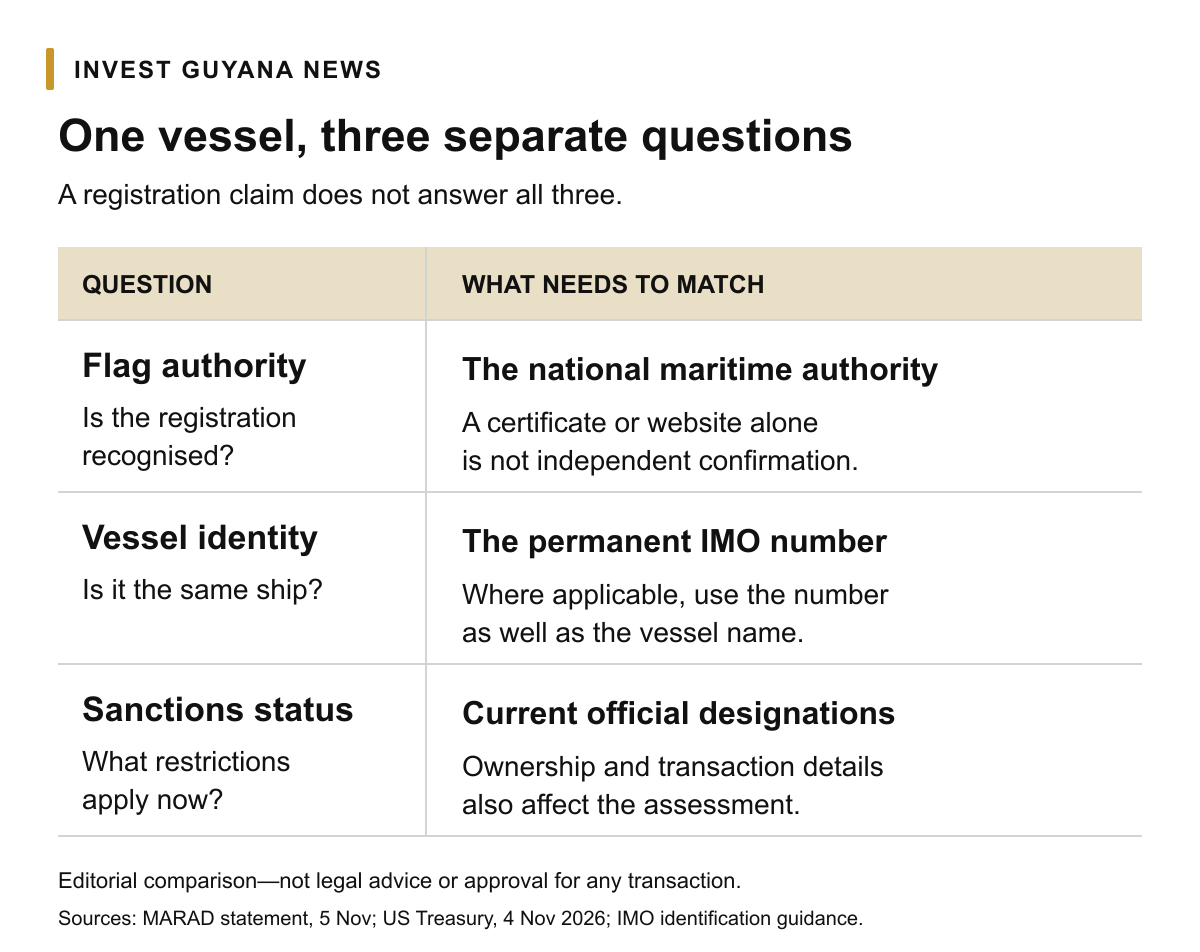
Stable identity and current authority answer different questions
The International Maritime Organization's account of fraudulent registration describes purported nationality without the relevant government's authorisation. It also identifies authentic-looking websites and manipulated vessel-identification information among the ways false representations can be sustained.
That helps explain why repeating a claim across several documents is not the same as independently confirming it. If each document ultimately depends on the same unauthorised issuer, the appearance of agreement adds little assurance. The useful question is where the information originated and what the responsible institution can actually confirm.
For ships within the relevant scheme, the IMO identification number provides a persistent reference: it remains with the ship when its flag changes and is not reassigned to another ship. That continuity is useful when names or other particulars change.
Yet a permanent identifier is not a current flag certificate, insurance confirmation or sanctions clearance. Knowing which ship is involved and knowing whether a claimed registration is authorised are complementary enquiries. Neither should be made to carry a conclusion it does not establish.
Insurance and payment require their own evidence
Consider another hypothetical situation. A business is told that a vessel is insured and therefore presents little commercial risk. Even if the assurance is sincerely given, the relevant question remains what the insurer has actually confirmed about that vessel and the proposed activity. A registration document cannot answer a different institution's question for it.
The same separation applies to payment. A purchase order may identify the party ordering goods while a proposed remittance comes from another entity. The sensible commercial concern is not to pronounce the transaction unlawful from that difference alone, but to understand and document why it exists before relying on the payment arrangement.
Sanctions add a further, time-sensitive consideration. Treasury's release describes blocking measures and transaction restrictions connected with the designated parties; it does not sanction Guyana or its authorised registry. The consequences for a particular business depend on the parties, ownership, payment route, applicable rules and any relevant authorisation. The announcement is not a universal legal opinion on every transaction involving a Guyana-flagged vessel.
For an enterprise, the practical lesson is to avoid collapsing several decisions into one reassuring document. Authority to register, the ship's enduring identity, insurance evidence, contractual responsibility and current sanctions status concern different sources and different risks. A satisfactory answer to one does not automatically resolve the rest.
Confidence depends on keeping the distinction clear
An agent needs information whose authority can be traced and whose purpose is understood, not a more elaborate-looking certificate. That discipline can protect a trading decision without treating every unfamiliar ship or intermediary as suspect.
For Guyana, the distinction is equally important. Reporting a false claim to the national flag as though it were an authorised act by the national administration would obscure the problem legitimate institutions are trying to address.
The fresh development is Guyana's public support for the US action. Its wider commercial significance is a reminder that trusted maritime trade depends not only on moving cargo, but on knowing who is entitled to certify, contract and receive payment along the way.