Omai Gold Mines Corp. is mobilising a sixth diamond drill to its Omai Project in Guyana for an initial 5,000-metre exploration programme, starting with eight holes at the BBH target west of the Gilt deposit.
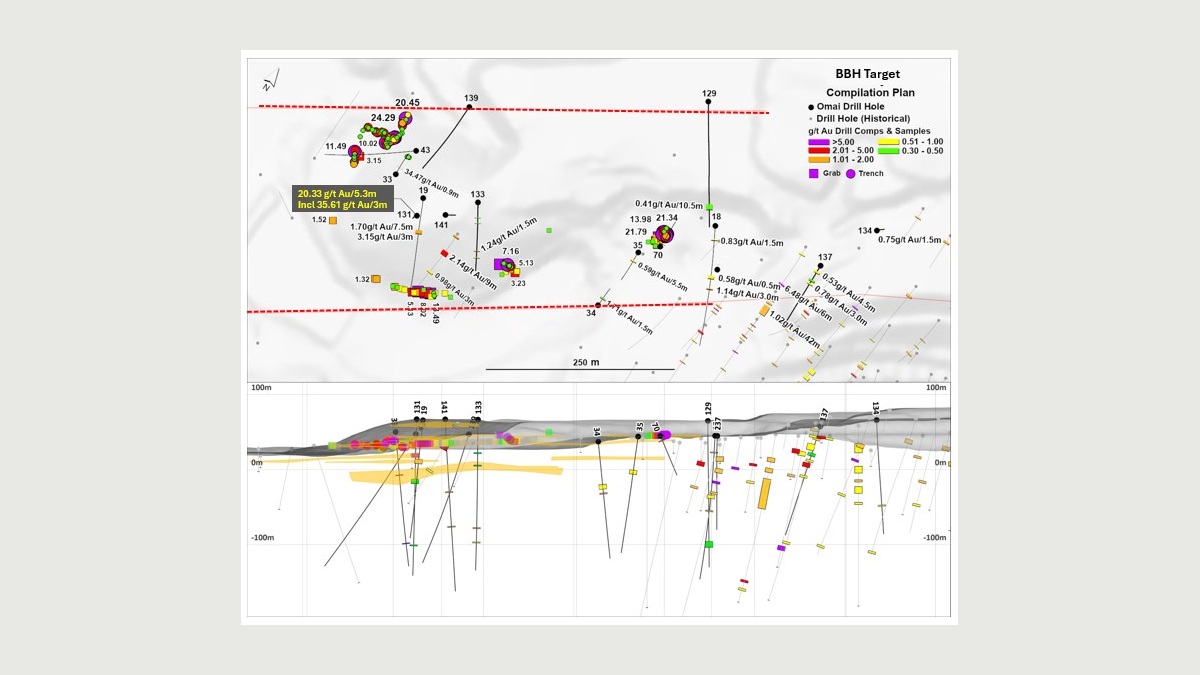
Map: Omai Gold Mines Corp.
The additional rig expands exploration capacity while five other drills continue infill and expansion work at the Wenot deposit. It is a material project-advancement step, but it remains exploration: the programme does not establish a new mineral resource, reserve, mine-development decision, permit or financing package.
A sixth rig focused on targets beyond Wenot
Omai Gold’s official October 8 release says the new rig will pursue targets identified through geophysics, trenching and earlier drilling. The company has concentrated much of its recent work on Wenot; the sixth rig gives it a separate platform to test areas around the existing Wenot and Gilt deposits without interrupting that programme.
The release was also distributed through Newsfile’s TMX-hosted corporate news service, which provides a matching public record of the programme, technical disclosures and cautionary statements.
The first target, BBH, extends for roughly 600 metres. The planned eight-hole programme will test a zone where surface trenching, shallow drilling and historical work have identified several occurrences of gold mineralisation.
Why BBH is being tested again
Omai reports that six of seven widely spaced holes drilled across the BBH trend in late 2025 intersected gold mineralisation. The highlighted intercept was 20.33 grams per tonne of gold over 5.3 metres, including 35.61 grams per tonne over 3.0 metres, at an estimated vertical depth of about 50 metres.
Those results are historical context for the new programme, not a resource estimate. The current work is intended to determine whether the mineralised occurrences connect into a deposit that can be modelled and assessed. Drill spacing, continuity, metallurgy and the volume of mineralised rock will matter more than any single high-grade intercept.
The company says other exploration targets are also being planned across the property. That creates a broader pipeline of possible follow-up work, although the October release does not provide a target-by-target schedule or budget beyond the initial 5,000 metres.
Project context after the 2026 PEA
Omai’s August preliminary economic assessment covers the Wenot open-pit and Gilt underground deposits. The company’s technical-report register links the October 2 NI 43-101 report prepared by SLR Consulting (Canada) Ltd.
The PEA outlines a conceptual 18-year mine plan producing 6.3 million ounces of gold, with average annual output of 351,000 ounces. At the company’s US$3,600-per-ounce base case, it reports a US$4.0 billion after-tax net present value discounted at five per cent. Those figures are planning estimates, not operating results.
Importantly, the PEA is preliminary and includes inferred mineral resources that are too speculative geologically to be treated as mineral reserves. Mineral resources do not have demonstrated economic viability. The project would still require additional studies, financing, permits, detailed engineering and development decisions before construction or production.
What the new drilling changes for investors
The sixth rig separates early-stage exploration from the five-rig programme at Wenot. That can accelerate the testing of satellite targets while the company continues work intended to improve confidence in, and potentially expand, the deposits already used in the PEA.
A successful BBH programme could add a near-surface target close to planned infrastructure and existing deposits. Proximity alone does not guarantee economic value, however. The commercial significance will depend on continuity, grade, geometry, metallurgical response and whether later resource modelling supports integration into a future mine plan.
The Omai site also retains infrastructure from historical mining, including road connections and an airstrip. Existing infrastructure may reduce some logistical barriers, but it does not remove the capital, permitting, environmental, social and execution risks associated with redeveloping a large gold project.
What to watch next
The next material evidence will be assay results from the eight BBH holes, the completed metres and timing of the programme, and whether management advances other targets into drilling. Investors should also watch for updated resource models and any pre-feasibility work that tests the PEA assumptions at a higher level of engineering confidence.
For now, the verified development is operational and specific: Omai Gold is adding a sixth drill and committing an initial 5,000 metres to exploration targets outside its main Wenot programme. The expansion increases the pace at which the company can test the wider Guyana property, while the economic outcome remains contingent on successful drilling and the later stages of project evaluation.