

Drone photograph from Invest Guyana’s media archive; contextual image, not the hypothetical project described.
Imagine a Guyanese company agreeing to buy equipment for US$10,000. The supplier’s invoice appears reassuringly clear, and the project manager enters the purchase into the investment budget. Several weeks later, the finance team discovers that the Guyana-dollar amount needed to make the payment differs from the original estimate.
The supplier has not changed its price. The company has encountered a second price: the amount of one currency required to obtain another. It may also face transaction charges and practical questions about when the payment can be completed.
Understanding exchange rates helps separate these issues. It does not require predicting currency markets, and it does not make every published rate an offer available to a particular customer. The first task is to understand exactly what is being quoted and which side of the exchange the business occupies.
Two currencies describe one purchase
An exchange rate expresses the value of one currency in terms of another. When a Guyana-dollar business buys a US-dollar invoice amount, the conversion determines how many Guyana dollars are needed before any separately charged fees are considered.
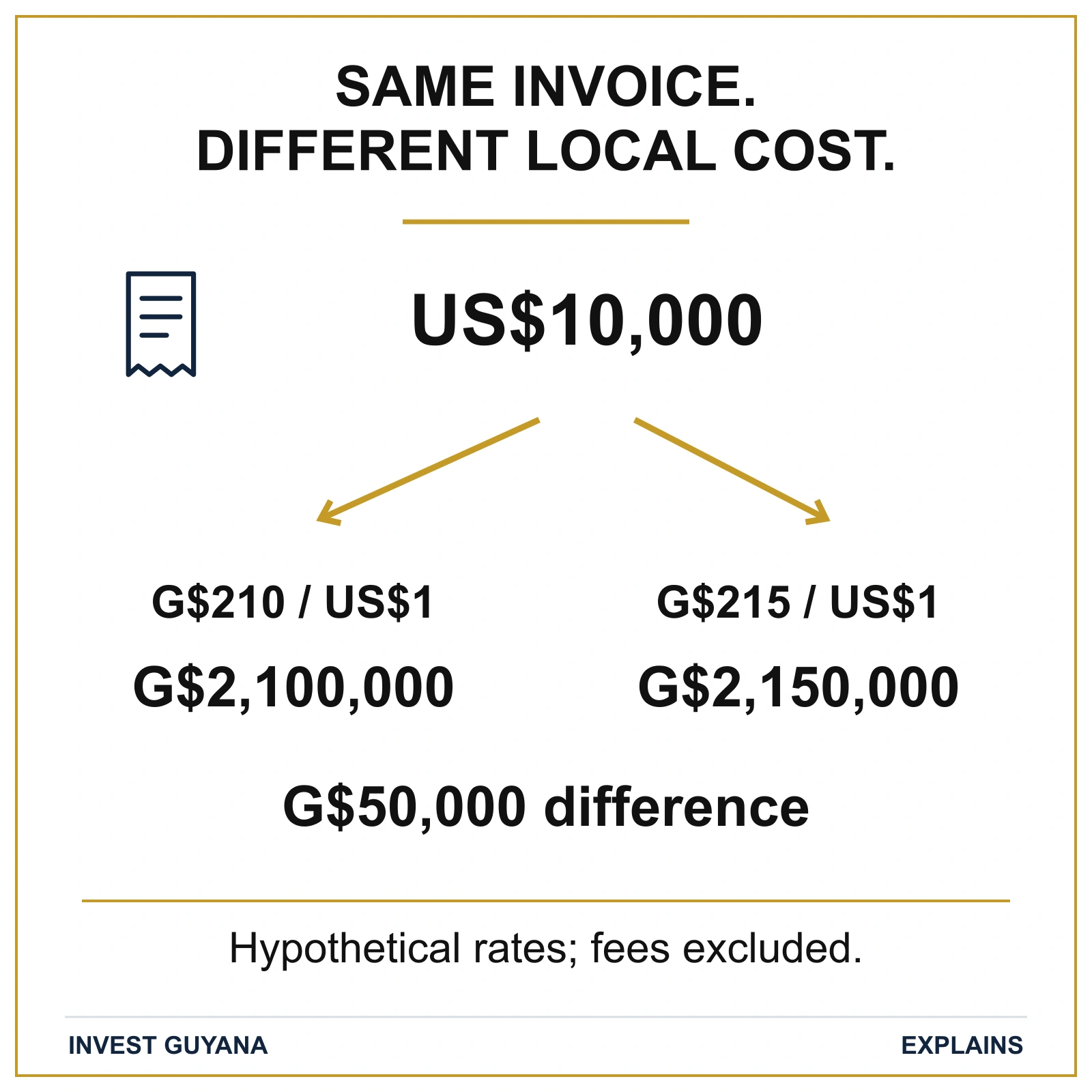
In a purely illustrative example, US$10,000 at G$210 per US dollar would require G$2.1 million. At G$215 it would require G$2.15 million. The G$50,000 difference comes from the assumed conversion rate, not from a change in the US-dollar invoice. These numbers are teaching examples, not current market quotations.
The direction of the quotation is essential. “Dollars” alone is insufficient when both currencies use that word. A clear discussion identifies the invoice currency, the currency being paid and the amount of the latter required for each unit of the former.
For our equipment buyer, this makes the budget easier to explain. The supplier’s price can remain fixed in US dollars while the company’s Guyana-dollar cost remains exposed until the relevant conversion or other agreed arrangement fixes it.
Buying and selling depend on the dealer’s position
Foreign-exchange tables often show buying and selling rates. These ordinarily describe the dealer’s side of the transaction: a dealer buys foreign currency from one customer and sells it to another. A business purchasing foreign currency therefore needs to understand the applicable selling quotation rather than selecting the more attractive number without context.
The Bank of Guyana publishes separate buying and selling information. Its market reports also distinguish transaction categories, illustrating why a rate needs a label before it can be interpreted. A market average and an individual customer quotation are not the same type of information. Bank of Guyana exchange-rate information; foreign-exchange market report.
The gap between buying and selling quotations is commonly called a spread. It is different from a separately charged transfer or service fee, although both can affect the total amount the business pays. Looking at one number while ignoring the rest of the quotation can make two offers appear more similar than they are.
Suppose our company compares an estimate prepared from a published average with an executable quotation for a particular payment. Any difference needs to be understood in context, including the transaction, currency direction and time. It should not automatically be described as an unexplained increase in the supplier’s price.
Time creates exposure
The date a purchase is agreed and the date it is paid may be weeks or months apart. If the obligation is denominated in a foreign currency, the local-currency equivalent can change between those dates. This is one form of foreign-exchange exposure. International Trade Administration explanation of foreign-exchange risk.
Consider a contractor quoting a customer in Guyana dollars while buying equipment in US dollars. If the customer price is fixed before the foreign-currency cost is settled, an unfavourable conversion movement can reduce the contractor’s margin. A favourable movement can have the opposite effect, but neither outcome should be assumed when the quotation is prepared.
The exposure is different if both the receipt and the payment are genuinely in the same currency. Even then, their timing and amounts matter. An expected receipt next month does not necessarily fund a supplier payment due today, and a customer who pays late can reopen a financing problem.
This is why currency discussions belong alongside the commercial terms of a transaction. The identity of the currency, the payment date and the allocation of any conversion responsibility can influence the economics of an otherwise straightforward purchase.
A stable rate does not answer every practical question
Readers may assume that a relatively stable exchange-rate environment removes currency concerns altogether. Stability can reduce one kind of uncertainty, but it does not by itself establish the availability of a requested amount at a particular time or the total cost of a particular service.
The IMF’s July 2026 assessment of Guyana discussed a stabilised exchange arrangement while also describing strong demand for foreign exchange associated with import-heavy private investment. These are compatible observations about different aspects of the market. They should not be turned into a guarantee about any future customer transaction. IMF’s July 2026 Guyana staff assessment.
For the equipment buyer, the practical distinction is between knowing an estimated conversion price and being ready to meet the supplier’s payment terms. The purchase timetable may depend on several arrangements beyond the invoice itself. This article explains the currency relationship, while a payment Guide would address the actual transaction process.
Institutional context matters as well. The Bank of Guyana oversees licensed foreign-currency dealers and money-transfer services under their respective frameworks. That identifies the regulatory setting without making this article a recommendation of a provider or an assurance that a specific transaction will be approved. Bank of Guyana regulatory overview.
Matching receipts and payments
A company that earns and spends the same foreign currency may be able to reduce the amount it needs to convert. This is often described as naturally matching currency flows. The idea concerns the net exposure left after considering relevant receipts and payments, rather than treating every invoice in isolation.
Suppose a hypothetical exporter expects US-dollar receipts and also buys US-dollar packaging materials. Some of the receipts may cover those purchases without a separate round of conversion. However, differences in timing, amounts or customer payment performance can leave part of the exposure unresolved.
The International Trade Administration’s trade-finance material distinguishes this commercial matching from financial instruments used to manage currency risk. Availability, costs and suitability of any such instruments require separate examination; an international explanation does not establish that every product is available to every business in Guyana. Trade Finance Guide, foreign-exchange chapter.
The broader lesson is that currency risk is shaped by how a business trades. A local retailer importing all its stock, an exporter earning foreign currency and a service firm billing locally may have very different exposures even when they use the same bank.
Reading the complete cost
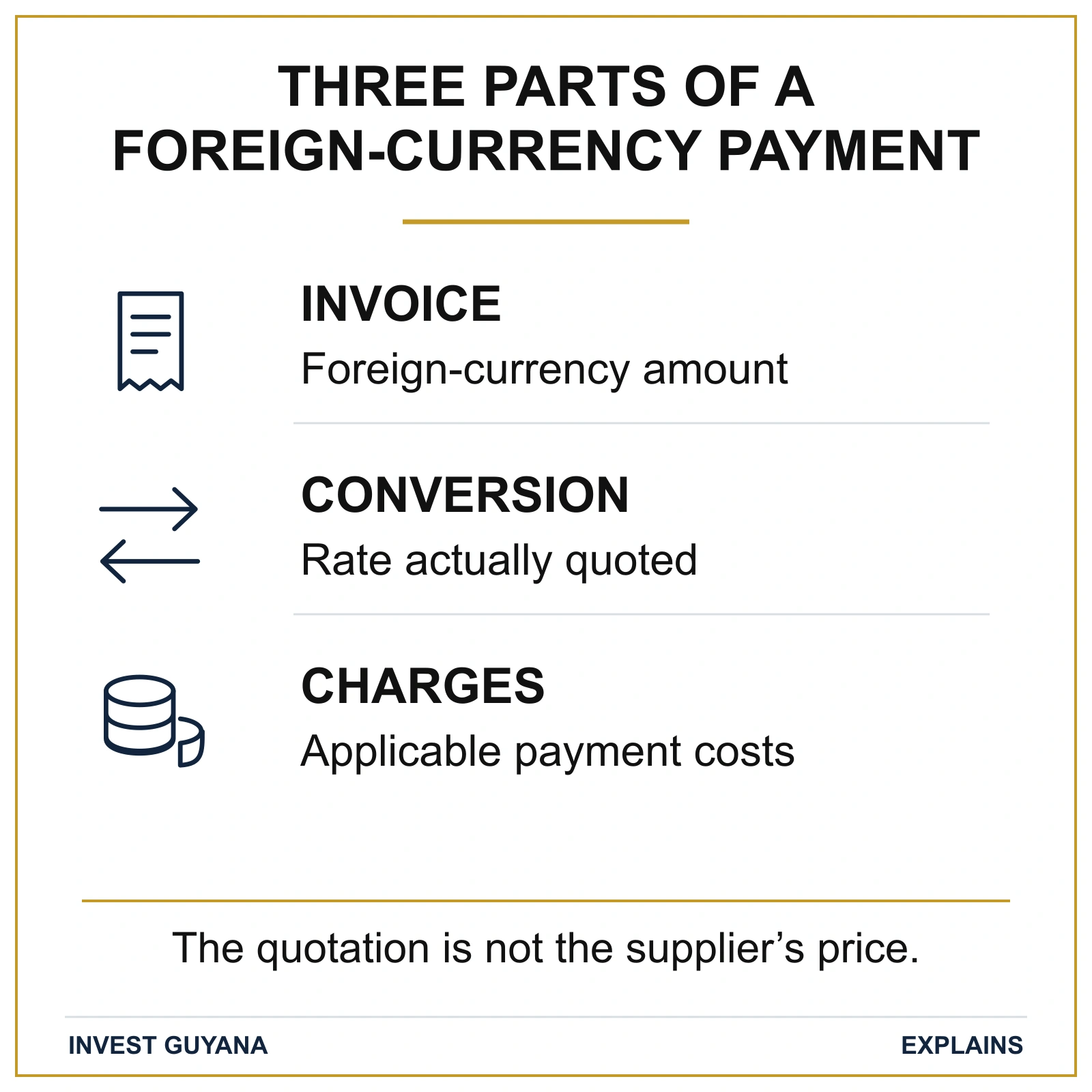
The equipment company’s revised budget now separates the supplier’s US-dollar price, the conversion assumption and any identified payment charges. It also recognises that a budget assumption is not the same as a binding quotation. This makes changes easier to explain and prevents unrelated costs from being hidden inside a single unexplained exchange-rate figure.
A useful cost discussion can distinguish price risk from timing risk without predicting either. What happens if the conversion is less favourable? What happens if the payment occurs later than expected? These are different commercial questions, and a business can understand them before choosing any particular response.
The company should also distinguish cash needed for the payment from the purchase’s accounting treatment. Paying for equipment may create an asset used over several years, but the cash can leave the business much earlier. Currency conversion is only one part of that wider timing problem.
Cross-border payments can raise questions beyond currency conversion, including the tax treatment of the underlying payment. The Guide on withholding tax on non-resident payments addresses that separate subject. A correct exchange calculation does not establish whether a deduction applies, just as understanding a tax obligation does not fix the conversion quotation. Keeping the questions separate makes the complete payment easier to understand without combining unrelated charges under one label.
Returning to the invoice
The project manager can now explain why an unchanged US$10,000 invoice did not guarantee an unchanged Guyana-dollar budget. The invoice specifies one obligation; the conversion quotation, relevant charges and payment arrangements determine how the company meets it in another currency.
Understanding that relationship is more useful than treating the published rate as a universal answer. It encourages clear language about currencies, dates and costs while leaving provider selection and transaction-specific arrangements to the appropriate practical review.
The next explainer follows the money into the business itself. A company can understand its currency costs, report a profit and still struggle to pay an invoice when it falls due. Cash flow explains why the timing of money matters as much as the amount earned.