

The celebration didn’t last long. After months of preparation, a renewable energy company finally received the news it had been waiting for. Parliament had passed legislation that would support investment in the sector. Around the boardroom table there were smiles, handshakes and a growing sense that construction could finally begin.
The next morning, the company’s project manager contacted the relevant government agency to ask when applications would open.
The reply was unexpected.
“The regulations haven’t been issued yet.”
The room fell silent.
“Parliament passed the law,” one director said. “Isn’t that enough?”
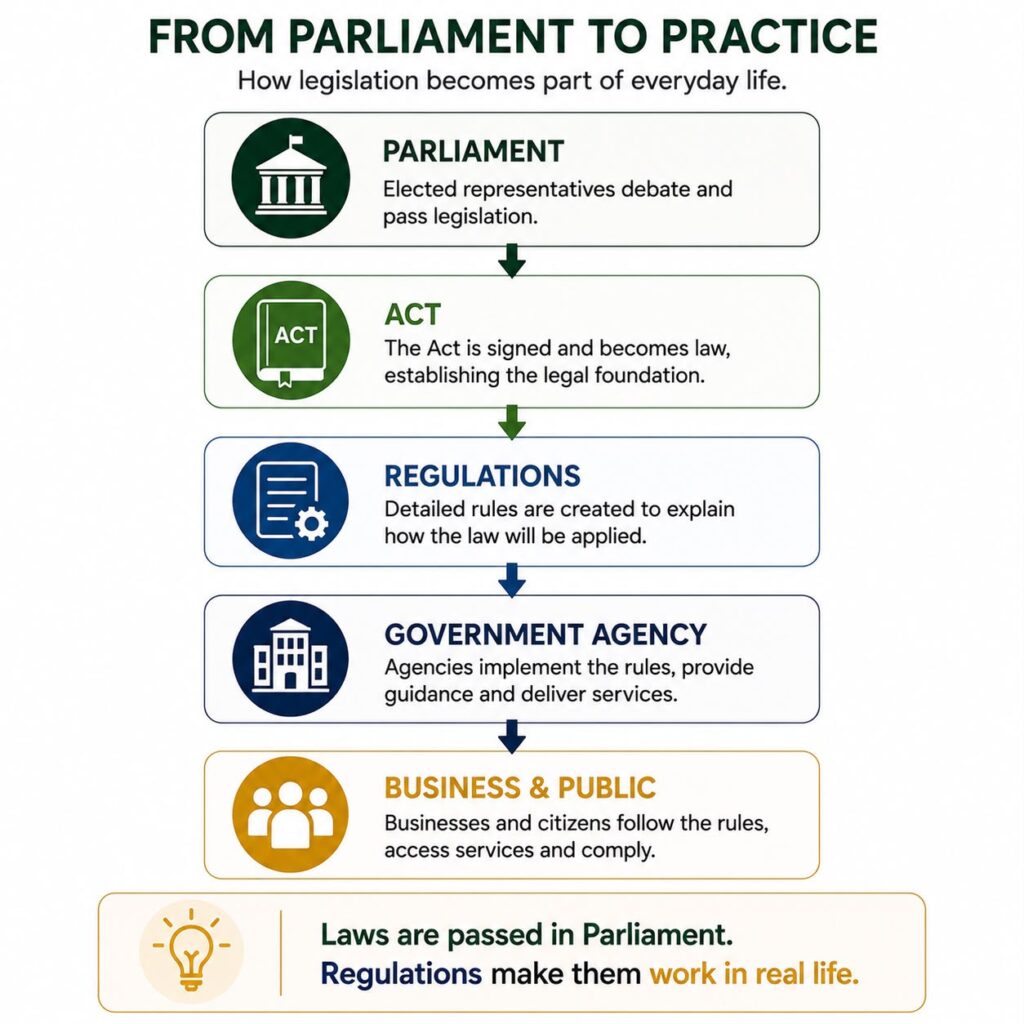
For many businesses, this is the moment they discover that passing a law is often only the beginning. While an Act establishes the legal framework, it is frequently the Regulations that explain how that law will work in practice. Understanding the difference helps businesses, investors and citizens navigate government with greater confidence and avoid expecting legal changes to take effect before the practical rules are in place.
An Act Creates the Framework
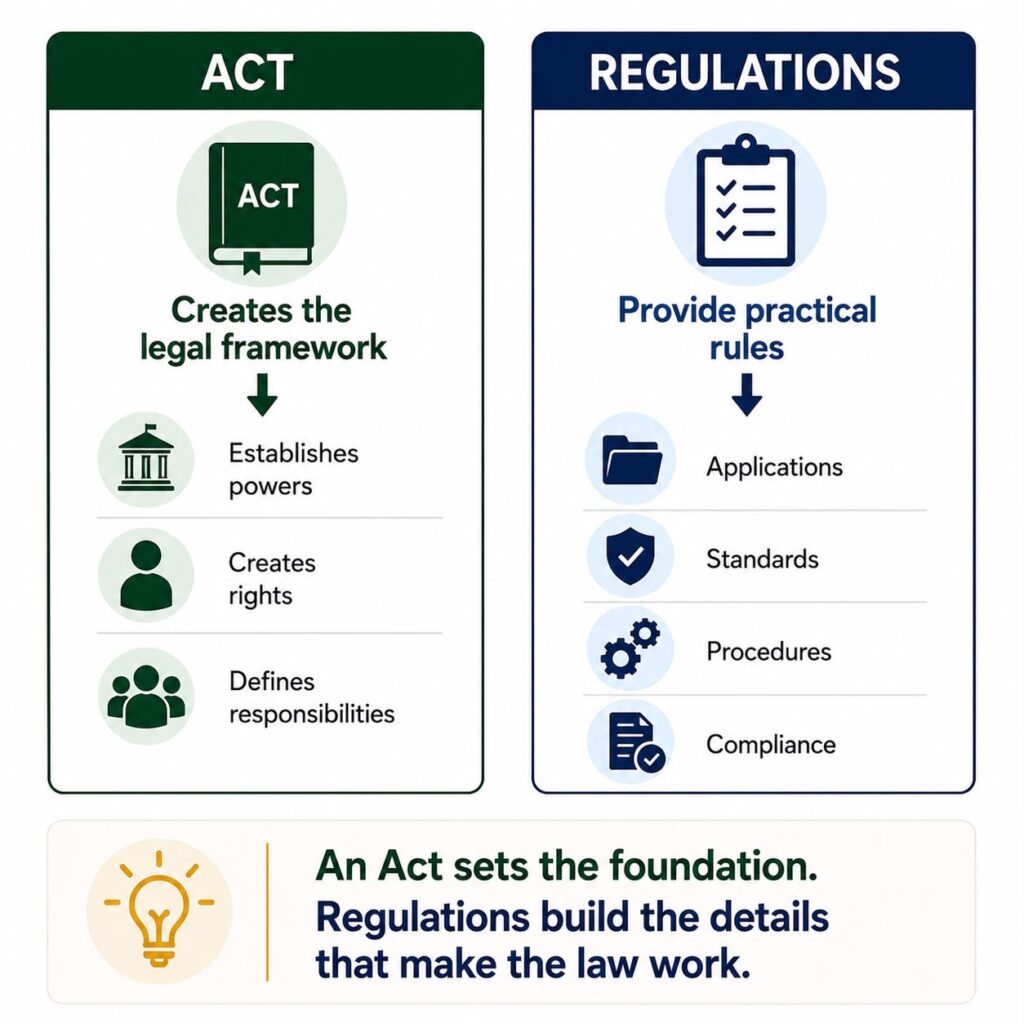
When Parliament passes legislation, the result is an Act. An Act establishes the legal foundation for a particular subject. It creates powers, responsibilities and rights while setting out the broad framework within which government, businesses and citizens must operate.
Think of it as the blueprint for a building.An architect’s blueprint shows what is going to be built. It defines the overall design, the purpose of each space and how the structure fits together.
What it does not do is explain every construction method, every inspection procedure or every technical requirement needed during the project. The same idea applies to legislation.
An Act establishes what the law intends to achieve. It provides the legal authority for action, but it often leaves many of the practical details to be developed separately. This approach allows Parliament to focus on the broader legal framework without filling every Act with highly technical operating instructions that may need to evolve over time.
Regulations Bring the Law to Life
If an Act provides the blueprint, Regulations provide the operating instructions. They explain how the law will work in practice.
Depending on the legislation, Regulations may establish application procedures, technical standards, reporting requirements, licensing processes or compliance obligations. They help transform broad legal principles into practical rules that businesses, government agencies and the public can follow consistently.
This is why many businesses encounter Regulations more often than they read Acts. When applying for a licence, completing an official form or meeting a technical standard, the requirements are often found in Regulations developed under the authority of an Act.
That does not mean every Act requires Regulations. Some laws operate effectively on their own. Many others, however, depend on detailed Regulations before they can be fully implemented.
Returning to our renewable energy company, Parliament had already established the legal foundation. What the business was waiting for were the practical rules explaining exactly how the new system would operate.
Why One Cannot Work Without the Other

Imagine trying to build a modern office tower using only the architect’s concept drawing. You would know what the finished building should look like, but you would still need engineering specifications, construction methods, safety requirements and inspection procedures before anyone could begin work.
The reverse would be equally difficult. A detailed construction manual would have little value without an approved blueprint showing what was actually being built.
Acts and Regulations work together in much the same way. The Act establishes the legal framework. The Regulations provide the practical detail needed to apply that framework consistently. One creates the legal authority. The other explains how that authority operates in everyday situations.
Understanding this relationship also explains why implementation sometimes takes time. Passing legislation may be a significant milestone, but preparing detailed operational rules often requires careful planning to ensure that businesses, government agencies and the public can apply the law effectively.
Where Businesses Meet Regulations
Most businesses do not experience legislation by reading Acts of Parliament. They experience it when completing applications, renewing licences, complying with technical standards or responding to inspection requirements.
These day-to-day interactions are often shaped by Regulations. A company applying for an operating licence may need to follow prescribed application procedures. A manufacturer may have to satisfy technical standards before bringing products to market. A developer may be required to submit specific information before approvals can be granted. These practical requirements are what businesses encounter most frequently. That is why understanding Regulations is so important.
When Parliament passes a new law, business owners often ask whether anything has changed immediately. The answer depends not only on the Act itself but also on whether the operational framework needed to implement it is already in place. For investors, recognising this distinction leads to better planning.
Instead of assuming that every legislative announcement creates immediate operational change, they understand that implementation may continue through the development and application of Regulations.
One System Working Together
Let’s return to the renewable energy company. At the beginning of the story, the directors believed Parliament’s approval meant they could begin operating immediately.
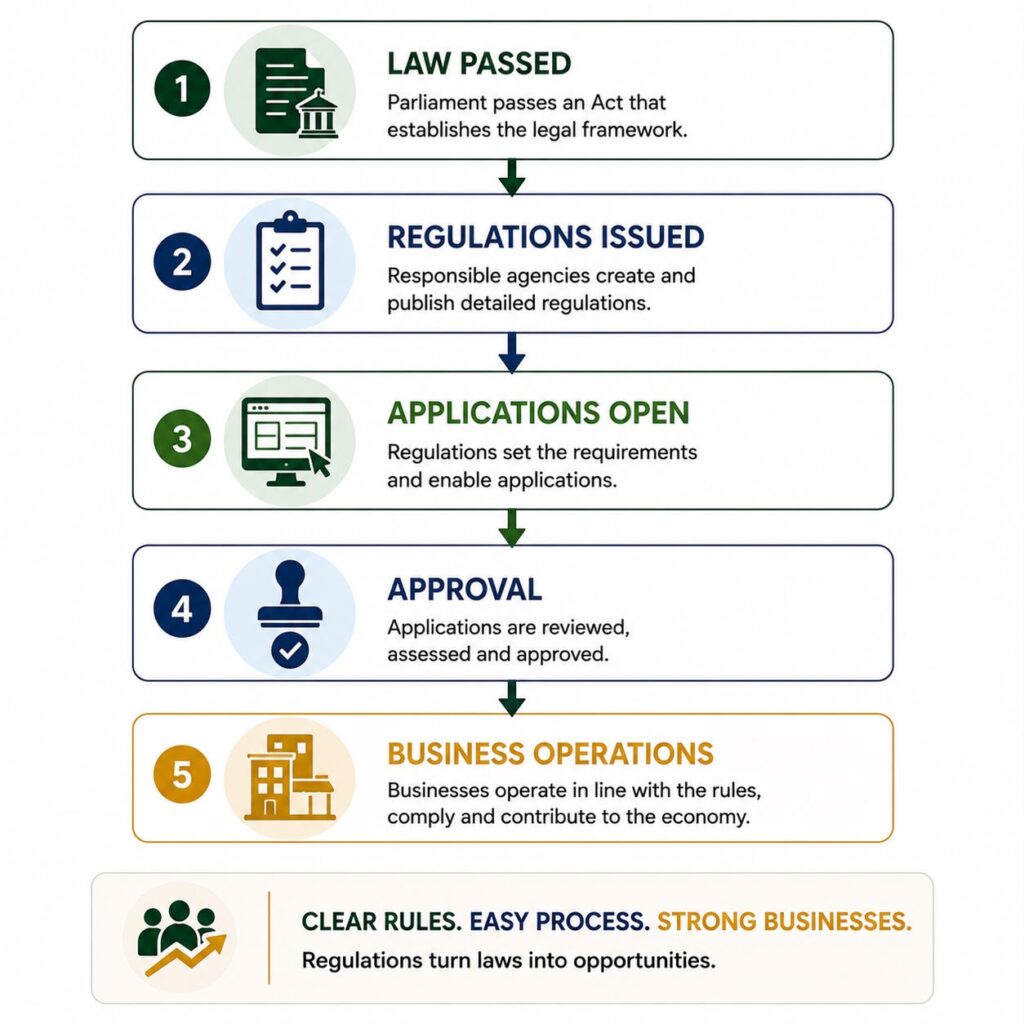
Now they understand the bigger picture. Parliament created the legal foundation by passing an Act. The Regulations would provide the detailed operating rules. Government agencies would then administer those rules by processing applications, issuing approvals and overseeing compliance.
Each stage depends on the one before it. Without an Act, there is no legal framework. Without Regulations, many Acts cannot be implemented consistently.
Without government agencies, there is often no practical mechanism for administering those rules. Seen together, they form one coordinated system rather than a collection of unrelated institutions. Understanding that system changes the way businesses interpret government announcements.
A new Act is an important milestone, but it is not always the final step. Businesses that understand the relationship between Acts and Regulations are better equipped to recognise when legal authority has been established, when operational rules are still being developed and when implementation is ready to begin.
The next time our renewable energy company hears that Parliament has passed a new law, the directors will ask a different question.
Not simply, “Has the law passed?”
But also,
“What Regulations will bring that law into operation?”
That small change in perspective leads to a much clearer understanding of how government works in practice.
In the next article in the Invest Guyana Explains series, we’ll take another practical step by exploring who regulates what in Guyana, helping readers understand which government agencies oversee different sectors of the economy and why knowing the right regulator can save both time and effort.