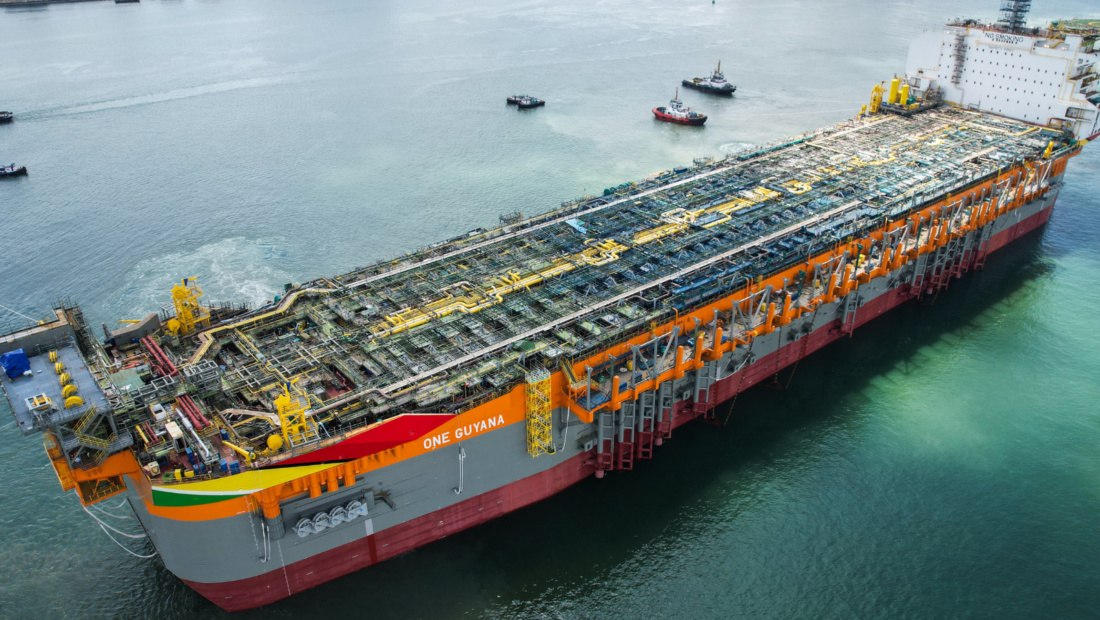
The ONE GUYANA FPSO operating offshore Guyana. Photo: SBM Offshore.
Two percentages have recently appeared in discussions about Guyana’s earnings from the Stabroek Block: 50 per cent and 39.8 per cent.
They measure different things.
Under the 2016 Stabroek Block Petroleum Agreement, Guyana is entitled to 50 per cent of profit oil. The more recent 39.8 per cent figure refers to Guyana’s approximate share of total production under the cost-recovery position described by the government in August 2026.
The 39.8 per cent figure therefore does not replace the contractual 50 per cent share. It is the result produced when the remaining oil is divided after recoverable costs have first been allocated.
How cost oil and profit oil work
The Stabroek agreement separates production into two principal categories.
Cost oil is the portion used to recover eligible expenses incurred by the contractor in petroleum operations. These may include approved exploration, development and operating costs.
Profit oil is the balance remaining after recoverable costs have been satisfied. Article 11.4 of the agreement divides that balance equally: 50 per cent to the Government of Guyana and 50 per cent to the contractor.
Article 11.2 limits the amount that may be allocated to cost recovery in any month to 75 per cent of production from the contract area, excluding petroleum used in operations or lost. The 75 per cent figure is a ceiling, not an automatic entitlement to take that proportion every month. The actual allocation depends on the recoverable costs available for that period.
The 2016 Stabroek Block Petroleum Agreement also provides for unrecovered eligible costs to be carried forward to later months, subject to the same monthly ceiling.
Why Guyana is currently receiving about 39.8% of production
The Ministry of Natural Resources said on August 24 that roughly 20 barrels out of every 100 are currently being allocated to cost recovery. This leaves approximately 80 barrels as profit oil.
Because profit oil is divided equally, Guyana’s half is approximately 40 barrels. The government has reported the more precise current figure as about 39.8 barrels out of every 100 produced.
This is why both statements can be correct:
- Guyana receives 50 per cent of profit oil.
- Under the cost allocation described by the government, that share currently represents approximately 39.8 per cent of total production.
The Ministry’s clarification specifically states that Guyana’s contractual profit-oil share has remained 50 per cent since 2016.
The 75% ceiling does not fix Guyana’s share at 12.5%
A simplified 100-barrel example helps show how the allocation changes.
If the full 75-barrel cost-recovery ceiling were required in a particular period, 25 barrels would remain as profit oil. Guyana’s 50 per cent share of that balance would be 12.5 barrels.
If only about 20 barrels are required for cost recovery, approximately 80 remain as profit oil. Guyana’s half would then be about 40 barrels.
The agreement’s 50–50 division of profit oil does not change between those examples. What changes is the amount of production remaining after eligible costs are recovered.
The Ministry has also cautioned that the cost bank has not disappeared entirely. Operating expenses and other recoverable costs continue, while additional approved developments may introduce new costs. Guyana’s percentage of total production can therefore move as the cost-recovery position changes.
The 2% royalty is separate
Guyana also receives a royalty under Article 15.6 of the agreement.
The provision requires the contractor to pay a royalty of 2 per cent of petroleum produced and sold, after excluding specified quantities used for fuel or transportation in petroleum operations. The payment may be made in cash or in kind, depending on the government’s election.
Royalty and profit oil are separate revenue streams with different contractual bases. The 2 per cent royalty should not be described as part of the 50 per cent profit-oil division, and the percentages should not be combined without explaining those differences.
What the 39.8% figure does—and does not—show
The figure indicates that a smaller proportion of current production is being used for cost recovery than during periods when the 75 per cent ceiling was fully utilised. That leaves a larger volume available for division as profit oil.
It does not mean that Guyana owns 39.8 per cent of the Stabroek Block, that the petroleum agreement has been amended, or that the government’s profit-oil share has been reduced from 50 per cent.
It should also not be treated as a permanent production percentage. The agreement calculates cost oil and profit oil monthly, while production, prices, operating expenditure, development spending and the treatment of recoverable costs can change.
What investors and the public should watch
The most useful indicators are the volume and value of cost oil and profit oil, the level of unrecovered eligible expenditure, new development spending, audit decisions and the petroleum receipts deposited into the Natural Resource Fund.
Disallowed costs cannot remain in the recoverable cost pool. Reducing approved recoverable costs leaves more production available as profit oil, which is then divided equally.
The Ministry said it intends to continue publishing production, cargo and royalty information monthly. Those disclosures, together with Natural Resource Fund reporting, should provide the clearest view of how the contractual formula is translating into revenue for Guyana.
The central distinction remains straightforward: 50 per cent is Guyana’s contractual share of profit oil; approximately 39.8 per cent is the current reported result when that formula is expressed as a share of total production.