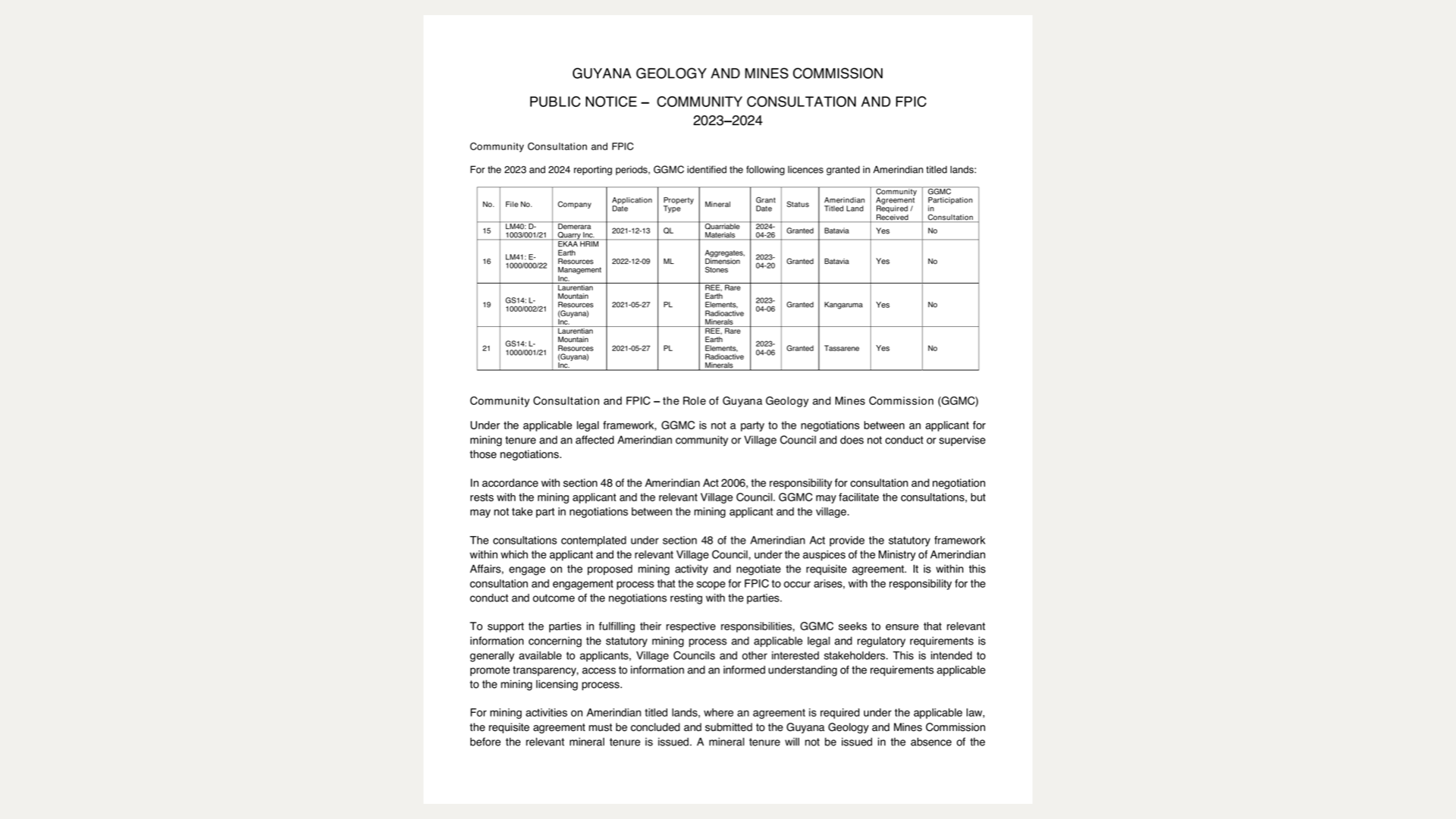
GGMC’s 2 November 2026 disclosure lists four mineral tenures granted on Amerindian titled lands during 2023 and 2024. Image: Guyana Geology and Mines Commission.
An exploration company can study geology, model a deposit and assemble finance, yet still be unable to advance a project if it has misunderstood the land beneath the mineral opportunity.
That risk becomes especially important where a proposed activity overlaps Amerindian titled lands. The commercial question is not simply whether an area appears on a mineral map. It is whether the applicant has followed the community-consultation, consent and agreement process required before the relevant mineral tenure can be issued—and which other approvals would still remain after that point.
The Guyana Geology and Mines Commission has now published a disclosure intended to clarify part of that process. The 2 November statement identifies four quarry, mining or prospecting licences granted on Amerindian titled lands during the 2023 and 2024 reporting periods. GGMC says a community agreement was required and received in each case, while also recording that the Commission did not participate in the consultations.
The disclosure is relevant to investors because it separates two responsibilities that are often blurred together. The applicant and the Village Council conduct the consultation and negotiation. GGMC administers the mineral-tenure process and verifies that the required agreement has been submitted before issuing the tenure.
It is also important to understand what the disclosure does not say. These are not new November 2026 licence awards, and the statement does not establish that any of the four properties is currently operating, producing minerals or holding every environmental and operating approval that may be required.
Four historical tenures, not four new projects
GGMC’s table covers two properties at Batavia and one each at Kangaruma and Tassarene:
- Demerara Quarry Inc. received a quarry licence for quarriable materials at Batavia on 26 April 2024. Its application was dated 13 December 2021.
- EKAA HRIM Earth Resources Management Inc. received a mining licence for aggregates and dimension stone at Batavia on 20 April 2023. Its application was dated 9 December 2022.
- Laurentian Mountain Resources (Guyana) Inc. received a prospecting license covering rare-earth elements and radioactive minerals at Kangaruma on 6 April 2023.
- The same company received a second prospecting licence covering the same stated mineral categories at Tassarene on 6 April 2023. Both Laurentian applications were dated 27 May 2021.
The property types matter. A prospecting licence supports exploration within its legal scope; it should not be reported as evidence that a commercial mine has been approved or that production has begun. A mining licence and quarry licence are also subject to their own terms, conditions and associated requirements.
GGMC labels all four entries “Granted” and says the required community agreement was received. The latest disclosure does not publish the agreements, consultation records, current tenure-expiry or renewal information, environmental decisions, work programmes, production data or project economics.
Those omissions limit the conclusion that can safely be drawn. The verified development is regulatory transparency about four historical grants and GGMC’s stated role in the process—not a new finding about the commercial status or social acceptance of the underlying projects.
What section 48 requires from a miner
GGMC anchors its explanation in section 48 of the Amerindian Act 2006. The section applies to a miner seeking to carry out mining activities on Village lands or in a river, creek, stream or other water source within the boundaries of Village lands.
The legislation requires the miner to obtain necessary permissions and comply with applicable laws. It must make reasonably requested information available to the Village and provide the Village Council with a written summary identifying the people involved, the proposed activity, the site, expected duration and likely effect on the Village and its lands.
The miner must attend consultations requested by the Village Council or Village, negotiate in good faith, address the tribute required by law and obtain the consent of at least two-thirds of the people present and entitled to vote at a Village general meeting.
Section 48 also draws a boundary around GGMC’s role: the Commission may facilitate consultation but may not participate in the negotiation. GGMC’s November statement similarly says it does not conduct or supervise negotiations between an applicant and an affected Village Council.
After consent is given, section 49 says the Village Council, acting for the Village, enters into a written agreement with the miner. The Act includes implied terms concerning employment, local purchasing, environmental protection and compliance with Village rules. If the Village requires it, the agreement can also address reporting, waste disposal, compensation, dispute resolution, health and educational support.
For an investor, those provisions are not peripheral community-relations language. They can create continuing obligations affecting employment, procurement, operating conduct, environmental management, reporting and dispute handling. The actual agreement therefore belongs in project due diligence alongside the mineral instrument and technical data.
The Act also contains a distinct route in section 50 for proposed large-scale mining where a Village has refused consent. That provision requires specified public-interest declarations, tribute arrangements, a written undertaking and a further negotiation period. GGMC’s November disclosure does not say that this exceptional route was used for any of the four listed tenures. Investors should therefore verify which statutory pathway applies instead of treating one description as universal.
What GGMC means—and does not prove—when it refers to FPIC
GGMC describes the four submitted documents as “FPIC-related” agreements. It says the statutory consultation process creates the scope within which free, prior and informed consent can occur, with responsibility for the negotiations and their outcome resting with the applicant and Village Council.
That wording requires careful attribution. The Commission is reporting that the agreement required for its licensing process was submitted. The November page does not publish the agreement, voting record, consultation material or a statement from the affected Village Councils independently confirming the process or its outcome.
An investor should therefore avoid treating the term FPIC as a simple certificate that removes all community or project risk. The practical review should examine whether the correct parties participated, whether the Village general meeting authorised consent, what information was provided, what obligations were agreed, whether the agreement remains effective and how disputes or project changes are handled.
Project changes can be especially important. A consultation based on one activity, location, scale or operating method may not answer every question created by a materially different development plan. The current GGMC statement does not explain whether any of the four projects has changed since its original application.
The Gazette creates another review stage
GGMC says submission of the required community agreement does not end public participation. Its licensing process publishes an intention to grant in the Official Gazette and provides a further 21-day period for concerns or objections.
The Commission’s prospecting-licence application guidance describes the same 21-day objection stage before a large-scale prospecting licence proceeds for ministerial approval. GGMC publishes separate procedures for other tenure types, so an applicant should follow the process applying to the specific instrument rather than assume every licence follows an identical sequence.
The public-notice stage is commercially relevant because it can reveal competing rights, boundary questions or other concerns before final issuance. A transaction team reviewing a mineral property should look for the Gazette notice, any objection record and evidence showing how an objection was resolved—not merely a copy of the final license.
Mineral tenure is only one layer of project readiness
The Amerindian Act itself requires necessary permissions and compliance with other applicable laws. A community agreement and mineral tenure therefore should not be treated as substitutes for environmental authorisation, land-access arrangements, operating permissions, approved plans or other project-specific requirements.
Invest Guyana’s guide to preparing an EPA environmental-authorisation application explains why an investor must distinguish land and sector rights from the environmental decision governing a proposed activity. The need becomes more acute in mining, where access roads, camps, fuel, waste, water use, processing and reclamation may each affect project design and obligations.
The same principle applies after operations begin. The recent Siparuni enforcement case illustrates why holding a mineral right does not authorise every method or remove responsibility for environmental damage and reclamation.
For the four tenures in GGMC’s table, the November disclosure does not report current environmental status. It should not be used as evidence that the EPA has authorised a particular activity, that construction or mining is under way, or that a deposit is commercially viable.
The investor due-diligence test
Before financing, acquiring or partnering in a project affecting titled Village lands, an investor should be able to reconcile several records:
- the current mineral-tenure instrument, map, boundaries, term and standing;
- the Village consent and written agreement required for the activity under the applicable statutory pathway;
- evidence of the meeting and authority through which consent was given;
- Gazette publication and any objection or resolution record;
- environmental authorisation and the approved project description;
- access, work-programme, reporting, tribute and community-benefit obligations;
- changes to ownership, control, scale, location or operating method since the original approval; and
- the responsibilities allocated among the licence holder, contractors, financiers and operating partners.
GGMC’s mineral-tenure map is a useful starting point, but the Commission advises users to obtain current property-status information from its Land Management Division. A public map or historical disclosure should not replace a current official search.
A clearer record, with important gaps still open
The November publication is useful because it identifies the licences, locations, companies, application dates, grant dates and GGMC’s stated position on the required agreements. That creates a more concrete public record than a general assurance about consultation.
The next level of transparency would include current tenure status, the stage of each project, the relevant environmental decisions, the Gazette notices and whether any objections were filed. Publication of non-confidential information on how community obligations are monitored would also help investors distinguish a completed licensing step from continuing performance.
For companies entering Guyana’s mining sector, the central lesson is straightforward: community engagement is part of the project’s critical path, not an exercise to be added after technical and financial decisions have been made.
The mineral right, community agreement, public-notice record and environmental approvals must tell the same project story. If they do not, the difference is not merely a documentation issue. It may be a material investment risk.
Editorial note: This article provides general information and does not constitute legal, environmental, Indigenous-rights or investment advice. Applicants and investors should verify the current law, tenure and project-specific requirements with the responsible authorities and qualified advisers.