
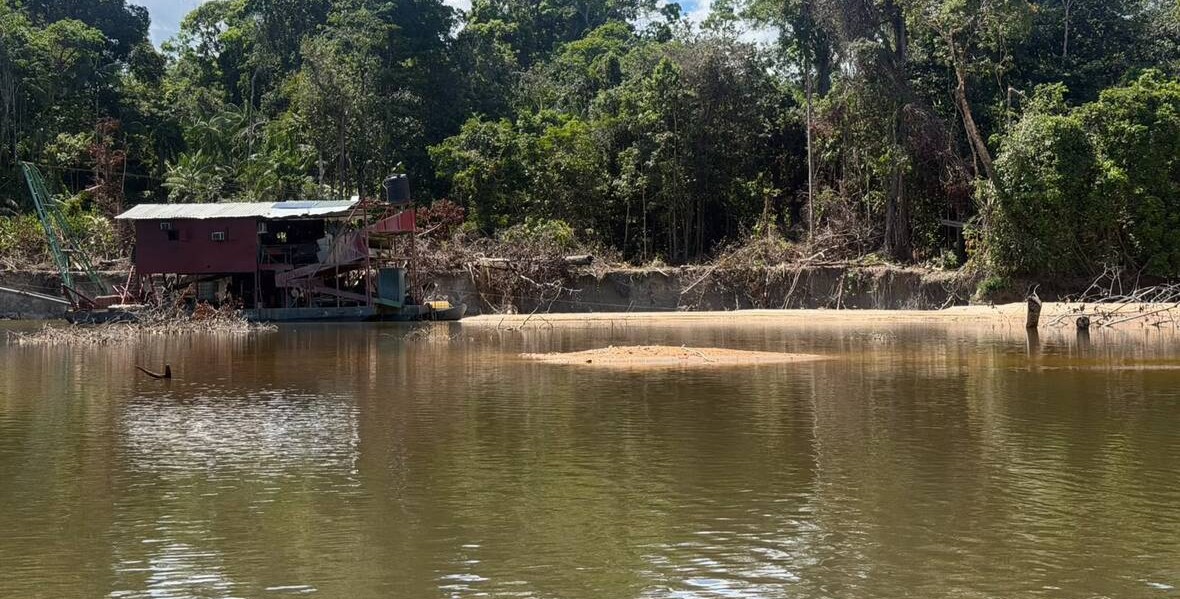
Photo: Ministry of Natural Resources.
Mining compliance is often discussed at the point where an operator applies for a permit. A recent enforcement operation along the Siparuni River shows why responsibility continues long after permission is granted.
The Ministry of Natural Resources reported that three miners, including two non-nationals, were detained after a Guyana Geology and Mines Commission enforcement team found machinery placed on a riverbank and a river dredge directed into it to extract minerals. According to the ministry, the operation damaged the bank, equipment was seized and the matter was transferred to the Guyana Police Force for further investigation.
The ministry also said the miner responsible would be required to account for gold extracted from the area and cover the cost of reclaiming the damaged site.
These are enforcement statements made by the authorities at an investigative stage. The release does not report a court conviction or provide a final assessment of the environmental damage. Even with that limitation, the case illustrates a wider point for mining businesses and their investors: compliance involves how an operation is conducted, not merely whether a licence or permit exists.
Permission is only the beginning
Guyana’s mining framework divides responsibilities across the Guyana Geology and Mines Commission and the Environmental Protection Agency.
The GGMC administers mineral properties and mining permissions. Its current mining-permit guidance states that medium-scale permit applicants must submit a mine or quarry plan, complete the application process and lodge an environmental bond before a permit is issued. The Commission’s guidance also identifies environmental permits or agreements where required.
The EPA separately states that projects capable of affecting the environment, including resource-extraction activities, require the appropriate environmental authorisation. Depending on the project, that authorisation may take the form of an environmental, construction, operating or prescribed-process permit.
Those approvals do not authorise every method in every location. Operations remain subject to the conditions attached to the relevant permission, the approved mine plan, environmental requirements and the rules governing the use of land and waterways.
That is why the first compliance question should not be simply, “Do we have a permit?” It should be, “Are the activity, equipment, location and method being used today covered by the permissions and plans that apply to this site?”
Reclamation is an operating responsibility
The Siparuni release brings reclamation into the centre of the story because the ministry says the responsible operator will have to meet the cost of repairing the riverbank.
The GGMC’s Code of Practice for Mine Reclamation describes reclamation as a planned part of mining rather than a clean-up exercise left until the end. Its principles include planning before mining begins, rehabilitating progressively, maintaining physical and chemical stability, monitoring the site and establishing conditions for closure and relinquishment.
The code uses the practical idea of “close as you go.” For an operator, that means integrating rehabilitation into daily work instead of allowing disturbed areas and potential liabilities to accumulate across the life of the mine.
This approach also has financial consequences. Reclamation requires equipment, labour, materials, monitoring and management time. If those costs are excluded from a project’s operating model, the investment case may understate the true cost of extraction.
An environmental bond provides one form of security, but it should not be treated as the operator’s maximum exposure. The value of actual remediation can depend on the scale and nature of damage, while enforcement may create separate risks involving seized equipment, interrupted production, investigation and reputational harm.
Contractor activity remains an investor risk
Mining projects often involve contractors, equipment owners, licence holders, landholders and financiers. That structure can create uncertainty about who is supervising a particular activity, but it does not remove the commercial risk from the project.
An investor or licence holder should know who is operating on the property, what equipment has entered the site, where it is being used and whether the activity matches the approved plan. Contractor agreements should identify compliance responsibilities, reporting lines and the consequences of unauthorised work.
Field controls matter as much as contract language. Site maps, daily production records, equipment logs, environmental inspections and incident reports provide evidence that an operation is being managed rather than merely funded.
The authorities’ statement that the operator must account for gold extracted from the Siparuni area highlights the importance of production records. Weak controls can turn an environmental issue into a broader question about mineral recovery, declarations and chain of custody.
What responsible operators should review
The enforcement action provides a useful prompt for mining businesses to test their own systems.
They should verify that licences, permits, environmental authorisations and bonds remain valid and correspond to the current operation. Managers should compare actual site activity with approved boundaries, mining methods and environmental conditions. Riverbanks, waterways, tailings, fuel handling and disturbed ground deserve particular attention because failures can spread beyond the immediate work area.
Reclamation plans should be active documents with assigned responsibilities and budgets. If rehabilitation is expected to occur progressively, management should be able to show what has been completed, what remains open and how performance is being monitored.
Businesses should also establish a clear stop-work rule. Employees and contractors need to know who can halt an activity when a boundary, method or environmental condition is uncertain. Production pressure is not a defence for work that falls outside an approval.
The investment lesson
The Ministry of Natural Resources has presented the Siparuni operation as illegal mining that damaged a riverbank. The investigation will determine the legal consequences for the people involved.
For the wider sector, the immediate lesson is already clear. A mineral right is not a blank cheque, and an environmental bond is not a substitute for environmental management.
Mining value is created over the life of a project, but so is liability. Investors therefore need to examine the quality of an operator’s field supervision, environmental records and reclamation planning alongside production targets and mineral potential.
In a sector where activity can alter land and waterways quickly, compliance must travel with the equipment. The cost of failing to do so may include not only enforcement and lost production, but the obligation to repair the place where the value was extracted.