

The meeting had gone better than expected. After months of planning, a foreign company had finally received the green light to move ahead with its investment in Guyana. The directors congratulated one another, confident that construction could begin within weeks.
Then their local adviser placed a folder on the table. Inside was a checklist of approvals that every major project would need to navigate. Before construction could begin, the company would have to secure environmental approvals, register for taxes, complete land documentation, obtain the necessary building permits, satisfy customs requirements and meet health and safety standards.
The chief executive looked up, puzzled.
“I thought the government already approved this. Why are we suddenly dealing with all these different organisations?”
It’s a question almost every investor asks at some point.
Many people imagine government as a single organisation making every decision. In reality, modern governments work very differently. Ministers and ministries set direction, but much of the day-to-day work of government is carried out by specialised agencies.
Understanding that distinction makes government far less confusing. It also helps explain why businesses, entrepreneurs and citizens spend far more time interacting with government agencies than they do with ministers.
Why Governments Need Agencies
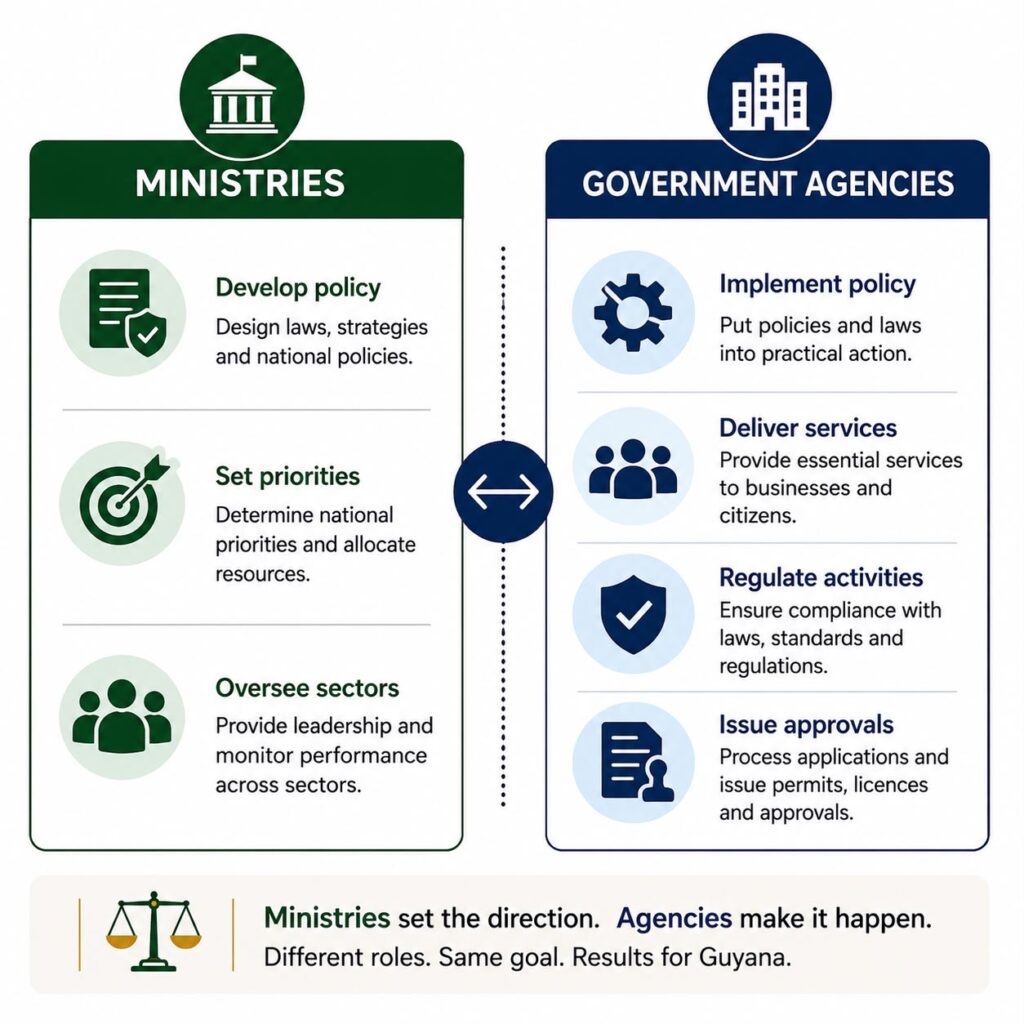
Imagine asking one ministry to inspect every building, register every taxpayer, monitor every mine, issue every environmental permit, manage every land record and regulate every financial institution in the country. It would be impossible.
Modern governments are responsible for thousands of specialised activities. Each requires technical knowledge, trained professionals and dedicated systems. Rather than concentrating every responsibility in a single ministry, governments create agencies that focus on specific functions.
Think of a large hospital. The hospital has one overall management team, but patients don’t go to the Chief Executive for an X-ray, a blood test or surgery. Those services are provided by specialised departments staffed by people with the right expertise.
Government works in much the same way. Ministries provide leadership and direction, while specialised agencies carry out much of the practical work that keeps the country operating.
That is not bureaucracy for its own sake. It is how governments manage complexity.
Ministries Set Direction. Agencies Deliver.
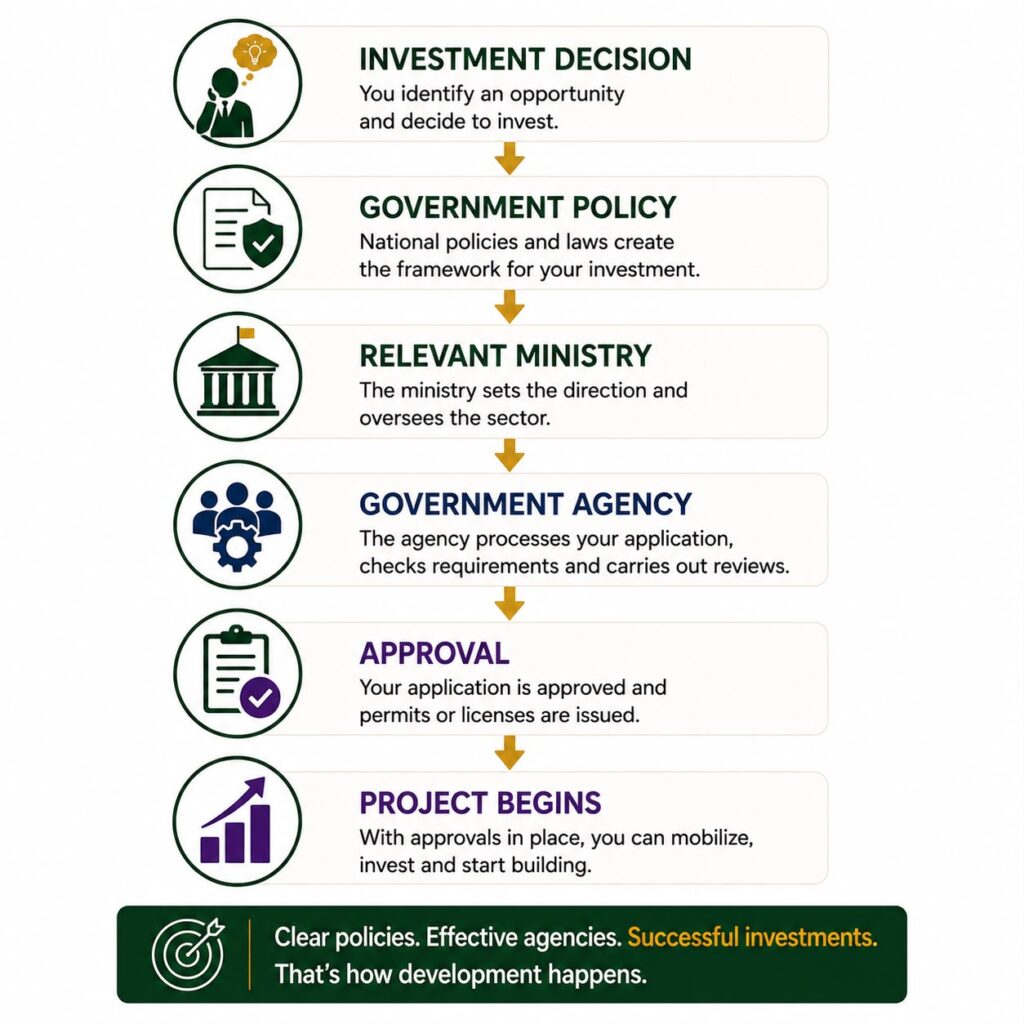
One of the easiest ways to understand government is to think of ministries and agencies as partners performing different jobs. A ministry is responsible for the overall direction of a particular area of government. It develops policies, establishes priorities and oversees the sector for which it is responsible.
A government agency, on the other hand, is usually responsible for putting those policies into practice. If a ministry determines that stronger environmental protection is needed, an environmental agency may carry out inspections, review permit applications and monitor compliance. If tax policy changes, the relevant revenue agency administers the tax system and works with taxpayers to implement the law.
This distinction is important because it explains why businesses often interact with agencies rather than ministers. A minister is unlikely to review an individual tax registration, inspect a construction site or process a licence application personally. Those responsibilities are typically handled by agencies with the expertise and systems to perform them consistently.
Understanding this relationship also helps explain why government can appear larger than it first seems. What many people refer to simply as “the government” is actually a network of ministries, agencies and public institutions working together to deliver services and implement the law.
The Agencies You Are Most Likely to Meet
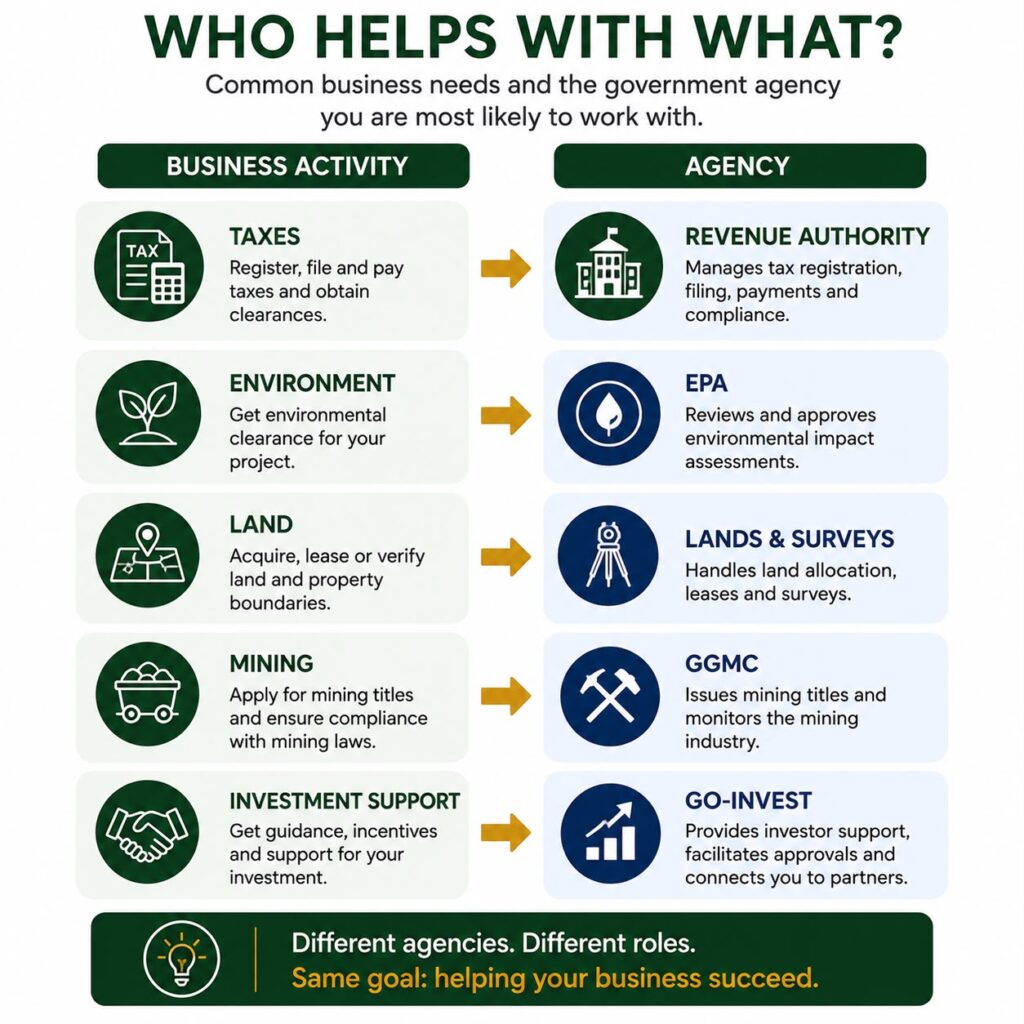
For many businesses, the first encounter with government is not through Parliament or a ministry. It is through an agency responsible for a particular approval or service. A company registering for taxes will deal with the Guyana Revenue Authority because that agency administers the country’s tax system.
A developer planning a major construction project may need to engage with the Environmental Protection Agency when environmental approvals are required. A business purchasing or developing land may interact with the Guyana Lands and Surveys Commission as part of that process.
An investor exploring opportunities in the mining sector may encounter the Guyana Geology and Mines Commission, while an overseas company looking for guidance on investing in Guyana may begin its journey with the Guyana Office for Investment.
Although these organisations perform very different functions, they all share a common purpose. Each specialises in a particular area of public administration, allowing government to deliver services through institutions with the knowledge and expertise required for that responsibility. Seen individually, they may appear to be separate organisations. Seen together, they form part of one larger system.
Why Investors Spend More Time with Agencies Than Ministers
Let’s return to our investor. The company has already received support for its project. Yet the directors still find themselves working through a long list of agencies before construction can begin.
At first, that may seem inefficient. In reality, it reflects the way modern government is designed to operate.
Major policy decisions may originate at the highest levels of government, but implementing those decisions requires specialist organisations capable of reviewing applications, verifying compliance, maintaining records and administering laws consistently.
Consider a hotel development. The overall investment climate may be shaped by government policy. But bringing that project to life may involve environmental approvals, tax registration, land administration, customs procedures and other regulatory requirements administered by different agencies.
No single organisation possesses all of the expertise required for every stage. Instead, each agency contributes one part of a larger process.
Understanding this helps investors approach government with more realistic expectations. Rather than expecting one office to solve every issue, they begin to recognise that successful projects often involve coordinated interaction with several specialised institutions. That understanding saves time, reduces confusion and makes government processes much easier to navigate.
One Government, Many Specialists
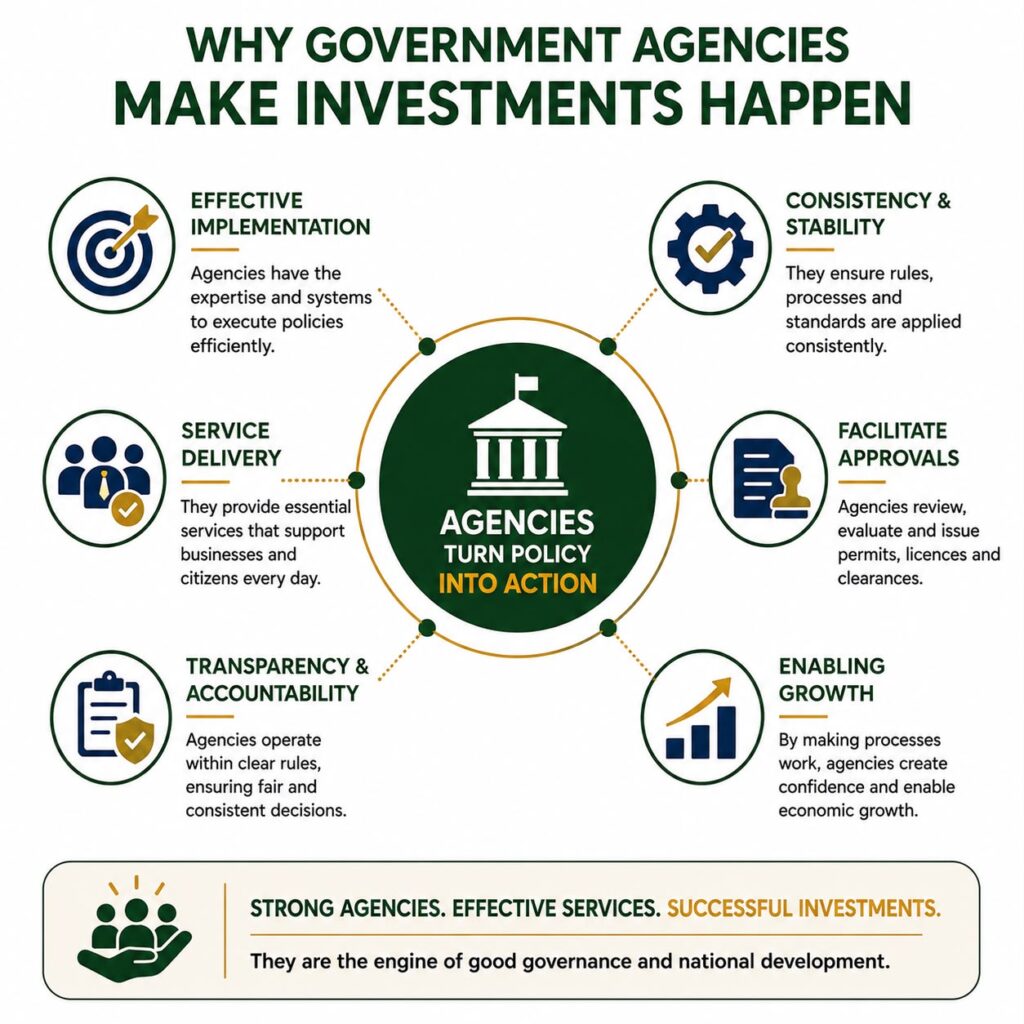
The checklist on the investor’s desk no longer looks quite so intimidating. Instead of seeing a collection of unrelated organisations, the directors now recognise a coordinated system.
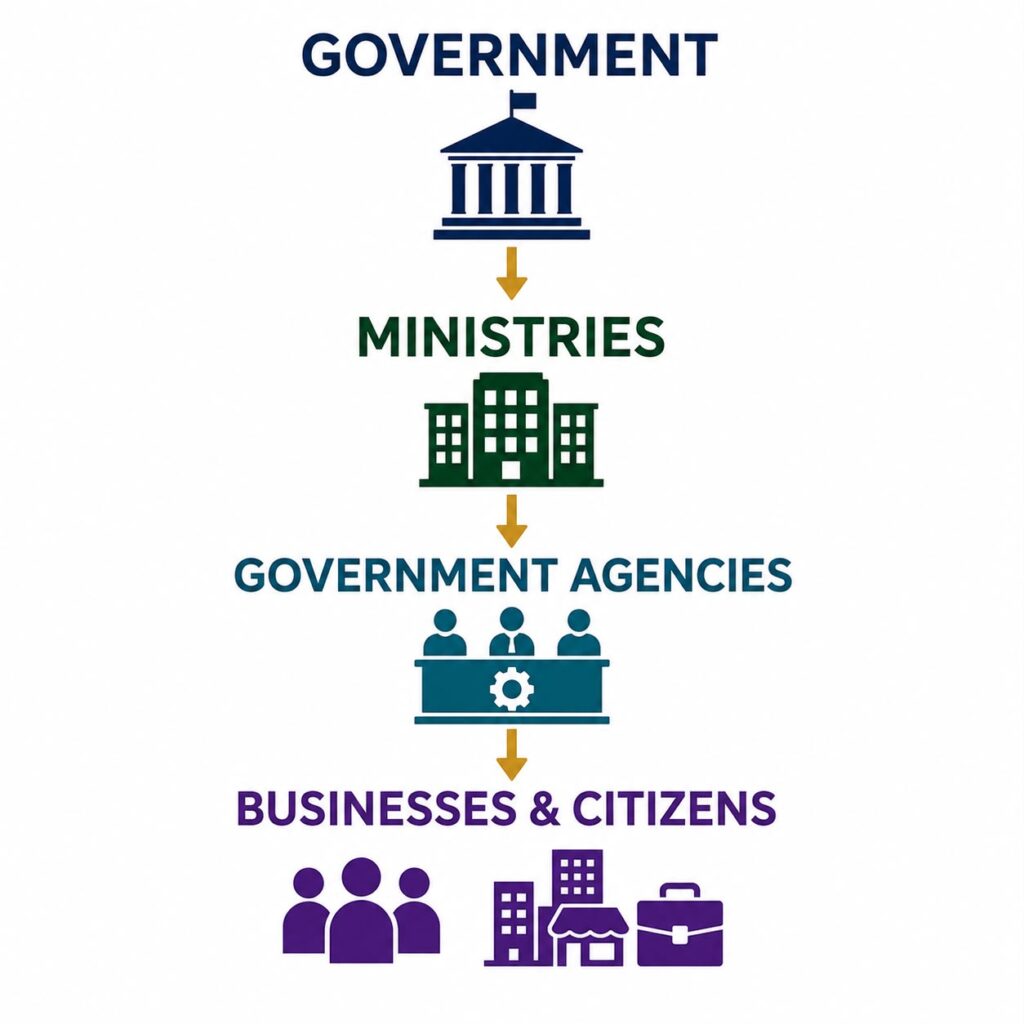
Government establishes national priorities. Ministries oversee different sectors. Government agencies carry those responsibilities into everyday practice by administering programmes, regulating activities, issuing approvals and delivering public services.
Each institution has a different role, but none operates in isolation. Together they transform laws passed by Parliament and policies developed by government into actions that people experience every day.
For businesses, this understanding changes the way government is viewed. An agency is not an obstacle standing between an investor and a project. It is usually the institution responsible for ensuring that a particular part of the process is carried out fairly, consistently and according to the law.
For citizens, the same principle applies. Whether renewing a licence, paying taxes, applying for a permit or accessing public services, the agency providing that service is part of a much larger system working to implement government decisions.
The next time our investor receives a checklist of approvals, the reaction is very different. Instead of asking, “Why am I dealing with all these organisations?” the directors understand that each agency has a specialised role within a coordinated system of government.
Once you see that system, government becomes much easier to understand. And once government becomes easier to understand, doing business, investing and navigating public services becomes far less mysterious.
In the next article in the Invest Guyana Explains series, we’ll explore another important piece of that system by explaining the difference between Acts, Regulations and the rules that agencies use to put laws into practice.