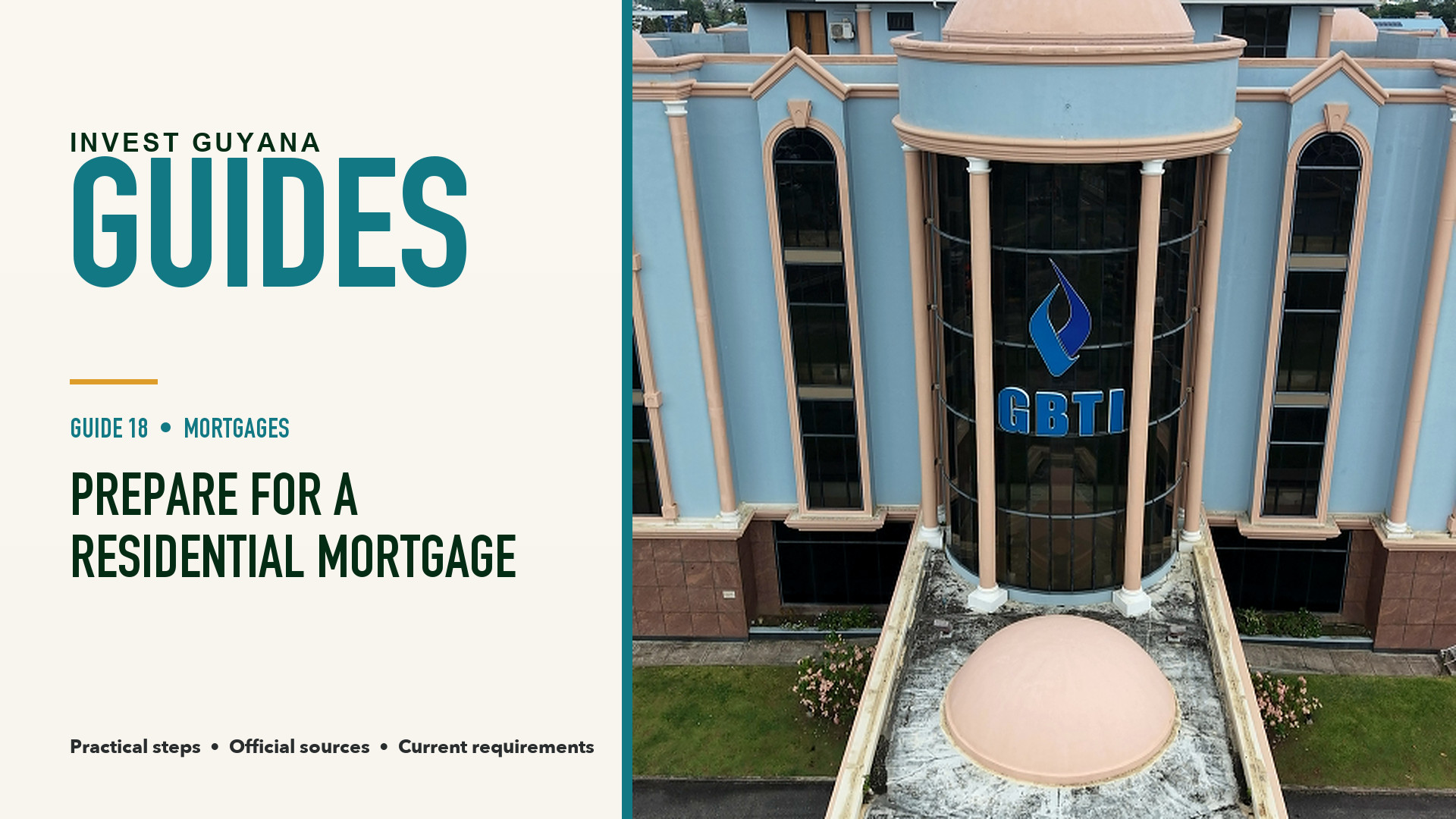
Mortgage requirements in Guyana vary by lender, borrower, property, loan purpose and title system. There is no single universal checklist, interest rate, deposit, ceiling or approval period that applies to every provider.
A good preparation process separates four questions: whether the provider is regulated, whether it currently offers the product, whether the borrower can satisfy its assessment, and whether the property can support the required security.
Verify the provider and the product
Use the Bank of Guyana’s licensed-institution information to confirm the identity of a regulated commercial bank or non-bank financial institution. Licensing does not prove that the institution currently offers the mortgage product you need.
Check the provider’s current first-party product page or contact its lending department. Ask about:
- the loan purpose it accepts;
- borrower and residency requirements;
- income and affordability assessment;
- equity or contribution requirements;
- property types and locations accepted;
- interest-rate structure and fees;
- security and insurance requirements;
- valuation and inspection steps; and
- expected application and disbursement stages.
Do not rely on an advertisement without confirming the terms for the actual application.
Prepare personal and financial records
Bank of Guyana’s general borrower guidance and lender-specific sources support preparing records such as:
- identification and proof of address;
- TIN;
- employment or business-income evidence;
- payslips, bank statements or other income records;
- information about existing debts and commitments;
- credit-report or credit-history information where requested; and
- the source of the applicant’s contribution and transaction costs.
The lender decides what is sufficient. A document used by one institution is not automatically accepted by another.
Prepare the property file
The property branch is as important as the borrower branch. Assemble the available:
- Transport, Certificate of Title, registered lease or other accepted tenure evidence;
- Agreement of Sale or CH&PA Agreement of Sale, where applicable;
- survey, plan or parcel information;
- valuation or inspection evidence requested by the lender;
- building plans, estimates and project documents for construction; and
- evidence concerning existing mortgages, charges, liens or other registered interests.
A Transport and Certificate of Title point to different registry systems. The lender’s security document and registration route must match the property’s title branch.
Understand the approval and security stages
A typical mortgage journey may include:
- initial product and eligibility discussion;
- application and document submission;
- income, debt and credit assessment;
- property inspection or valuation;
- approval subject to conditions;
- legal and security-document preparation;
- mortgage or charge registration; and
- disbursement, sometimes in stages for construction.
These stages differ by provider. Approval is not the same as registry registration, and registry registration is not the same as disbursement.
Construction mortgages
Provider-specific evidence supports construction disbursements tied to inspections or project targets. Do not assume the full approved amount will be released at once.
Ask the lender how it verifies progress, what must be completed before each release, who pays inspection and valuation costs and what happens if the project cost changes.
Check Mortgage Interest Relief separately
Mortgage Interest Relief is a GRA tax-relief process, not a lender’s credit approval. Current GRA guidance limits the relief to qualifying applicants and loans within the stated statutory and policy conditions.
If it may apply, confirm the current Form 1, lender Form 2, interest schedule, title or lease evidence, loan agreement and tax-compliance requirements. Do not assume mortgage approval automatically produces MIR approval.
Before applying
- Confirm the lender is regulated and the product is currently offered.
- Obtain the provider’s current checklist and written product information.
- Review income, debts, credit and available contribution.
- Identify the property’s title or lease system.
- Assemble property, survey, sale and valuation evidence.
- Ask how security registration and disbursement will work.
- Budget for legal, registry, valuation, insurance and other transaction costs.
- Keep lender approval, registry security and MIR as separate decisions.
Common mistakes to avoid
- Assuming a licensed institution offers every mortgage product.
- Treating one lender’s checklist or rate as universal.
- Applying without confirming the property’s registry route.
- Ignoring existing registered mortgages or charges.
- Confusing approval with disbursement.
- Expecting all construction funds at once.
- Treating lender payoff as automatic registry discharge.
- Assuming MIR approval is part of the bank’s mortgage decision.
Official sources
- Bank of Guyana
- GRA Mortgage Interest Relief
- GRA Mortgage Interest Relief Policy
- Guyana Land Registry
- Deeds and Commercial Registries Authority
Related Invest Guyana guides and explainers
Editorial note
This guide provides general information, not lending, affordability, legal or financial advice. Mortgage products and approval decisions are provider- and applicant-specific. Obtain the current terms directly from the lender.