

Drone photograph from Invest Guyana’s media archive; contextual image, not the hypothetical project described.
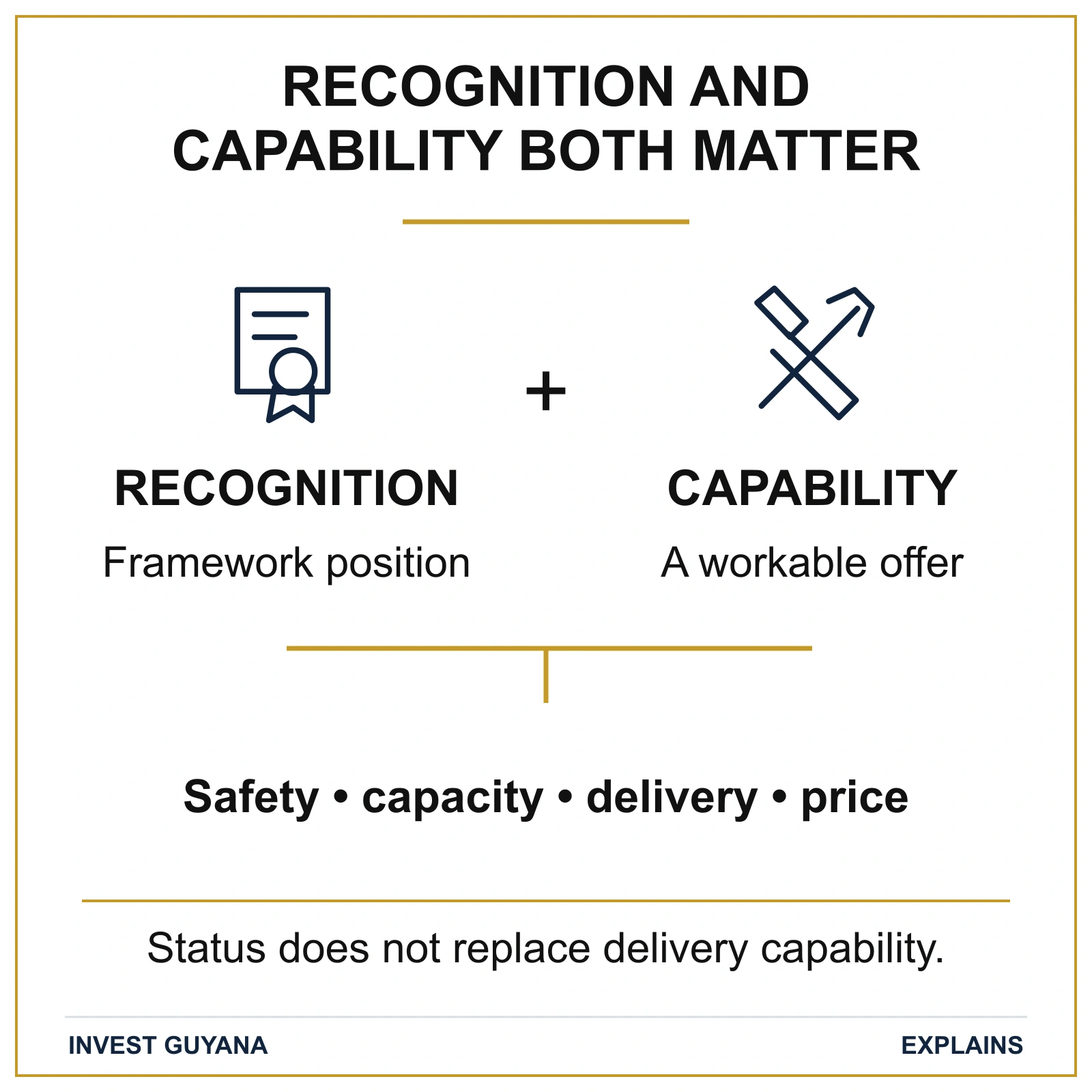
Imagine a Guyanese-owned service company receiving its local-content certificate and preparing to approach petroleum-sector buyers. The owners see a promising opening, but the first procurement discussion concerns staff capability, safety arrangements, delivery capacity and commercial terms. The certificate matters, yet it has not completed the conversation.
That distinction is central to understanding local content. A framework can support Guyanese participation without awarding every qualifying business a contract. Qualification, recognition, procurement and performance concern different parts of the route from policy intention to commercial activity.
For businesses and international partners, the useful question is how these parts fit together. The answer begins with the scope of Guyana’s petroleum-sector framework, rather than treating local content as a universal description of every purchase made within the country.
Participation in a particular value chain
Guyana’s Local Content Act 2021 concerns petroleum operations and related activities. It establishes a framework intended to prioritise Guyanese participation and develop local capacity in that sector. Its scope should not be casually extended into a general ownership rule governing every business in the economy. Local Content Act 2021, official Gazette text.
For our service company, this means the nature of the customer and work matters. A petroleum-related procurement opportunity sits within a particular institutional framework. A different customer buying an unrelated service may be operating under different arrangements, even when both transactions occur in Guyana.
The idea of a value chain helps explain the broader relevance. Petroleum operations can require services, equipment, logistics and expertise supplied by many businesses. Participation is therefore not limited to the most visible activity offshore, although the statutory framework still determines which operations and relationships fall within its scope.
This is a different question from the public-procurement article earlier in the series. Government purchasing and petroleum-sector local content are not interchangeable systems. A business should not assume that understanding one automatically establishes the requirements of the other.
A local address is not the whole definition
The Act’s definition of a qualifying Guyanese company considers beneficial ownership and voting rights as well as Guyanese participation in management and other employment. Incorporation in Guyana alone does not answer the complete qualification question. The definition belongs to this framework and must be read within it. The Secretariat’s currently linked application requirements, checked on 13 September 2026, seek ownership and employment evidence as well as incorporation documents.
Our hypothetical company might have a local office, local customers and staff who know the market well. Those facts can be commercially important, but the owners still need to understand the legal criteria applicable to the status they seek. An everyday description such as “locally based” is not automatically equivalent to the statutory category.
This distinction also matters when businesses enter partnerships or change their ownership structure. A commercial agreement can alter who controls decisions and who ultimately benefits from the enterprise. Qualification should reflect the actual arrangements, not merely a familiar trading name or the location of a registered office.
The earlier beneficial-ownership explainer provides useful background without deciding eligibility here. It explained why identifying the people behind an enterprise matters. Local content applies its own specific criteria to participation in a defined economic framework.

Recognition and procurement answer different questions
The Local Content Secretariat maintains registers relating to suppliers and employment. Registration makes status visible within the system, while procurement involves the selection of a supplier for particular work. The official platform itself distinguishes these functions rather than treating registration as a purchase order. Local Content Register.
For the owners, a certificate can therefore be an important piece of evidence without being evidence of future revenue. It does not state that a buyer has accepted their price, approved their proposed delivery arrangements or committed to purchase a particular volume.
Imagine the company planning new premises immediately after recognition, based on an assumption that work will automatically follow. The investment may still prove worthwhile, but the assumption about revenue needs its own support. A recognised status and a customer commitment are different commercial facts.
This does not diminish the framework’s purpose. It explains where the company is within it. Clear distinctions make it easier to identify whether the remaining challenge concerns qualification, access to opportunities, competitiveness or execution.
Winning work still involves a business proposition
The Secretariat’s Procurement and Bid Evaluation Guideline considers local content alongside technical, health, safety, environmental and commercial factors. The version cited here is 1.4, dated 16 August 2024. This supports understanding procurement as an evaluation of a proposal rather than an automatic distribution of contracts among certificate holders. Procurement and Bid Evaluation Guideline, version 1.4.
Suppose our company offers maintenance services. A prospective buyer needs to understand whether the people, tools and working arrangements can deliver the required outcome. Local participation and dependable performance can reinforce each other, but the first does not make the second irrelevant.
The commercial proposition also concerns scale and timing. A company capable of a modest assignment may need additional capacity for a larger one. An attractive price is meaningful only in relation to the scope, resources and risks included in the offer.
For an international partner, this can change how collaboration is understood. A durable relationship should contribute to a workable operation rather than assume that a local name alone creates a complete route to market. The particular structure still requires proper legal and commercial review.
Capacity grows through more than one contract
Local-content policy also concerns the development of skills and business capability. The Secretariat’s procurement guidance discusses supplier development and participation measures, including ways to make opportunities more accessible. The underlying objective extends beyond counting the location of a single invoice.
For our service company, a successful assignment can produce experience, better internal systems and stronger evidence of delivery. Training staff or improving technical capability can increase what the enterprise is able to offer in future. These are commercial effects that cannot be captured simply by asking whether a certificate has been issued.
However, capacity development should not be confused with a guarantee that every investment in expansion will be recovered. A company still needs to understand the likely demand for its services and the cost of meeting the required standard. More equipment does not create an order by itself.
This is where the preceding finance and supply-chain explainers connect. A business may qualify for opportunities while needing to finance mobilisation, manage inputs and carry the interval before payment. Participation in the framework does not remove the ordinary economics of delivery.
Announcements and operative requirements must be separated
Local-content policy can evolve, so readers should distinguish an announcement about intended changes from requirements already in force. The Ministry of Natural Resources discussed proposed amendments in February 2026. A statement of intention should not be treated as evidence that every proposed change has already become law. Ministry of Natural Resources, February 2026 statement.
This explainer therefore concentrates on the verified framework and its conceptual distinctions, rather than reproducing a list of procurement categories or promising the current scope of each target. Those operational details require a current check when a business is making an actual application or tender decision.
For the owners, this is another reason to describe their position precisely. They can distinguish the requirements they have met, the opportunities they are assessing and any announced changes they are still monitoring. Treating these as separate facts prevents expectations from outrunning the evidence.
It also preserves the boundary between this series and practical Guides. An Explainer helps readers understand what the framework does. A Guide should handle current submission channels, documentary requirements and application-specific steps after checking the operative rules.
Readers can use the existing beneficial-ownership information Guide for its distinct corporate-record task. It does not replace a local-content eligibility assessment, even when some underlying information is relevant to both. A future local-content registration Guide should explain the current application route and required evidence, while linking here for the meaning of qualification, procurement and performance. That division avoids giving readers two articles that repeat the same application instructions under different series labels.
That separation also improves investment planning: the company can identify what recognition establishes today without assigning a value to contracts that have not yet been agreed. Its commercial forecast remains tied to evidence of demand.
Returning to the service company
The company now sees its certificate as an important beginning to a more specific commercial discussion. Its status matters within the framework, while a buyer still needs a credible proposal and the enterprise still needs the resources to deliver it.
Local content is therefore best understood as a structure for participation and capability development, not a promise of automatic turnover. That distinction helps both Guyanese businesses and overseas partners engage with the opportunity more realistically.
The next article follows a successful commercial discussion into the agreement itself. A contract translates intentions into commitments about work, payment, change and disputes, and understanding those commitments matters long after the initial opportunity has been won.