

The payroll was correct, but the compliance file was incomplete
The company had hired its first five employees. Salaries were entered into the payroll system, deductions appeared on the payslips and the monthly totals balanced.
Then the finance manager asked whether the PAYE return had been prepared. The human-resources manager replied that the employees had already been registered with NIS.
Both statements could be true, and the employer could still be missing an obligation.
PAYE and National Insurance begin with employment remuneration, but they are not two labels for the same deduction. They operate under different laws, serve different purposes and are administered by different authorities.
PAYE is part of income-tax administration
PAYE is the mechanism through which an employer deducts applicable income tax from employment remuneration and accounts for it to the Guyana Revenue Authority.
The employee may ultimately be the person whose income is taxed, but the employer has responsibilities within the withholding and reporting chain. Payroll information must therefore support the correct deduction, remittance and return process.
PAYE rates, allowances, forms, deadlines and payment methods can change. A live payroll implementation should therefore be checked against current GRA and NIS requirements rather than copied from an old spreadsheet.
NIS is a social-insurance system
The National Insurance Scheme operates for a different purpose. It connects employers and employed persons to the national social-insurance framework and the contributions and records that support it.
An employer registration with NIS is not a PAYE activation. An employee’s NIS registration does not create a GRA taxpayer record. A payment to one authority does not settle the amount due to the other.
The same employee name, salary period and payroll data may appear in both processes, but the legal destination and compliance purpose are different.
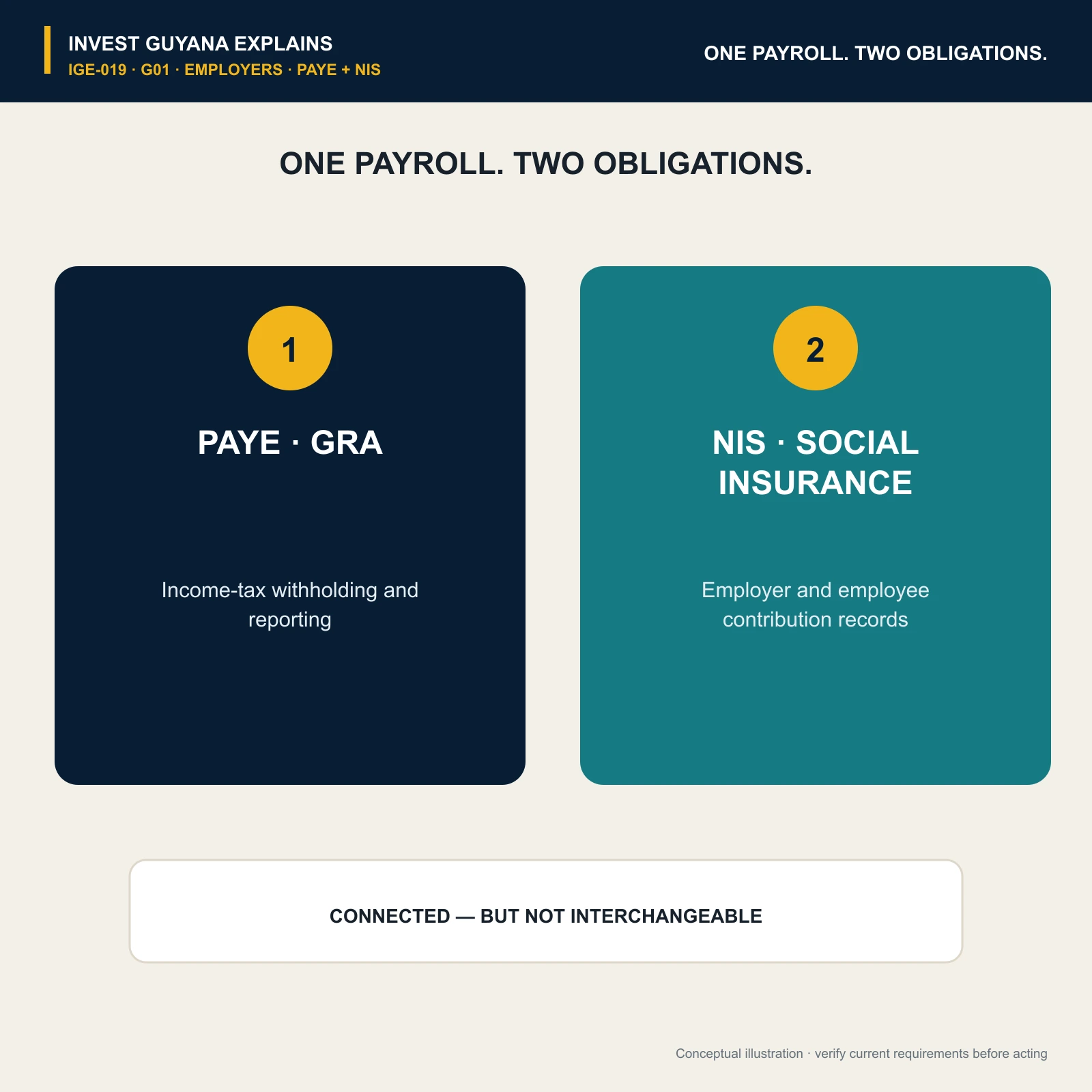
One payroll, two compliance routes
The easiest way to understand the relationship is to start with the payroll and then split the flow.
On the PAYE side, the employer considers taxable employment remuneration, the applicable deduction basis, the GRA return and the remittance obligation.
On the NIS side, the employer considers the insurable employment relationship, registration records, contribution information and the NIS reporting and payment process.
The routes can be coordinated internally, but they should not be collapsed.
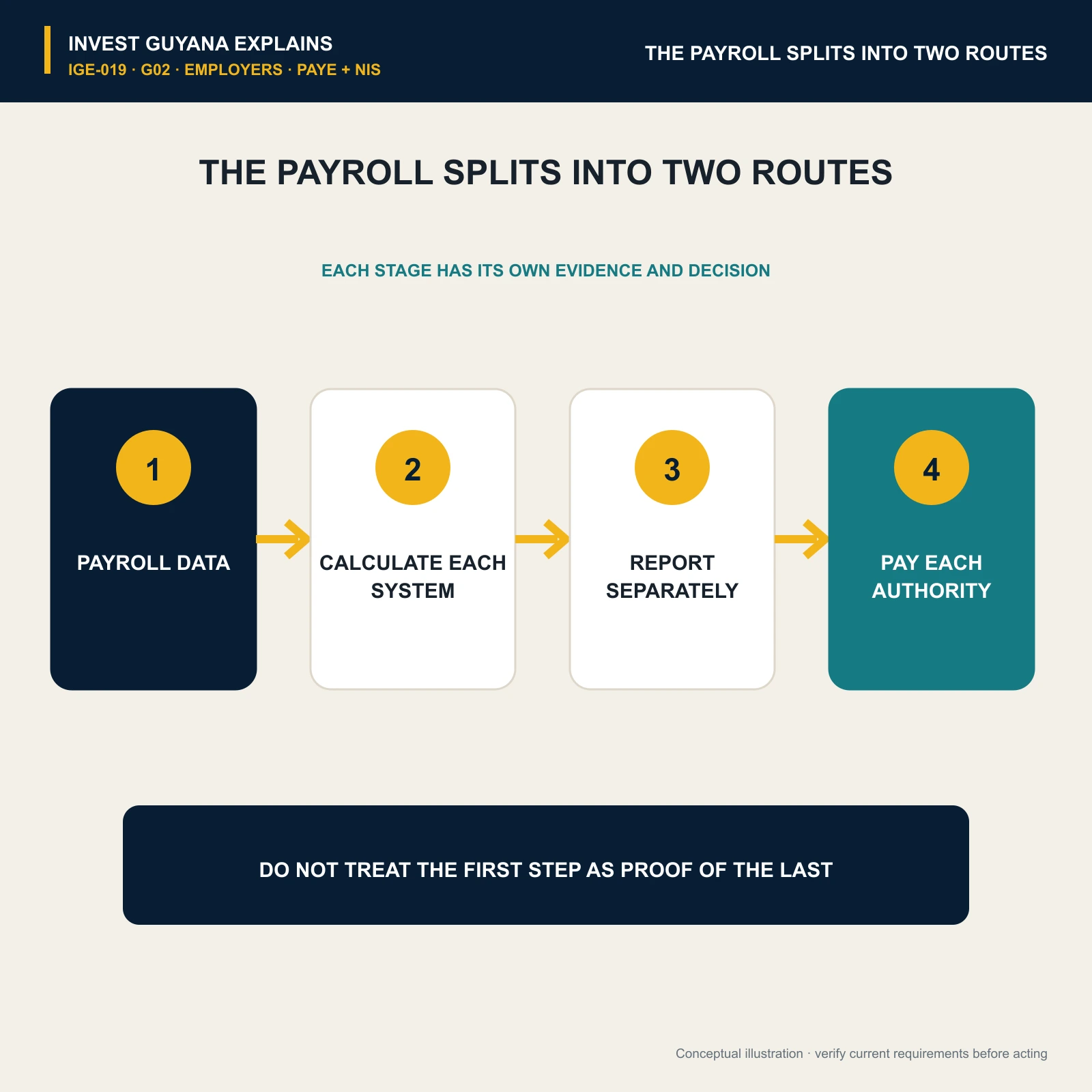
Registration, reporting and payment are different stages
Another common mistake is to assume that registration completes the monthly obligation.
Registration establishes the employer or employee within the relevant system. Reporting tells the authority what happened during the period. Payment transfers the amount due. Recordkeeping preserves the evidence that the correct information and amounts were used.
A company can therefore possess an employer number and still have an unfinished return or payment. It can submit a schedule and still need evidence that the related amount was paid. It can pay an aggregate amount and still need employee-level records capable of explaining the calculation.
Why separate records matter
When every payroll obligation is stored in one undifferentiated folder, errors can be difficult to trace.
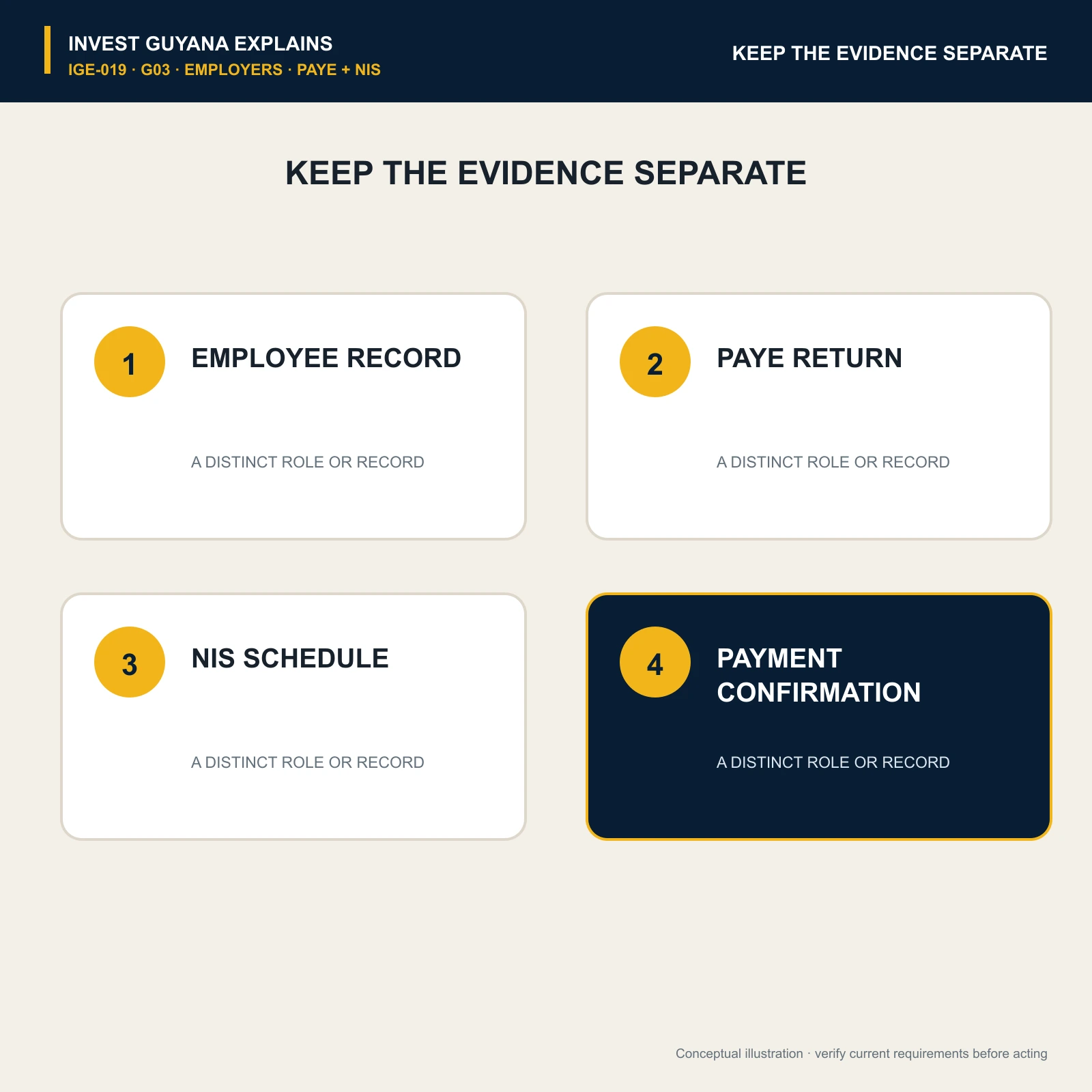
A stronger record system distinguishes:
- employee identity and employment details;
- PAYE calculations and GRA returns;
- NIS registration and contribution records;
- payment confirmations for each authority;
- corrections and correspondence;
- the current official source used for rates, allowances or contribution rules.
Separate records do not prevent one payroll platform from producing both outputs. They make it clear which evidence satisfies which obligation.
Why the distinction matters to employees
The difference is not merely administrative.
PAYE affects how employment income is brought into the income-tax system. NIS contributions support the person’s social-insurance record and potential access to applicable benefits under that system.
If an employer treats one deduction as proof of the other, the employee’s records can be affected even when the total amount deducted from the payslip appears plausible.
Employees should be able to understand the categories shown on the payslip, while employers should be able to reconcile each category to the correct return, payment and authority.
The employer should manage a compliance map, not one deduction total
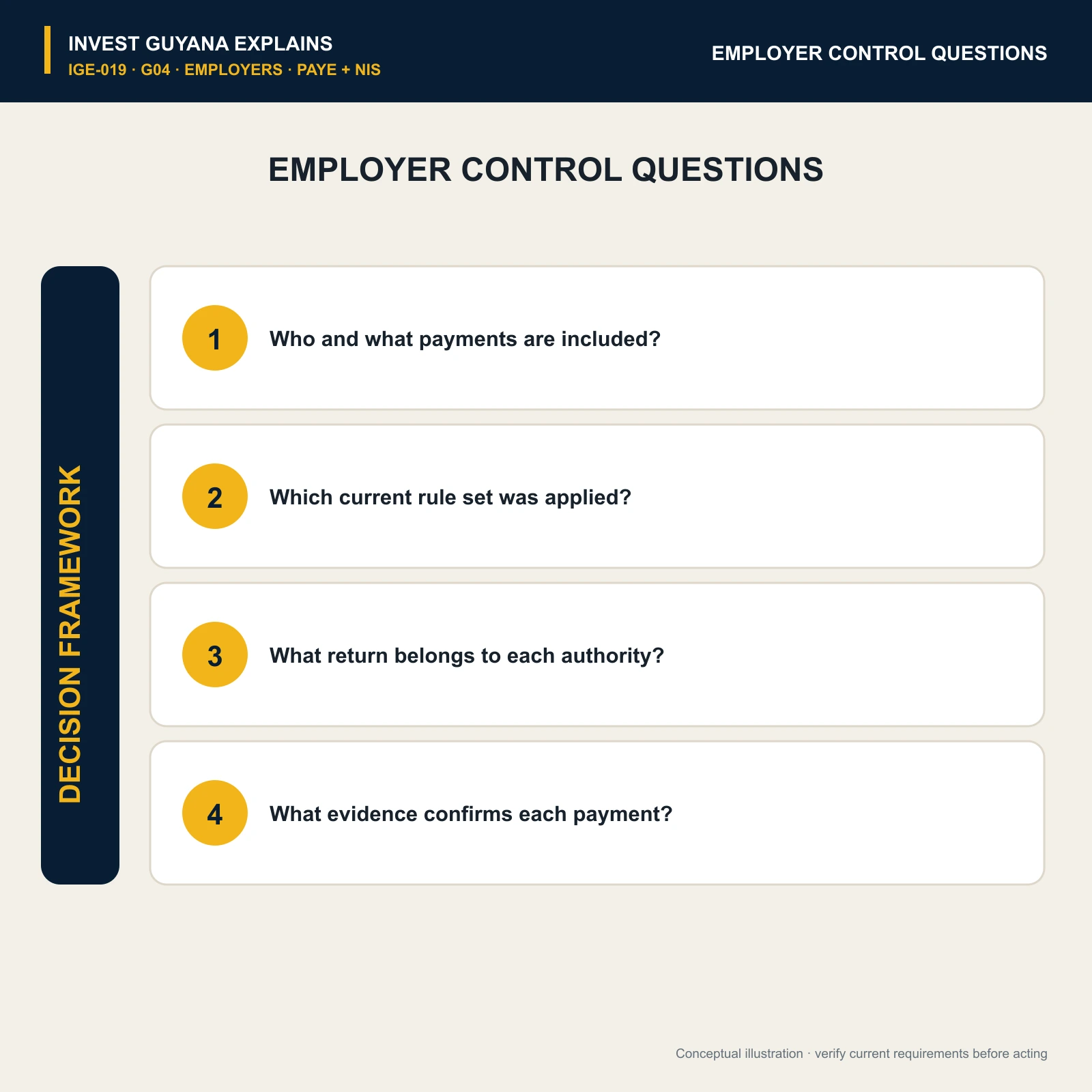
Before each payroll cycle is closed, the employer should be able to answer:
- Which workers and payments are included?
- What current official PAYE guidance was applied?
- What NIS contribution basis and registration records apply?
- Which returns or schedules are required for each authority?
- What evidence confirms each submission and payment?
These are control questions. The procedural answers belong in the relevant current Guide and official forms.
The investor takeaway
PAYE and NIS begin with the same employment relationship but follow different legal routes.
PAYE is an income-tax withholding and reporting system administered by GRA. NIS is a social-insurance registration and contribution system administered by the National Insurance Scheme.
The employer can coordinate both through one payroll process, but it should never assume that registration, reporting or payment in one system satisfies the other.
The next article in Invest Guyana Explains will examine VAT registration and VAT invoices, showing why registration status does not make every receipt a valid VAT invoice.