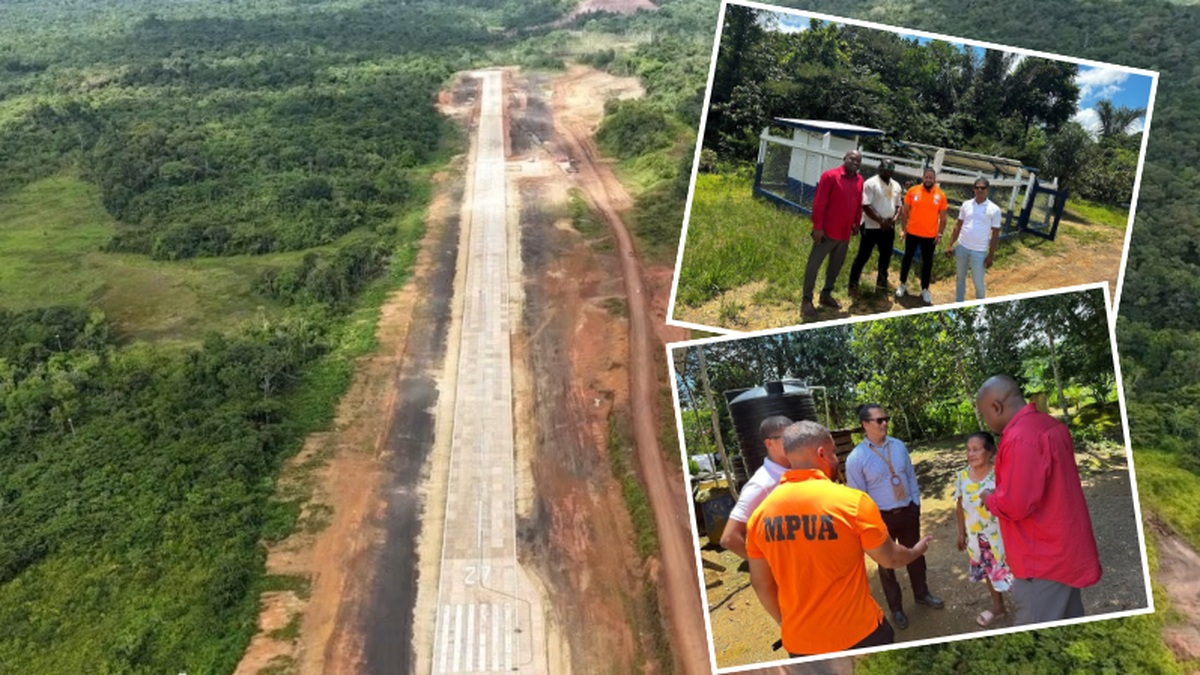
Guyana has completed the upgrade of the Matthews Ridge Airstrip in Region One, delivering a 4,200-foot concrete runway with lighting for 24-hour operations and capacity for larger aircraft.
Photo: Ministry of Public Utilities and Aviation, Guyana.
The Ministry of Public Utilities and Aviation said on 10 October that the facility is expected to be commissioned soon. The completed runway is a material transport-infrastructure milestone for a remote mining and commercial district, even though commissioning and scheduled airline service are separate next steps.
For investors, contractors and operators, the upgrade improves the region’s aviation capacity and reduces a longstanding access constraint. It can support business travel, movement of essential goods, emergency medical evacuation and more reliable links between the North West District and the coast. The announcement does not itself establish a new route, traffic forecast or private contract opportunity.
A G$800 million project reaches completion
Earlier government updates put the investment at approximately G$800 million. The project was delivered in two phases: an initial 2,200-foot section followed by a 2,000-foot extension. The final runway measures about 4,200 feet and is supported by an apron, taxiways, runway markings and visual-aid lighting.
The Department of Public Information reported on 3 October that rehabilitation was complete and that the reinforced-concrete runway can accommodate larger aircraft, including Beechcraft-class operations. The ministry’s newer release confirms the completed facility and places the emphasis on 24-hour operations and improved economic connectivity.
The specifications have varied slightly across earlier updates, which described a planned 4,000-foot runway, while the completion reports state 4,200 feet. This article uses the final completed measurement reported by both the ministry and DPI in October.
The investment supports a mining and logistics hub
Matthews Ridge serves communities in Region One and has long been associated with manganese mining and hinterland commerce. Reliable aviation infrastructure matters where road and river travel can be slow, seasonal or operationally difficult.
A stronger air link can lower the time cost of moving technical personnel and urgent parts, improve access for public services and make emergency response more dependable. It may also support tourism and small-business activity, although the commercial impact will depend on actual flight schedules, pricing, operator demand and the quality of connecting ground transport.
Government reporting during construction also highlighted local employment. DPI said the project employed approximately 60 residents of Matthews Ridge and 15 skilled workers from Mabaruma during the completion phase. An earlier update reported about 50 local workers when construction began.
The project sits inside a wider hinterland-airstrip programme
The 2026 national Budget provides the wider policy context. It says G$2.5 billion was spent in 2025 on hinterland airstrips, including advancing works at Matthews Ridge, and allocates G$4 billion in 2026 to complete continuing projects and begin additional upgrades.
That programme matters to suppliers in civil works, concrete, drainage, lighting, navigation aids, security, maintenance and aviation services. However, completed infrastructure should not be confused with an open tender. Companies should track the ministry, the National Procurement and Tender Administration Board and other official procurement channels for project-specific notices.
What investors should watch next
The immediate milestones are formal commissioning, publication of operating arrangements and evidence of regular airline or charter use. Investors should also watch for maintenance contracts, fuel and ground-handling services, safety and security systems, passenger facilities and any complementary road or utility works.
Demand is the central commercial test. A longer, lit runway expands capacity, but sustained economic value will depend on passenger and cargo volumes, mining activity, airline economics and operating reliability. Potential users should confirm aircraft limitations, published operating hours, landing permissions, fees and emergency-service availability directly with the relevant aviation authorities.
The completion of the Matthews Ridge Airstrip is therefore best read as an enabling infrastructure development: a substantial public investment that strengthens access to a resource-rich interior district and creates the conditions for future aviation and logistics activity, without guaranteeing that those opportunities will materialise automatically.
Primary update: Ministry of Public Utilities and Aviation, 10 October 2026.