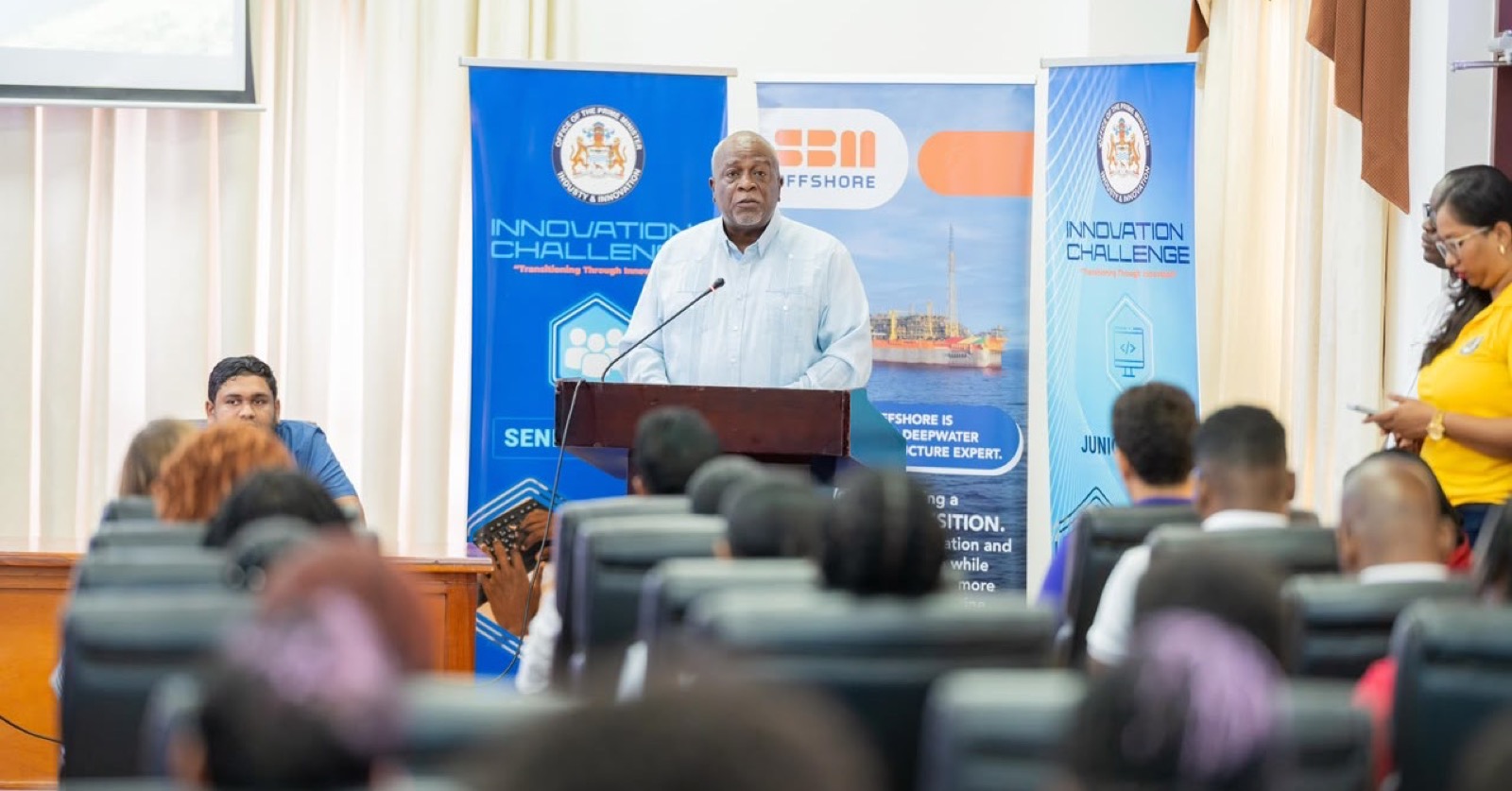
Prime Minister Mark Phillips addresses the closing ceremony of Innovation Challenge 2026 (Source: Department of Public Information).
High-speed internet is now available at more than 3,800 public locations across Guyana, according to a September 7 release from the Office of the Prime Minister.
The government says connectivity has been extended through public buildings and spaces to all 253 hinterland, remote and rural communities. It also reports that 97 per cent of schools, 92 per cent of health facilities and every fire station are connected to high-speed internet.
Prime Minister Mark Phillips, performing the functions of President, disclosed the figures at the closing ceremony of Innovation Challenge 2026 at the Arthur Chung Convention Centre.
The figures describe the reach of the public connectivity programme, but the release does not publish service speeds, uptime, capacity, user numbers or independent performance data. Coverage should therefore not be treated as proof that service quality or affordability is uniform at every location.
Investment in access and digital skills
Nearly G$1.8 billion was invested in ICT hubs across hinterland communities between 2021 and 2026, according to the release. More than 3,000 people from 200 communities received training, with women accounting for approximately 75 per cent of those trained.
The government identified education, healthcare, agriculture, public safety, energy, manufacturing, commerce and public administration as areas in which information and communications technology is becoming more important.
Wider access can enlarge the potential market for online services and make remote training, digital payments, e-commerce and technology-enabled work more practical. The commercial impact will still depend on reliable electricity, affordable devices and data, digital literacy, cybersecurity and the ability of businesses to deliver services outside Georgetown.
The Prime Minister also referenced work involving the national electronic identification system, My Guyana Citizen Portal, Citizen Connect and the AI-supported AskGov platform. The September release describes these as part of ongoing modernisation efforts; it does not establish that every service or function is fully operational nationwide.
Innovation Challenge and the start-up pathway
The sixth Innovation Challenge placed emphasis on research, design thinking, rapid prototyping, collaboration, user testing, responsible use of artificial intelligence and realistic implementation planning.
The Industry and Innovation Unit identified SBM Offshore Guyana as a collaborator for the 2026 competition, which ran from September 4 to 6 at the Arthur Chung Convention Centre. A Junior Competition was also introduced for the first time.
The government encouraged participants to develop prototypes into pilots, start-ups, public-interest tools or services capable of reaching regional and international markets.
That invitation establishes a potential pathway, not a commitment to procure, fund or adopt any particular prototype. The September 7 release does not identify post-competition grants, procurement contracts, incubation terms, intellectual-property arrangements or a timetable for moving projects into commercial use.
What technology businesses should watch
Technology firms and founders should monitor whether the competition’s strongest projects enter formal pilot or procurement processes and whether agencies publish technical standards, data-access rules or partnership opportunities.
Businesses developing services for government or regulated sectors will also need clarity on privacy, data protection, cybersecurity, hosting, identity verification, payment integration, accessibility and long-term maintenance.
Connectivity providers and digital-service companies should watch for updated coverage maps and service-quality information. Reported access at a public location does not necessarily establish household coverage or a commercial connection suitable for data-intensive operations.
The most useful next indicators will be active-user numbers, measurable improvements in public-service delivery, new digital businesses formed, employment outcomes from training and the number of prototypes that secure pilots, customers or investment.
For now, the verified development is that public connectivity has expanded significantly and that the government is coupling infrastructure investment with digital-skills and innovation programmes. The commercial results will depend on implementation, service quality and whether promising ideas move beyond the competition stage.