
Photo: Department of Public Information, Guyana.
Consider a family with money in a bank account and purchases to make at the market. If the only workable option is to withdraw cash first, receiving the money electronically has helped with one transaction. It has not necessarily changed how the next one happens. That everyday distinction matters to Guyana's digital-payment ambitions.
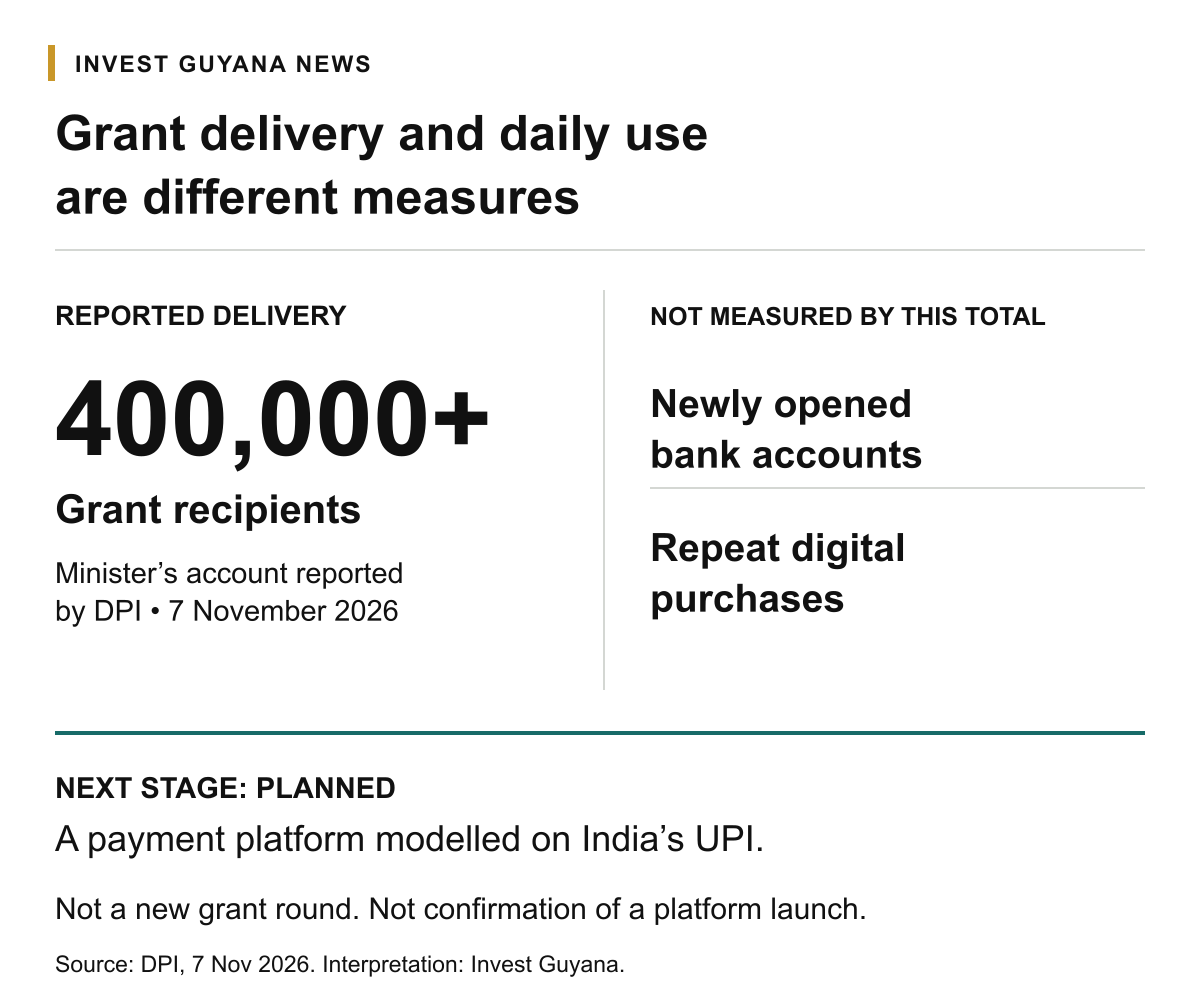
Finance Minister Dr Ashni Singh says more than 400,000 Guyanese received government cash grants using digital registration. DPI published the update on 7 November, following an interview with the minister at the Ogle hostel groundbreaking the previous day. He described online registration, submission of bank details and transfers into recipients' accounts without a visit to a government office.
The milestone concerns payments already delivered, not a newly announced grant round. In the same account, Singh discussed a planned payment platform modelled on India's Unified Payments Interface, with mobile and QR-code transactions envisaged for everyday purchases. That is a separate prospective service, not evidence that the proposed platform is already operating.
A payment delivered is an important but specific result
The reported count gives the digital-delivery discussion a concrete foundation. It describes people receiving grants through a registration and account-payment arrangement, rather than simply a proposal to move a service online. Its immediate importance is the connection between an administrative process and money reaching the intended recipient.
For a household, avoiding a separate office visit can change how a payment fits around work, caring responsibilities or travel. The scale of any saving will differ by person. The minister's account does not measure those individual costs or establish how recipients subsequently used their funds.
The wider financial-inclusion question begins there. Receiving one payment through an account is different from being able to use that account conveniently for ordinary needs. Neither the count nor the announcement should be treated as a count of new bank accounts, a measure of nationwide merchant acceptance or proof that cash withdrawals have declined.
That distinction is reflected in the World Bank's government-to-person payments framework. It treats digital public payments as a potential route to broader financial inclusion and private-sector participation, not only a disbursement mechanism. This is international background, not a World Bank assessment of Guyana's reported result.
Everyday usefulness depends on the other side of the counter
A payment service connects at least two decisions: a customer choosing how to pay and a business choosing what it can accept. The family in the opening example may welcome a digital option, but the market vendor also needs a practical reason to use it. Availability on one side does not complete the transaction.
The issue is familiar beyond Guyana. In a 17 March World Bank discussion of small-merchant acceptance, Oya Ardic and Salvador Perez-Galindo distinguish access to digital accounts from their use for purchases. They identify merchant costs and the commercial challenge of serving small transactions as obstacles to wider acceptance.
For a Guyanese retailer or service provider, the operational question is quite concrete. Can staff recognise a completed payment, associate it with the correct sale and determine when the proceeds are available? If the process creates uncertainty at a busy counter, the difficulty is not resolved merely by displaying a payment code.
Suppliers matter too. A shop might accept digital payments from customers but still need cash for some purchases or expenses. Whether it can use the incoming funds directly will influence the value of the service to the owner. This is an issue for payment-system design and commercial relationships; it is not evidence that a particular Guyanese business currently faces those conditions.
The opportunity for banks and payment providers is therefore wider than enrolling customers. It includes making the service useful where money changes hands repeatedly, with arrangements that fit the merchant's business rather than treating acceptance as a one-time installation.
The cost of acceptance includes time and reconciliation
Price is part of the decision, but not the whole of it. A merchant considering a payment option needs to understand any charges, the equipment or connectivity involved and the work required to account for transactions. Those are assessment categories, not published fees for the planned Guyana platform.
Reconciliation is the task of matching the day's sales to the money received. A digital transaction can provide a record, but that record has to fit the business's way of working. A retailer with several staff members or sales points needs to distinguish who took a payment, what it covered and whether a refund changed the final amount.
The customer has a related need: a clear understanding of whether a payment succeeded and what to do if the result is uncertain. A moment of ambiguity can leave the customer reluctant to pay twice and the merchant unwilling to release goods. Designing for that situation is part of building trust in routine use.
For investors evaluating payment-related opportunities, these details affect the commercial proposition. A growing number of registered users may create potential demand, but sustained usage depends on whether the service resolves a genuine problem for both parties. Customer acquisition, support and merchant servicing all require resources; registrations alone do not establish profitable transaction activity.
Trust depends on support when something goes wrong
Reliability is easiest to overlook when every transaction works. Its importance becomes clearer when a phone is unavailable, connectivity fails or a customer cannot identify the right support channel. A payment service intended for everyday spending needs a credible response to interruptions as well as a convenient normal experience.
Support should be understandable to the person using it. That includes knowing which institution is responsible for a problem and how a disputed or uncertain transaction will be examined. This is not an account of the planned platform's operating rules, which must be established through its implementing arrangements.
Privacy belongs in that discussion too. The registration route described by Singh involved bank information. Extending digital services makes the handling of customer information consequential: people need confidence that access is controlled and that they can recognise legitimate communications. Convenience should not require a customer to guess who is entitled to request sensitive information.
Access also has to survive differences in circumstances. A service that works comfortably for someone with a dependable connection may be harder for another person to use. Retaining workable support and alternatives is a practical inclusion issue, not an argument against digitisation.
The next measure is what people can do after the money arrives
Guyana's reported grant experience can inform the next stage without being mistaken for the finished payment system. The useful follow-up would distinguish successful delivery from subsequent use: whether recipients can access their funds, whether suitable businesses accept digital payment and whether problems are resolved clearly.
Evidence should keep those measures separate. Account registrations, completed transactions, active merchants and complaints describe different parts of a service. A total can look impressive while leaving the experience of a particular community or type of business unclear. Consistent definitions and reporting periods would make progress easier to judge.
For local enterprise, the potential benefit is an easier connection with customers who already hold money electronically. For households, it is greater practical choice over how to receive and use that money. Both depend on a payment experience that remains understandable beyond the first successful transfer.
The family at the market provides a simple test. Money reaching an account is meaningful. A further step is the ability to use it confidently for a purchase, with a willing seller and a reliable record of what happened. The minister's update establishes a reported delivery milestone; the next challenge is making that kind of everyday usefulness widely available.