

Photo: Caribbean Development Bank.
Consider a Guyanese food processor looking beyond its existing customers. Its proposed equipment could serve buyers in several Caribbean markets, but no single buyer offers enough committed demand to support the expansion. The opportunity looks larger on a regional map than it does in the company's confirmed sales.
For an investor, collecting those enquiries into one presentation does not make them dependable revenue. The question is whether the business can connect customers, distribution and production well enough for the larger market to become commercially useful. This is an illustrative dilemma, not an announced project.
In a release published on 6 November, the Caribbean Development Bank reported President Daniel Best's call for stronger regional integration and investment risk sharing at the Commonwealth Business Forum in Antigua and Barbuda. He advocated connecting markets, grouping projects and expanding guarantees and co-financing to address the constraints facing small economies. For Guyanese enterprises, the relevant question is how that regional ambition could become a workable commercial relationship.
His argument also concerns how countries gain access to affordable finance. Best called for vulnerability to be considered alongside income, pointing to the Multidimensional Vulnerability Index as a tool for financing decisions. That is a reform agenda, not a statement that Guyana's financing classification or a particular company's eligibility has changed. Country-level access and an individual project's ability to earn and repay remain related but different questions.
A larger market needs more than a larger number
The food processor's potential customers may want different quantities, delivery schedules and product specifications. Adding their estimated purchases together can make a project appear substantial while concealing how much work is needed to serve them consistently.
A customer expressing interest is also different from one agreeing to buy on defined terms. That distinction matters before a business commits to equipment whose usefulness depends on sales outside its established market. An investment case becomes stronger when the route from interest to purchasing is understandable, rather than represented by a single optimistic regional total.
Regional expansion also changes the relevant competition. Reaching additional buyers can create opportunities, but those buyers may already have suppliers with dependable distribution, familiar products and established relationships. A new entrant needs a reason to be chosen that survives the cost of reaching the customer.
For a Guyanese enterprise, the practical value of connected markets is therefore specific. It might be the ability to supply a product more reliably, combine demand across seasons or find a distribution partner whose customer relationships make expansion feasible. None follows automatically from treating the Caribbean as one addressable market.
Grouping investments does not create a single decision maker
Best's emphasis on project aggregation addresses a different aspect of scale. Several investments considered together may justify shared preparation or attract an investor whose attention would be difficult for each to secure separately. That is a possible commercial structure, not proof that combining projects improves every investment.
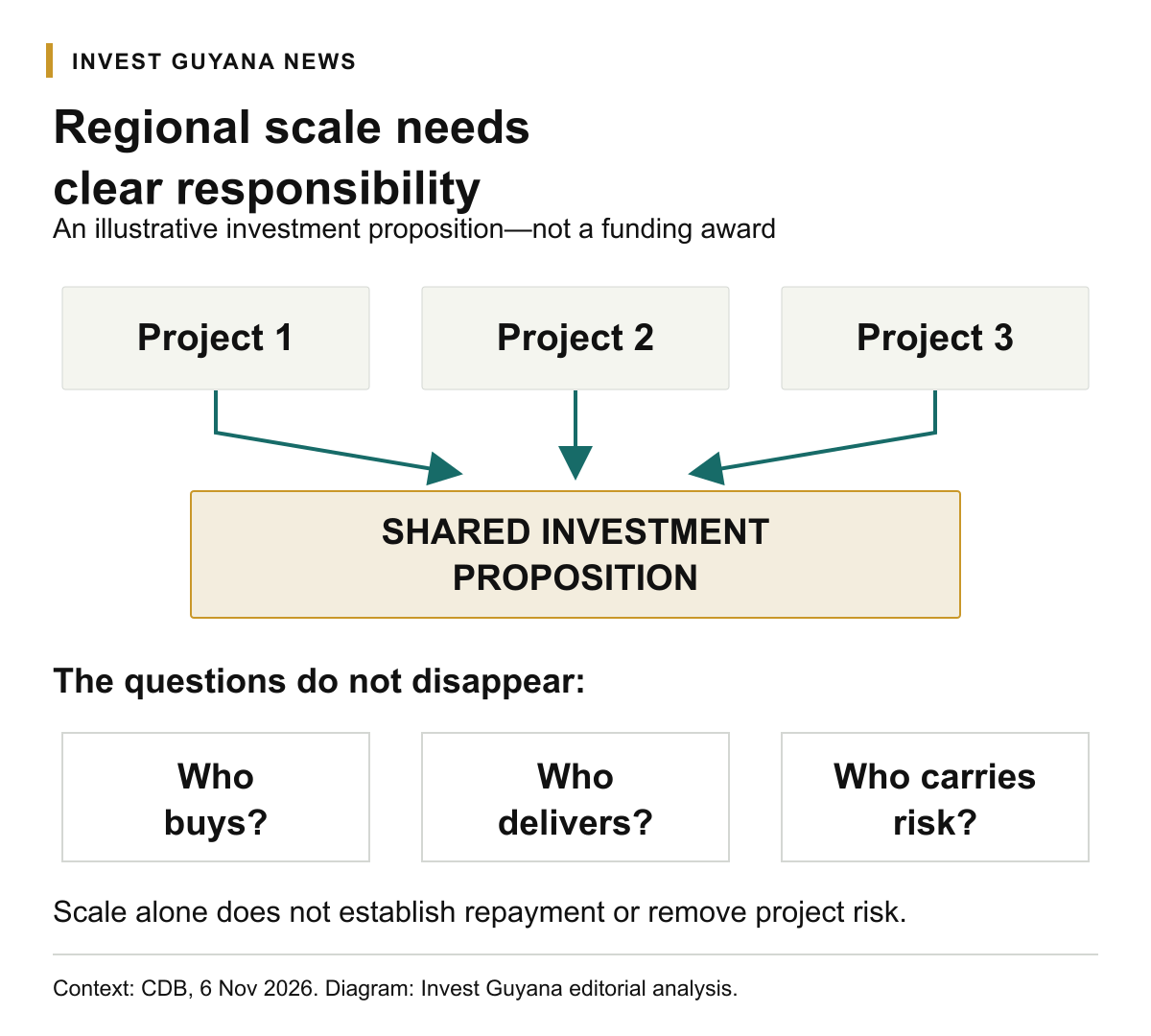
The distinction becomes important when the participants have separate owners. A common presentation does not settle who can commit each business, authorise spending or accept a change in scope. Nor does it establish that money earned by one participant is available to meet another's obligations.
Imagine a regional proposal involving production, storage and distribution businesses. The activities may complement one another while their owners retain different priorities. One may want to expand quickly; another may need to replace ageing equipment first. A proposal that hides those differences can make coordination look easier than it will be after investment.
The useful work is to identify what is genuinely shared. Participants might agree on common technical preparation or a coordinated delivery timetable while keeping ownership and financing separate. Alternatively, they may negotiate a more integrated structure. The appropriate arrangement depends on their agreement; aggregation alone does not supply it.
For investors, the central question is who remains responsible when the combined plan encounters a delay. Scale is useful when it makes a proposition more coherent, not when it obscures the people and organisations accountable for delivery.
Risk sharing has to identify the risk being shared
A guarantee can address a defined exposure without making the underlying enterprise risk-free. Its commercial meaning depends on what it covers, the conditions attached and the party able to honour it. The presence of the word guarantee cannot substitute for that examination.
There is concrete regional background to the discussion. CDB's 10 June announcement described a trade-finance guarantee facility with IDB Invest, involving partial guarantees and financial institutions in countries including Guyana. That earlier agreement is context for the latest address, not a new allocation to Guyanese businesses or confirmation that any particular transaction qualifies today.
The distinction between financial protection and operating performance matters to the processor in the opening example. An instrument addressing a payment-related exposure would not, merely by existing, solve an unsuitable product specification, unreliable delivery or insufficient customer demand. Those problems require their own commercial response.
Risk sharing can make a sound transaction more workable when it addresses the constraint that actually prevents participation. It can be less useful when participants use it to avoid examining an unresolved weakness in the business itself. The question is not whether all uncertainty can disappear, but whether the remaining exposures are understood and carried by parties able to manage them.
Guyana's opportunity includes the connections around a project
The relevance to Guyana is not confined to an enterprise seeking a large regional investment. Smaller suppliers can examine how they fit into a commercial network that reaches more than one market, without assuming they must own every part of it.
A processor might work with a distributor rather than establish its own presence in each destination. A specialist service business might support several projects through a regional partner. These are possible business choices, not CDB-announced opportunities or a claim that access to another market has already been secured.
The quality of those connections influences the investment case. A production expansion can be technically achievable while distribution remains uncertain. A buyer may welcome a new product but be unwilling to carry inventory on the terms the producer expects. Each gap can affect whether a larger regional proposition is commercially convincing.
This places attention on relationships as well as assets. Investment in equipment has a clearer purpose when there is a credible account of how customers will be reached and served. Regional coordination becomes valuable when it helps resolve those practical connections, rather than adding another layer of meetings around an unchanged problem.
The next evidence should come from transactions
The address sets out a direction for regional investment; it does not itself establish a new project pipeline, disbursement or outcome. Meaningful follow-up would identify which proposals move into preparation, who is participating and what prevents viable transactions from advancing.
For a business or investor, progress should become visible in firmer customer commitments, clearer responsibilities or a financing structure that addresses a defined constraint. An aggregate investment ambition says less about delivery than evidence that those relationships are beginning to work.
The Guyanese processor still has a decision to make. Buying equipment to serve an imagined regional total would be one choice; developing reliable customer and distribution relationships before committing to the expansion would be another. CDB's call places regional scale and risk sharing in the investment conversation. The commercial test is whether they help turn separate possibilities into a proposition that can actually be delivered.
Editor's note: Official information was reviewed on 7 November 2026. The enterprise and project situations are illustrative analysis, not named businesses, CDB-approved transactions or investment recommendations.