

The accountant and the company secretary were asking for different things
The email arrived near the end of the financial year. The accountant asked for the records needed to prepare the company’s tax return. A few minutes later, the company secretary asked whether the annual return had been filed.
The managing director assumed the second message was a duplicate.
“The accounts are already being prepared,” he replied. “Isn’t that the annual return?”
It was a reasonable misunderstanding. Both obligations recur. Both require accurate company information. Both can involve financial records. But they belong to different systems and perform different jobs.
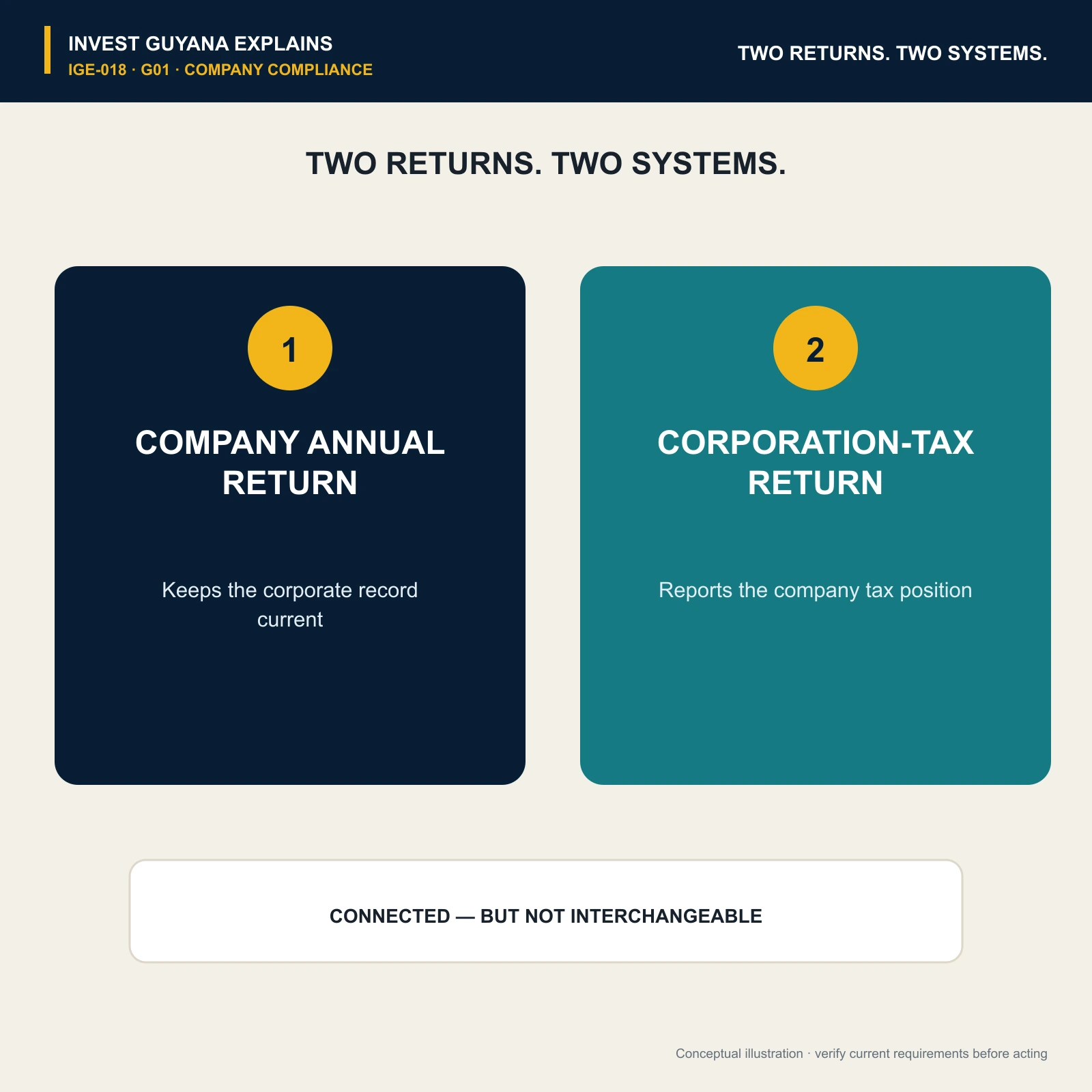
A company annual return helps maintain the public corporate record. A tax return reports information required for tax administration. Neither automatically replaces the other.
One company can exist in several official systems
Incorporation creates a company under the Companies Act and places it within the corporate-registry system administered by the Deeds and Commercial Registries Authority. Taxpayer registration places the same company within the Guyana Revenue Authority’s system.
The company remains one legal entity, but the two authorities are looking at it through different lenses.
The corporate registry is concerned with the company’s continuing legal record: its registered identity, prescribed office and governance information, and other changes that legislation requires the company to report.
The tax authority is concerned with the company as a taxpayer: its income, deductions, classification, returns, payments and supporting financial information.
That is why one filing cannot be assumed to update every other official record.
What a company annual return is designed to do
An annual return is a corporate-maintenance record. It is not the document that calculates corporation tax.
Its purpose is to give the registry the prescribed periodic information about the company. It helps the official record remain usable even when the company has operated for many years after incorporation.
Think of incorporation as the creation of the company and the annual return as one of the mechanisms that keeps its registry profile current.
The annual return should also not be confused with an event-driven notice. If a company changes a director, secretary, registered office or another prescribed item, the relevant change may have to be reported through its own process. Waiting for the annual return is not automatically a substitute for making a required change filing.
Beneficial-ownership information is another distinct layer. A company can file an annual return and still need to examine whether the natural persons who ultimately own or control it have changed.
What a corporation-tax return is designed to do
A corporation-tax return belongs to tax administration. It reports the company’s tax position for the relevant period and is supported by the records required by the applicable tax rules.
The tax exercise can involve the company’s classification, income, allowable deductions, chargeable income, advance payments, balance payable and supporting financial statements or schedules. Those questions are different from the registry’s periodic confirmation of corporate particulars.
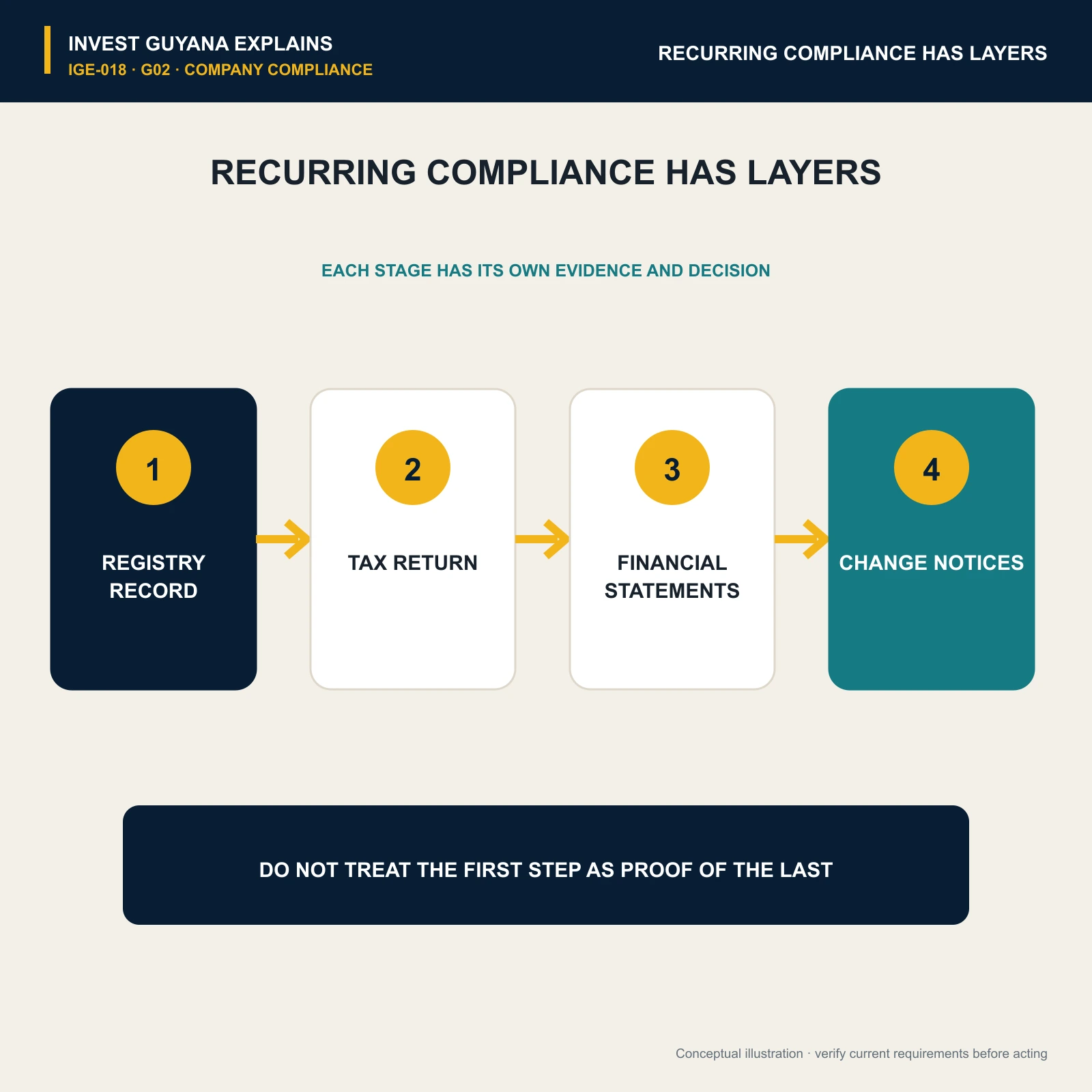
A company may therefore have completed its registry filing and still have unfinished tax obligations. The reverse is also true: submitting a tax return does not prove that the company’s registry record, beneficial-ownership information or change notices are current.
Financial statements are related, but they are not a universal replacement
Financial statements describe the company’s financial performance and position according to the applicable accounting and reporting requirements. They may support tax reporting, corporate governance, financing and other obligations.
But financial statements do not automatically perform the legal function of every form to which they may be attached.
Attaching accounts to a tax filing does not turn the accounts into a corporate annual return. Preparing audited statements does not update a change in the company’s registered office. A bank’s review of financial statements does not satisfy the registry’s beneficial-ownership requirements.
The practical lesson is to identify the legal purpose of each record before treating one document as a substitute for another.
“Annual” does not mean “same deadline”
The word annual can create false confidence. Two obligations may both recur yearly while using different reporting periods, triggers, due dates and authorities.
Companies should therefore avoid building a compliance calendar around labels alone. The calendar should record:
- the obligation;
- the responsible authority;
- the reporting period or triggering event;
- the required record or return;
- the person responsible internally;
- the evidence that the obligation was completed.
Exact forms, submission channels and deadlines can change. A company should therefore confirm the current DCRA, GRA and other applicable requirements before relying on a filing calendar.
Why the distinction matters during transactions
The difference becomes especially important when a company seeks finance, enters an investment transaction, tenders for work or opens a regulated account.
A counterparty may ask whether the company is in good standing at the registry. A lender may ask for financial statements. A procuring entity may request tax and NIS compliance evidence. A due-diligence team may ask for the beneficial owners. These requests can arrive together, but they do not become one legal obligation simply because they are collected in one folder.
Treating compliance as a single certificate can create blind spots. A company may be current in one system and overdue in another.
The better way to think about recurring compliance
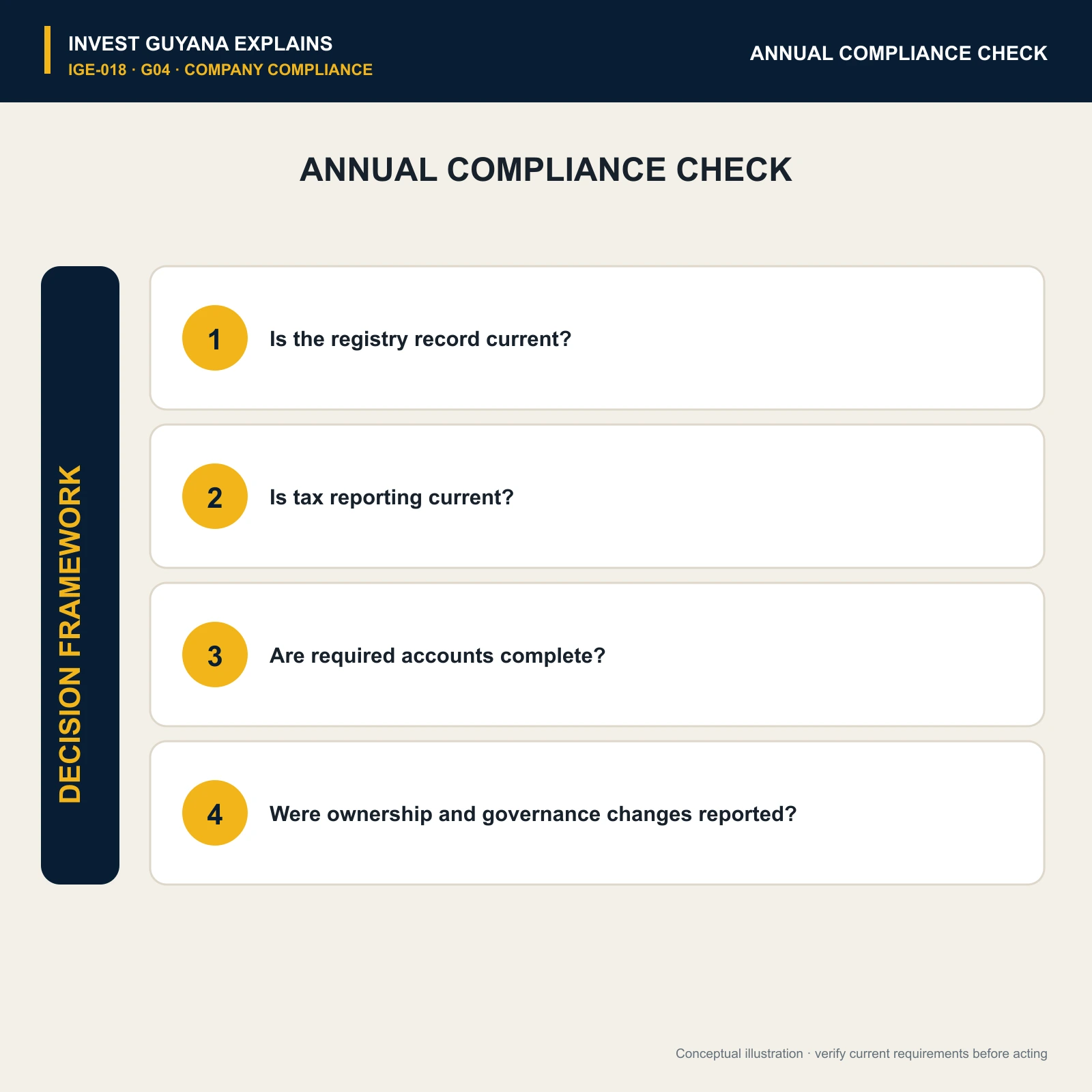
Instead of asking, “Did we file the annual document?”, ask four separate questions:
- Is the corporate-registry record current?
- Is the company’s tax reporting current?
- Are required financial statements and supporting schedules complete?
- Have ownership, control or governance changes been separately reported where required?
Those questions create a compliance map rather than a pile of similarly named documents.
The investor takeaway
An annual return and a tax return are not two names for the same filing.
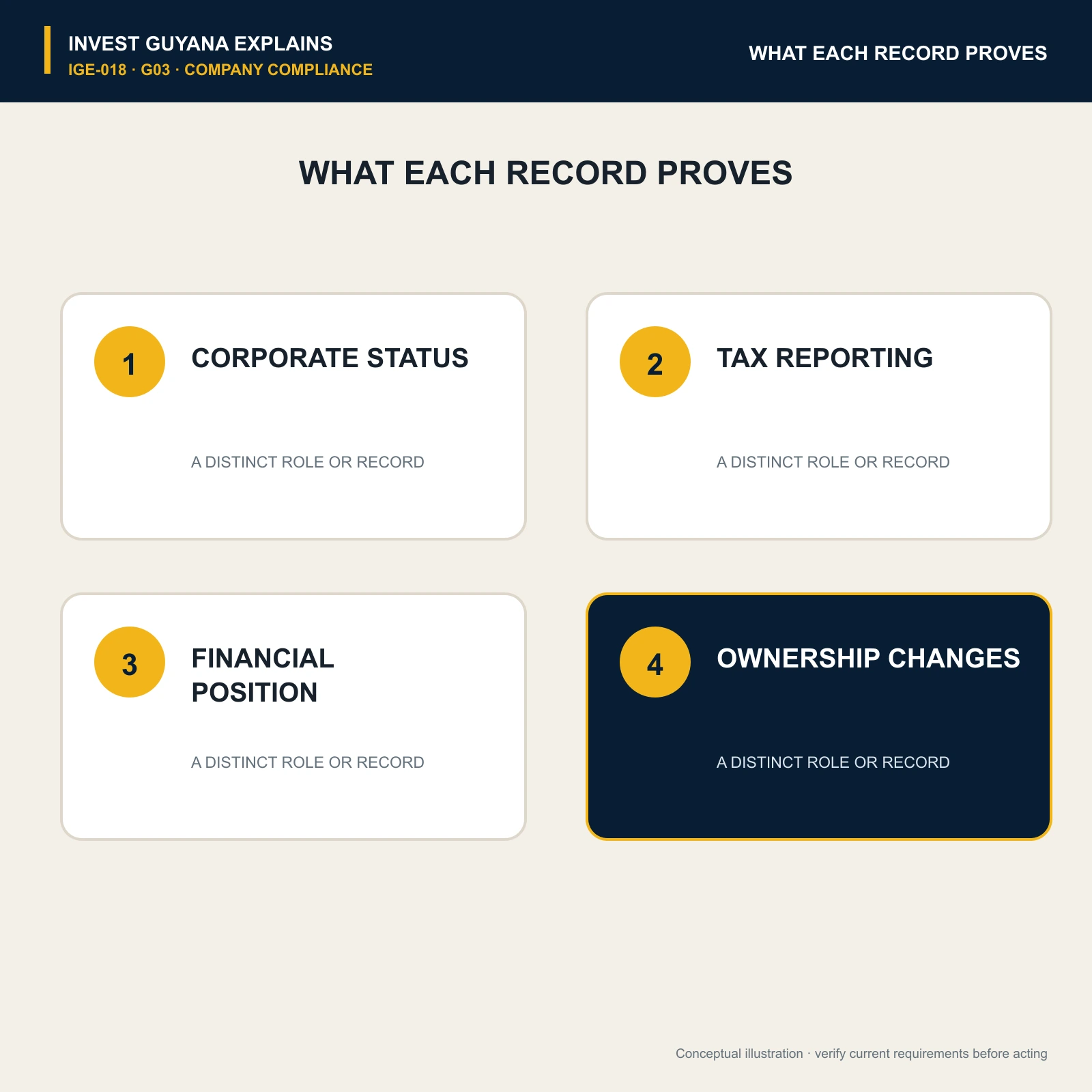
The annual return serves the continuing corporate record. The tax return serves tax administration. Financial statements may support one or more obligations, while beneficial-ownership and change notices answer still other questions.
The company is the connecting point, but each system retains its own purpose. Businesses that understand that distinction are less likely to discover a missing filing when a bank, investor, regulator or tender process asks for evidence.
The next article in Invest Guyana Explains will turn to payroll, explaining why PAYE and NIS arise from the same employment relationship but remain two separate employer systems.