Photo: Department of Public Information, Guyana.
For a family that has qualified for mortgage financing, approval does not end the wait for a home. The property still has to move from foundation and walls to a completed unit that can be inspected, financed and occupied.
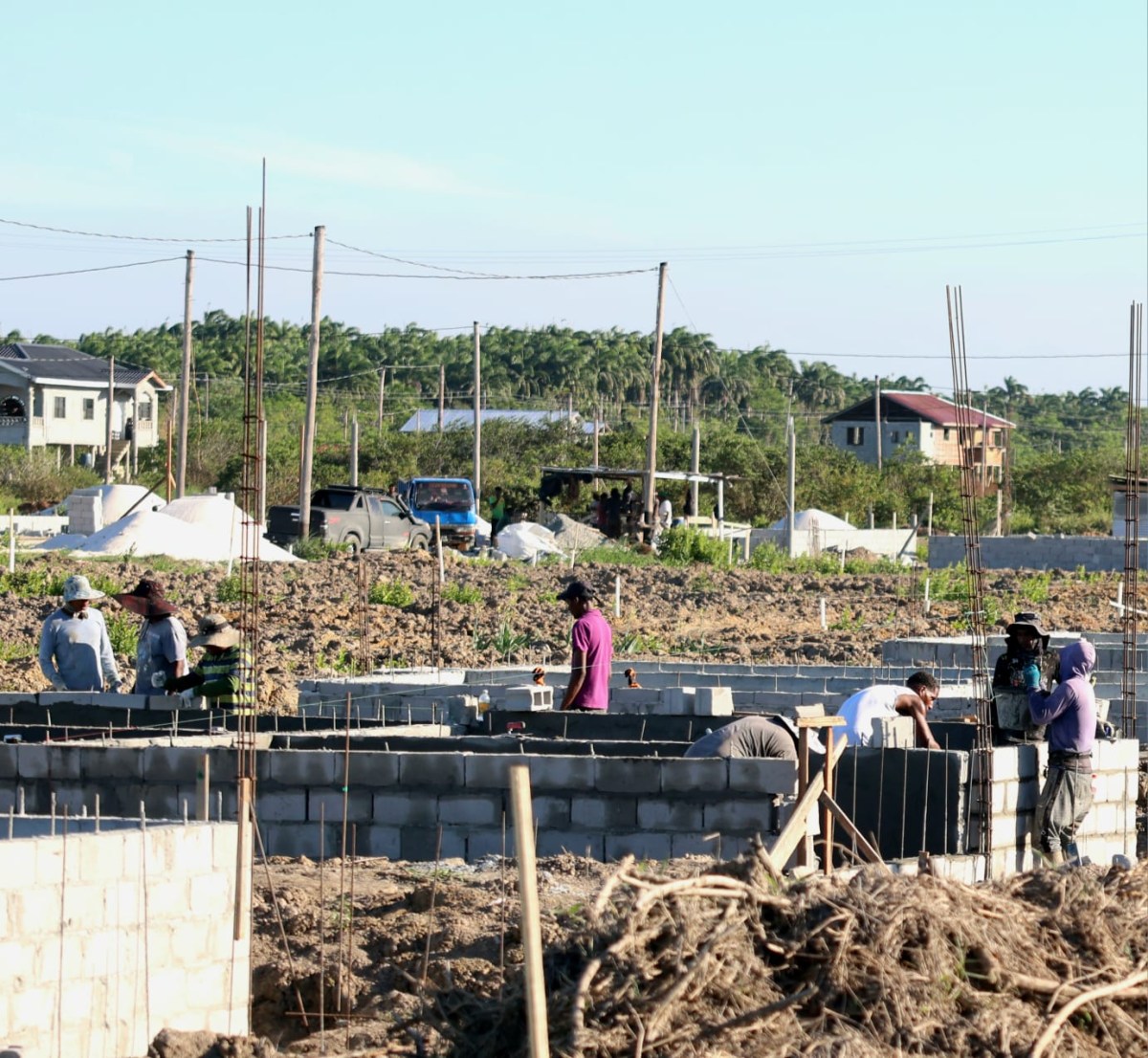
At Le Reconnaissance on Guyana’s East Coast of Demerara, construction of 100 two-bedroom, low-income homes has reached approximately 15 per cent. The government says eight contractors are working on the project, more than 120 people are employed, and substantial completion is expected by January 2027.
Each house is currently valued at G$5.5 million. The units have been allocated to pre-qualified beneficiaries who have secured financing through the banking system, according to Housing Minister Collin Croal.
The development offers a practical view of Guyana’s housing-delivery chain. It combines public land and infrastructure, private contractors, mortgage finance and household demand in one construction programme.
One hundred homes within a larger development
The current package forms part of a wider 175-home development at Le Reconnaissance. The official project update says the remaining 75 homes adjoin the block now under development.
The 100 homes are being delivered by eight contractors. Dividing the work among several firms can broaden contractor participation and let construction advance across multiple plots. It also makes consistent supervision important: buyers will expect the same specification and workmanship even when different contractors deliver different units.
The January 2027 date is a substantial-completion target. It should not be read as a guarantee that every beneficiary will receive a home on the same day. Individual units may finish at different times, and handover can depend on inspection, utilities, documentation and remedial work.
Minister Croal said some units could be completed before Christmas. That remains a forward-looking expectation, not a confirmed handover schedule. Beneficiaries should rely on formal communication from the housing authority and their lender before making moving or rental commitments.
Mortgage approval meets construction delivery
This project differs from a house-lot allocation because beneficiaries are waiting for completed homes. That brings mortgage finance directly into the construction timetable.
A household with bank approval may already have completed income and lending checks, but the lender still needs a completed asset capable of supporting the mortgage. Progress certification, insurance, valuation and final documentation can therefore become part of the path to handover.
The official update does not identify participating banks or publish individual mortgage terms and deposit requirements. Those arrangements can vary by lender and beneficiary. The G$5.5 million house value should not be interpreted as the total amount every household will pay over the life of a mortgage, because interest, insurance and other charges depend on the financing agreement.
For buyers, it helps to keep three documents distinct. A government allocation identifies the beneficiary and property; the construction programme produces the house; and the mortgage governs the financing. A delay or condition in one part of that chain can affect the others.
Construction creates immediate economic demand
The project is already supporting more than 120 workers, and contractors say additional skilled labour, including masons, is needed. The development therefore matters not only to housing applicants but also to the construction economy.
One hundred homes require blocks, cement, steel, timber, electrical supplies, plumbing fixtures, windows, doors, transport and supervision. The official release does not identify suppliers or quantify local-content spending, so no company should be assumed to hold a contract. The wider demand is nevertheless clear: multi-unit delivery requires organised procurement and a dependable flow of labour and materials.
For contractors, that opportunity carries delivery risk. Labour shortages, weather, material availability and coordination with roads, drainage and utilities can affect schedules. Smaller firms participating in housing programmes need enough working capital to pay workers and suppliers while meeting certification and quality requirements.
The use of eight contractors also creates a practical test of the distributed-delivery model. If the project meets its specifications and timetable, it may show how several firms can handle volume together. If progress varies widely between blocks, project management and quality control become more difficult.
Region Four remains the centre of demand
Le Reconnaissance sits in Guyana’s most heavily demanded housing region. A July government update reported 50,375 pending Region Four applications at the end of 2025. It said that 1,569 allocations by the end of April 2026 had reduced the revised backlog to 48,806.
The October update again described more than 50,000 pending applicants. The figures were reported at different times and may use different cut-offs, but the central point is unchanged: demand substantially exceeds the number of homes in this project.
That scale explains why the housing programme is moving beyond undeveloped lots. The 2026 Budget at a Glance outlines plans to facilitate construction of 8,000 homes, develop housing areas, issue titles and improve roads, drainage, lighting and community facilities.
Le Reconnaissance will not resolve Region Four’s backlog by itself. Its significance lies in one delivery model within the larger programme: pre-qualified buyers, multiple contractors and completed homes rather than land allocation alone.
What beneficiaries should monitor
For allocated families, the most useful information is specific. They need the expected completion status of their unit, what is included in the G$5.5 million value, when inspections occur, how defects are reported and when utilities and access infrastructure will be ready.
Beneficiaries should also keep mortgage approval current and respond when a lender requests updated information. An approval obtained months before handover may carry conditions or expiry dates that need attention.
Prospective buyers outside this project should not assume that the same price, design or financing arrangement applies elsewhere. Programmes differ by location, income category, land cost and specification.
Delivery will be measured one home at a time
The Le Reconnaissance project combines an immediate construction programme with a much larger policy challenge. One hundred homes can provide completed assets for 100 families, support employment and create demand across the building-supply chain. Against Region Four’s backlog, however, it remains one part of a broader requirement for land, infrastructure, finance and construction capacity.
The January target matters because beneficiaries have already arranged financing and are waiting for delivery. Progress percentages and project values are useful markers, but the final test is tangible: completed homes of consistent quality, supported by functioning infrastructure and handed over through a clear process.