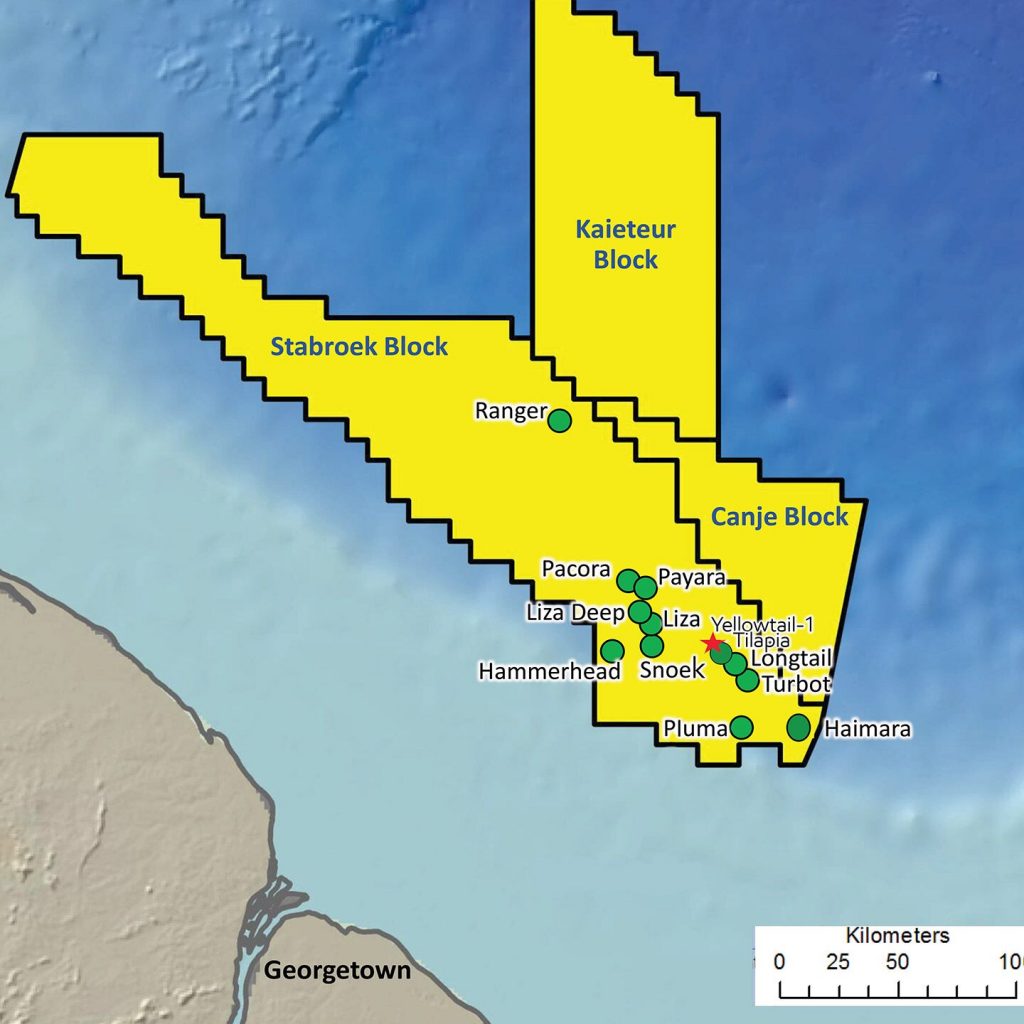
Archival map identifying Longtail in the Stabroek Block (Image: Department of Public Information, Guyana).
Guyana is reviewing a field-development plan and production-licence application for Longtail, a project that the government expects to become the Stabroek Block’s first development focused primarily on natural gas. The 2026 Mid-Year Report says the plan was submitted in March and identifies 2030 as the proposed startup year.
That is a meaningful step in the review process, but it is not a production licence. The project still needs the government’s decision on the submitted plan and application. Treating a target year as a completed approval would obscure the most important question for businesses following Guyana’s next energy investment cycle: what has actually been authorised?
A different kind of gas project
The distinction between Longtail and Guyana’s Gas-to-Energy project at Wales matters. As the Department of Public Information explained on 21 September, Wales is designed to use associated gas produced with oil from existing Liza developments and bring it ashore for processing and electricity generation. Longtail, by contrast, would develop a new offshore field with gas at the centre of the project, although oil is also expected.
For an investor, those are different propositions. A power plant, a gas-processing facility and a new offshore field can be connected in the wider energy economy without being the same asset or sharing the same regulatory timetable. Longtail’s significance is that it could expand the commercial use of gas beyond the model of bringing associated gas from producing oil fields to shore.
The government describes Longtail as the proposed eighth Stabroek development. That sequence is useful context, but it does not show that the project’s gas volumes, sales arrangements, infrastructure needs or final economics have been settled in public. The Mid-Year Report gives a review status and a startup target, not a final investment decision or a detailed commercial plan.
What comes next
Longtail is part of a broader prospective gas portfolio. The same report says an application for environmental authorisation for Haimara, a proposed ninth development, was submitted in the first half of 2026 and that public scoping meetings were completed. Haimara is also expected to centre heavily on gas and condensate, with production envisaged for the early 2030s. Those are separate projects at different stages, and their timelines should not be combined.
For companies assessing future demand for offshore services, fabrication, logistics, training or gas-related industry, the immediate signals to watch are the Longtail licensing decision, any updated development scope and a clearer account of how produced gas would be handled and marketed. The current public record supports an emerging direction, not a procurement forecast for every supplier.
Longtail therefore belongs in Guyana’s forward energy outlook, with its status stated plainly. The government’s review could move the project closer to development, but only subsequent approvals and project decisions will establish what, when and at what scale it will be built.