

Drone photograph from Invest Guyana’s media archive; contextual image, not the hypothetical project described.
Imagine a contractor agreeing to fit out a new office. The price and opening date are clear enough in the first meeting, but the project changes as work proceeds. Additional fittings are requested, access is delayed and the client expects the original completion date to remain unchanged.
Both sides believe they are being reasonable. The disagreement grows because their understanding of the arrangement has developed differently. What began as a straightforward commercial promise now raises questions about scope, authority, cost and the consequences of delay.
A contract gives a business relationship a more defined structure, but its value extends beyond the signature page. Understanding the commitments helps the parties manage performance, recognise changes and address disagreements before assumptions become expensive disputes.
Defining the exchange
At a practical level, a commercial agreement describes an exchange of obligations. One party may provide goods or services while the other pays under agreed terms. The useful questions concern what has been promised, how performance will be identified and what happens when circumstances differ from expectations.
For our office project, “complete the fit-out” may be insufficiently precise for everyone involved. The parties could have different expectations about materials, finishes, testing, access or work performed by others. A price is meaningful only in relation to the work and risks it covers.
This is an illustrative business discussion, not a universal legal test for forming or enforcing a contract. The effect of an actual agreement depends on its terms and applicable law. The aim is to understand why a document must be read as a set of connected commitments rather than as a receipt for a deal.
The same reasoning applies outside construction. A service subscription, equipment purchase or distribution arrangement can create continuing obligations after the first payment. Understanding the relationship means following those obligations through performance, not stopping once the parties have agreed to do business.
Scope determines what the price buys
A clearly understood scope connects the expected outcome to the resources and price agreed. Without that connection, one party may view a request as a minor clarification while the other sees additional work. Neither description alone settles what the agreement requires.
Suppose the client asks for additional electrical points after installation has begun. The commercial consequences might include materials, labour, access and effects on other tasks. Even a modest physical change can affect more than the price of the extra components.
The contractor therefore needs to distinguish the original obligation from the proposed alteration. The client likewise needs to understand what is included before assuming that every desirable improvement belongs within the original quotation. The relevant agreement determines how such questions are addressed.
This distinction protects the usefulness of the price itself. A fixed figure cannot provide meaningful certainty if the parties continually attach different work to it. The scope and price need to be interpreted together.

Delivery and acceptance concern performance
Completing an activity, delivering an item and obtaining acceptance can be different events. Their relationship depends on the agreement. A business should not assume that sending an invoice proves satisfactory performance or that an informal expression of satisfaction settles every contractual requirement.
Imagine equipment delivered to a site but awaiting installation and testing. The buyer has received something, yet the promised outcome may involve more than physical arrival. Conversely, the supplier may have completed its agreed responsibility even though another contractor’s work remains outstanding.
These differences matter because payment or other consequences may be linked to defined stages. The parties need to understand what each stage means in their own arrangement. A familiar word such as “completion” can carry a more specific meaning than it does in everyday conversation.
The office project becomes easier to discuss when the participants distinguish work performed, evidence of performance and any contractual acceptance process. They are no longer relying on a single broad assertion that the job is either finished or unfinished.
Changes need a shared account
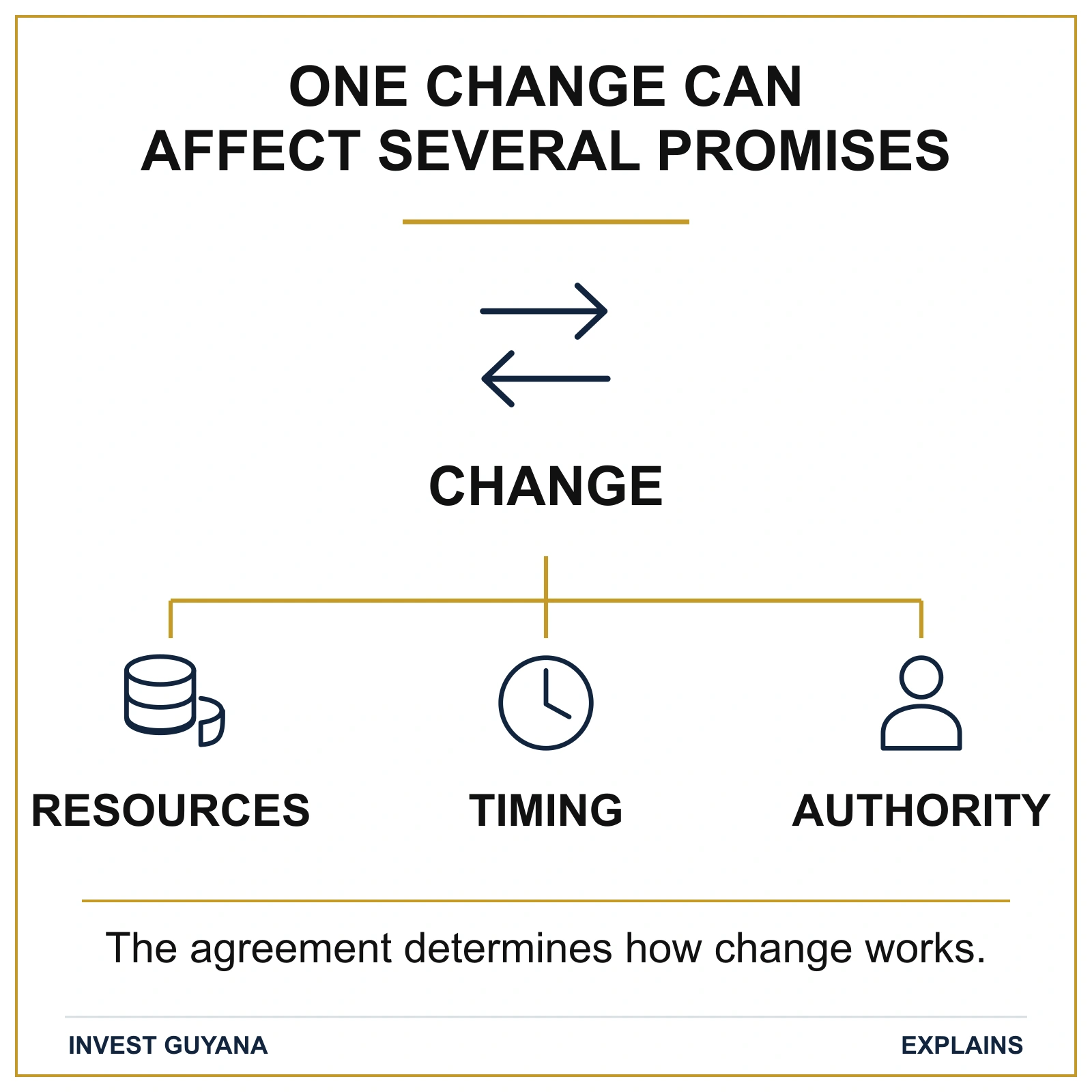
Projects often evolve, and a change is not automatically evidence that the original agreement was poor. The challenge is to understand who can authorise a change, how it affects obligations and what record establishes the revised position. An enthusiastic conversation may not answer all three questions.
A recent Guyana appeal illustrates the importance of these relationships. In Attorney General v Azad Meerza, the Caribbean Court of Justice considered a dispute involving changed work scope and agreed dispute processes. The case demonstrates that the handling of obligations and objections can have consequences beyond the underlying disagreement about the work. It should not be treated as a universal timetable for other contracts. CCJ judgment, 11 March 2026.
For our hypothetical contractor, a useful commercial record distinguishes the request, the authority behind it and the implications agreed. This is not a substitute for the contract’s required process. It explains why relying on memory becomes increasingly fragile as more people and changes enter the project.
The client benefits from the same clarity. A documented understanding can reveal that a requested improvement affects the opening date before expectations harden around an impossible combination of scope, price and timing.
A problem and its remedy are separate questions
Businesses sometimes assume that any breach automatically permits them to stop work, cancel an agreement or withhold all payment. Those conclusions depend on the agreement and law. Identifying a failure is not the same as establishing every action another party may lawfully take in response.
In Blairmont Rice Investment v Kayman Sankar Investments, the CCJ examined contractual terms and the consequences of non-payment in a Guyana dispute. The judgment supports taking the circumstances seriously rather than reducing every payment failure to one automatic result. CCJ judgment, 25 June 2021.
Suppose our client considers a delay unacceptable while the contractor believes that late site access caused it. The parties may disagree about responsibility before they even reach the question of a remedy. Acting on an assumed right can introduce further risk if the agreement does not support the response.
This is an appropriate point for transaction-specific legal advice. A general explainer can clarify the distinction between performance, breach and consequences, but it should not tell a reader to terminate, refuse payment or ignore a notice on the basis of a hypothetical story.
Dispute arrangements are part of the agreement
Commercial parties may agree ways to address disagreements, potentially involving negotiation, adjudication, arbitration or court proceedings as applicable. The relevant process, authority and timing depend on the arrangement and law. These provisions matter before a dispute, because they influence how the parties must respond when one develops.
The Meerza judgment illustrates that failing to engage with an agreed process can have serious consequences. It involved its own contractual and legal setting, including an older statutory framework. Readers should not copy that case’s procedural details into a different contemporary agreement.
An older agreement and the law applied in its dispute may differ from the arrangements relevant to a new project. Before relying on a procedural example, the parties need advice on their own contract and the applicable rules. The case illustrates the importance of taking dispute arrangements seriously; it does not supply a universal route or deadline.
For the office project, the conceptual lesson is straightforward: a disagreement does not erase the agreed relationship. The parties need to understand how the contract expects concerns to be raised and resolved, rather than assuming that ordinary correspondence can safely replace every required action.
For readers working with public procurement, the Guide on what happens after bid evaluation addresses the relevant recommendation, award and formation process. This article has a different role: explaining the business commitments that must be understood within an actual agreement. It should not be used to bypass public-procurement requirements or to infer that an informal commercial discussion has completed a regulated award. A future contract-review preparation Guide can organise practical questions for professional advice without purporting to provide a universally suitable contract.
An agreement can also outlast the people who negotiated it. Clear records help a replacement manager understand the commitments already made, rather than reopening every earlier discussion from memory when responsibilities change.
Returning to the fit-out
The contractor and client can now separate the questions that had become entangled. They need to understand the original scope, any properly agreed changes, the evidence of performance and the consequences of each party’s conduct. Those questions can be addressed without pretending that a single disappointed expectation settles the whole dispute.
A contract is valuable because it gives commercial cooperation a more defined structure. It does not eliminate uncertainty or guarantee harmonious performance. Its usefulness depends partly on whether the parties continue to understand and manage their commitments after signing.
The next explainer follows a related question for goods themselves. A supplier may deliver exactly what was ordered, yet a product can still face requirements concerning conformity, labelling or sale. Contractual performance and regulatory compliance answer different questions about the same transaction.