

Drone photograph from Invest Guyana’s media archive; contextual image, not the hypothetical project described.
Imagine an entrepreneur discussing finance for new equipment. The business forecast is promising, but the lender also asks about security and a possible personal guarantee. The entrepreneur hears these as different descriptions of the same reassurance: if the company has valuable assets, the loan should be safe.
That interpretation leaves out several important distinctions. The company’s ability to make ordinary payments is one question. The assets supporting a lender’s claim are another, and a separate person’s promise to answer for an obligation can create a further source of exposure.
Understanding collateral and guarantees helps a business owner recognise what is being discussed before agreeing to documents. It does not establish the enforcement rights in a particular case, which depend on the actual arrangements and applicable law.
Repayment remains the starting point
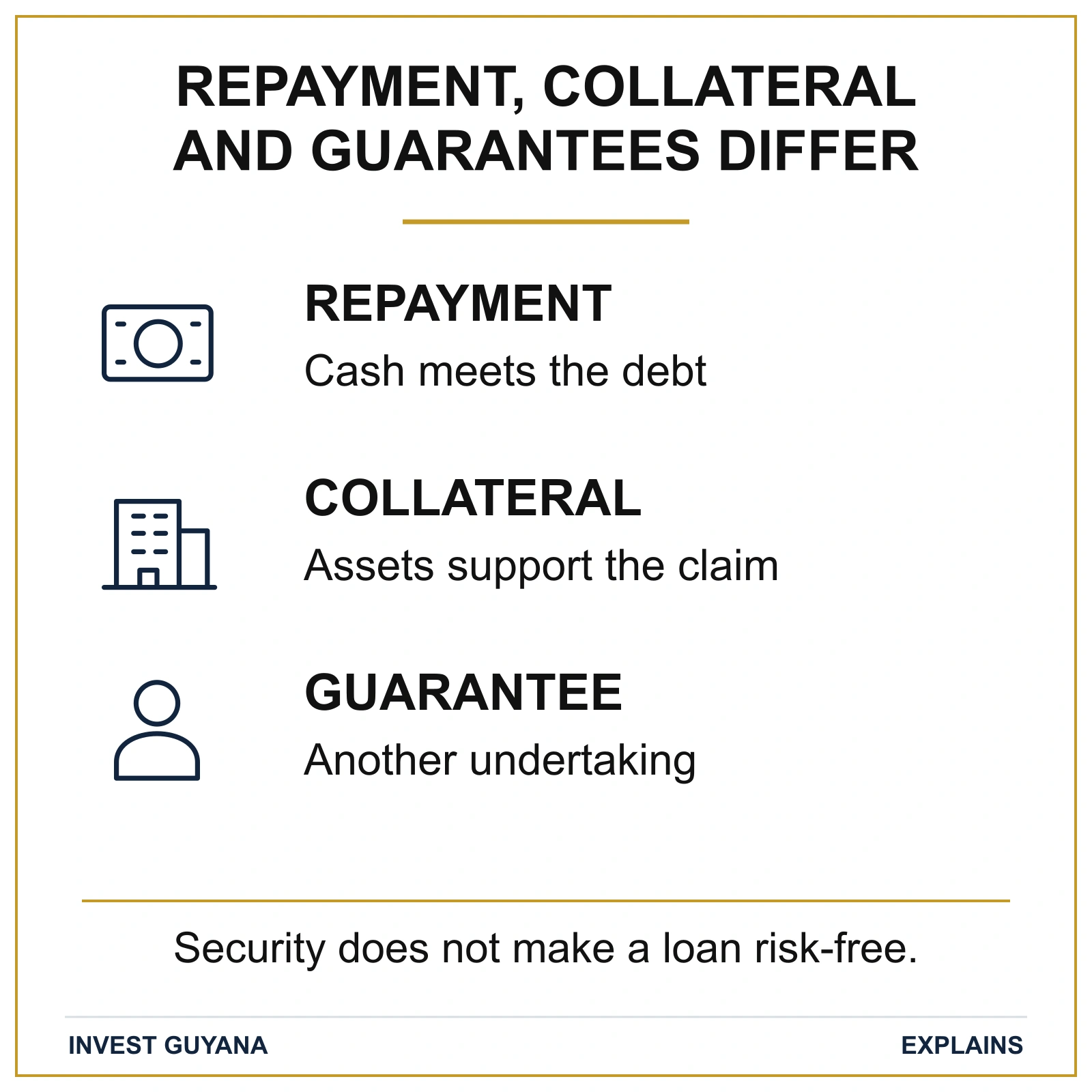
A lender ordinarily wants the business to generate enough cash to meet its obligations. Collateral does not turn weak cash generation into strong cash generation, and a guarantee does not make an unprofitable project commercially viable. These protections address aspects of credit risk rather than replacing the underlying business case.
The Bank of Guyana’s lending explanation describes assessment of a borrower’s financial position and the lender’s own policies. This helps explain why a valuable asset alone does not create an automatic entitlement to finance. Bank of Guyana explanation of loans.
For our equipment buyer, the projected customer receipts must still support normal repayment. If the enterprise cannot explain where that cash will come from, adding a second party’s promise does not answer the operational question. It changes who may face consequences if the expected cash fails to arrive.
This distinction is useful even when an application is successful. A borrower should understand the loan as an obligation expected to be met through its agreed payment arrangements, not as permission to disregard payments because an asset has been offered in support.
Collateral concerns assets
Collateral is an asset pledged in support of a borrowing arrangement. Depending on the lender, the transaction and applicable requirements, discussions might involve property, equipment or other business assets. Whether a particular asset is acceptable and what rights can be created over it require specific examination.
BDC’s general explanation distinguishes pledged assets from the broader protections that may form part of a lending arrangement. The conceptual distinction is useful, but Canadian legal or enforcement examples should not be imported into a Guyana transaction. BDC explanation of collateral.
Suppose our entrepreneur proposes the new machine as collateral. Its invoice price does not tell the whole story. A specialist machine may be productive for this particular business while being difficult to sell quickly to someone else. Its condition, market and other claims can affect the lender’s assessment.
The owner therefore needs to distinguish the machine’s contribution to the enterprise from its role in a security arrangement. One concerns the income it may help generate; the other concerns rights and potential recovery if repayment fails.
A guarantee concerns an additional promise
A guarantee involves another party undertaking responsibility under defined terms for an obligation. It can therefore expose someone other than the principal borrower. A personal guarantee should not be treated as a character reference or a ceremonial signature confirming that the owner believes in the business.
The Guyana Association of Bankers’ published code separately discusses individual third-party guarantees and the liability being accepted. As an industry code rather than legislation, it does not determine every case, but it reinforces the importance of distinguishing this undertaking from ordinary company borrowing. Code of Banking Practice.
Imagine the company’s founder being asked to guarantee its debt. The company and the founder are not the same borrower merely because the founder controls the business. The guarantee may create a separate exposure whose extent depends on the document and law.
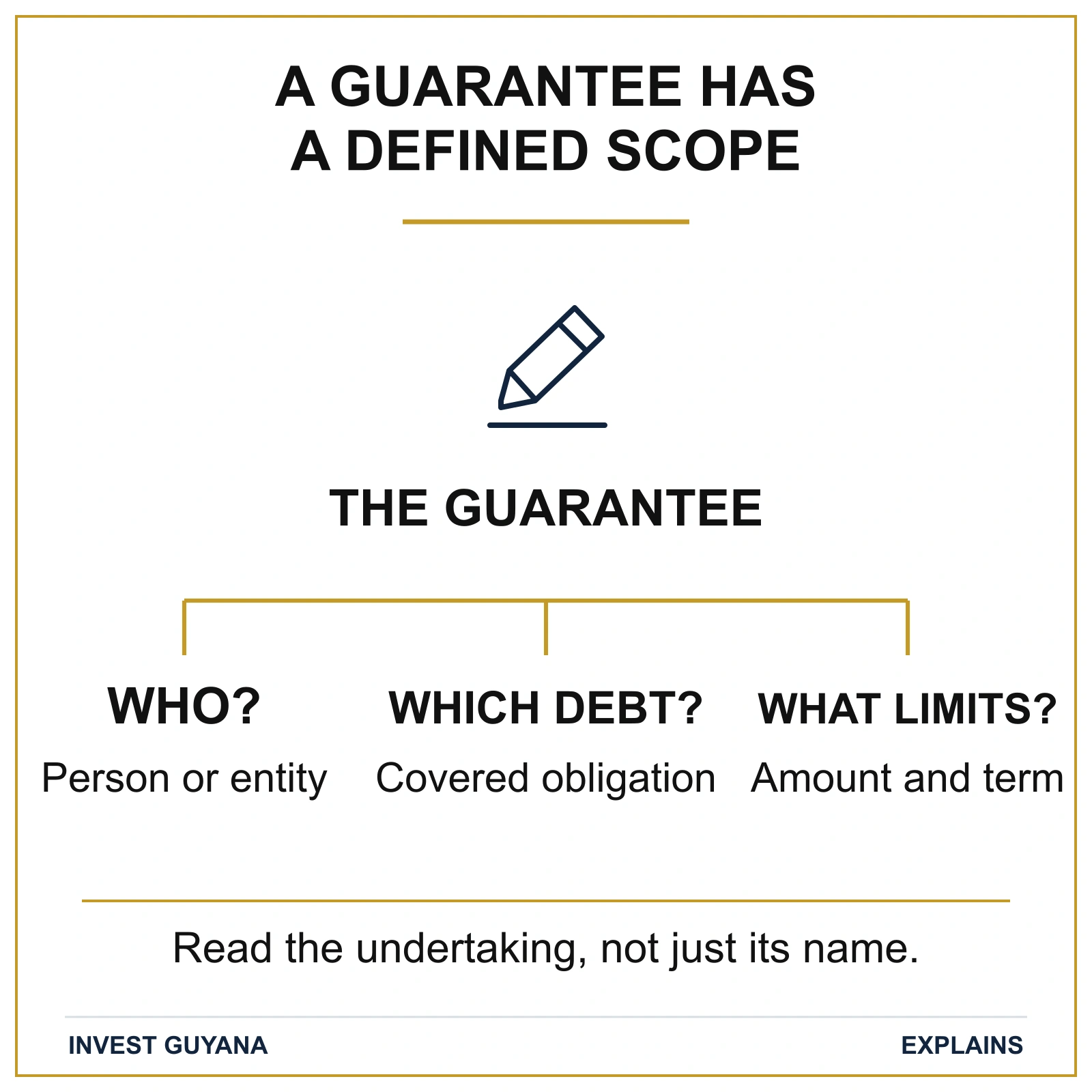
That exposure cannot safely be inferred from the word “personal” alone. Limits, duration, covered obligations and the effect of later changes require careful understanding. An owner who focuses only on the initial loan amount may overlook the actual scope of the undertaking proposed.
Assets and promises can appear together
A lending arrangement can include both collateral and a guarantee. Their coexistence does not make one redundant, because they can support the lender’s position in different ways. The relationship between them is established by the documents and applicable rules.
Bank of Guyana prudential guidance treats collateral and guarantees as distinct forms of credit-risk mitigation. Those provisions concern banks’ regulatory capital treatment; they are not a complete statement of a borrower’s enforcement rights. They nevertheless show that the distinction is recognised within Guyana’s banking framework. Bank of Guyana Supervision Guideline No. 14.
For our entrepreneur, offering a machine does not establish that any proposed personal guarantee is irrelevant. Nor should the entrepreneur assume that the lender must always dispose of the machine before taking any other permitted action. Such a sequence cannot be promised without examining the actual legal position.
This is where apparently simple lending language can conceal important consequences. “The loan is secured” tells the reader that protections exist, but it does not identify every asset, undertaking or person affected by them.
Security does not mean safety for the borrower
The word “secured” can sound reassuring because everyday language associates security with protection. In lending, it commonly describes protections supporting the creditor’s claim. Those protections may place important business or personal interests at risk if obligations are not met.
Conversely, an unsecured loan should not automatically be understood as a loan without any personal exposure or contractual protections. Whether guarantees or other commitments exist depends on the arrangement. The everyday label is not a substitute for reading what has actually been agreed.
Suppose the founder assumes that incorporating a company resolves every question about personal financial risk. A separately executed undertaking may require a different analysis. The corporate structure and the promises an individual later gives are related but distinct matters.
The lesson is not that security or guarantees are inherently inappropriate. They are established features of financing. The lesson is that their consequences should be understood deliberately rather than discovered after a business experiences difficulty.
A guarantee programme is not an automatic loan
Institutional guarantees can also feature in efforts to support access to finance. Their role is different from handing an applicant unconditional funding. A programme may support the lender’s risk position while leaving credit assessment, approval and disbursement with participating financial institutions.
Guyana’s Small Business Bureau describes such a relationship in its development-loan information. The distinction is useful for understanding the system without relying on changing programme amounts, coverage percentages or application requirements. Small Business Bureau loan programme.
For a small enterprise, this means programme participation and lender approval should not be treated as identical decisions. Nor does support for the lender ordinarily mean that the business can disregard its repayment obligations. The particular programme and finance agreement determine the relevant conditions.
This also keeps the article separate from the earlier mortgage explainer. IGE-026 dealt with property ownership, loan approval and mortgage security. Here the focus is the broader distinction between business repayment capacity, assets supporting a claim and additional parties’ undertakings.
Evidence about an asset is another distinct part of the conversation. If property is proposed as support, the relevant records can help establish its legal position; they do not by themselves establish that a lender will accept it on the proposed terms. The Guides on Deeds Registry property searches and Land Registry title searches address those practical record-search routes. They complement the lending concepts by identifying a task that may supply evidence, rather than promising that the evidence settles valuation, credit approval or the scope of a guarantee.
The parties’ circumstances can change during a loan’s life. A business may acquire assets, restructure operations or propose new borrowing, and the existing commitments may remain relevant to those decisions. Understanding the original security arrangements therefore supports later business planning as well as the initial financing discussion; it is not merely a question reserved for financial difficulty.
Returning to the equipment proposal
The entrepreneur now has a clearer picture of the financing discussion. The forecast concerns how the company expects to pay. The collateral concerns an asset supporting the lender’s claim, while a proposed guarantee concerns another undertaking with its own possible consequences.
These distinctions do not decide whether the founder should accept the arrangement. They make it possible to seek advice on the right questions and to describe the proposed commitments accurately before signing. Specific rights and enforcement remain matters for the documents and professional review.
The next explainer looks at a different way businesses address financial risk: insurance. Rather than supporting repayment after a borrowing failure, an insurance contract can transfer specified financial consequences of covered events, subject to its own boundaries.