
Drone photograph from Invest Guyana’s media archive; contextual image, not the hypothetical project described.
Imagine a small manufacturing company finding a location that appears suitable for its next factory. The directors send an expression of interest for state land, describe their intended development and begin discussing the site with a potential financier. In their presentation, the proposed parcel soon becomes “our land”, even though the correspondence establishing their interest says something much narrower.
Nobody has deliberately misled anyone. The company has simply allowed its expectations to move faster than the evidence. An expression of interest can be a meaningful step in exploring a project, but it does not carry the same effect as an allocation decision, a lease or another instrument granting rights.
For a business planning a long investment, the distinction matters before money is committed to buildings, equipment or promises to customers. Understanding state-land correspondence begins with a practical question: what does this particular document establish, and what remains undecided?
Expressing an intention
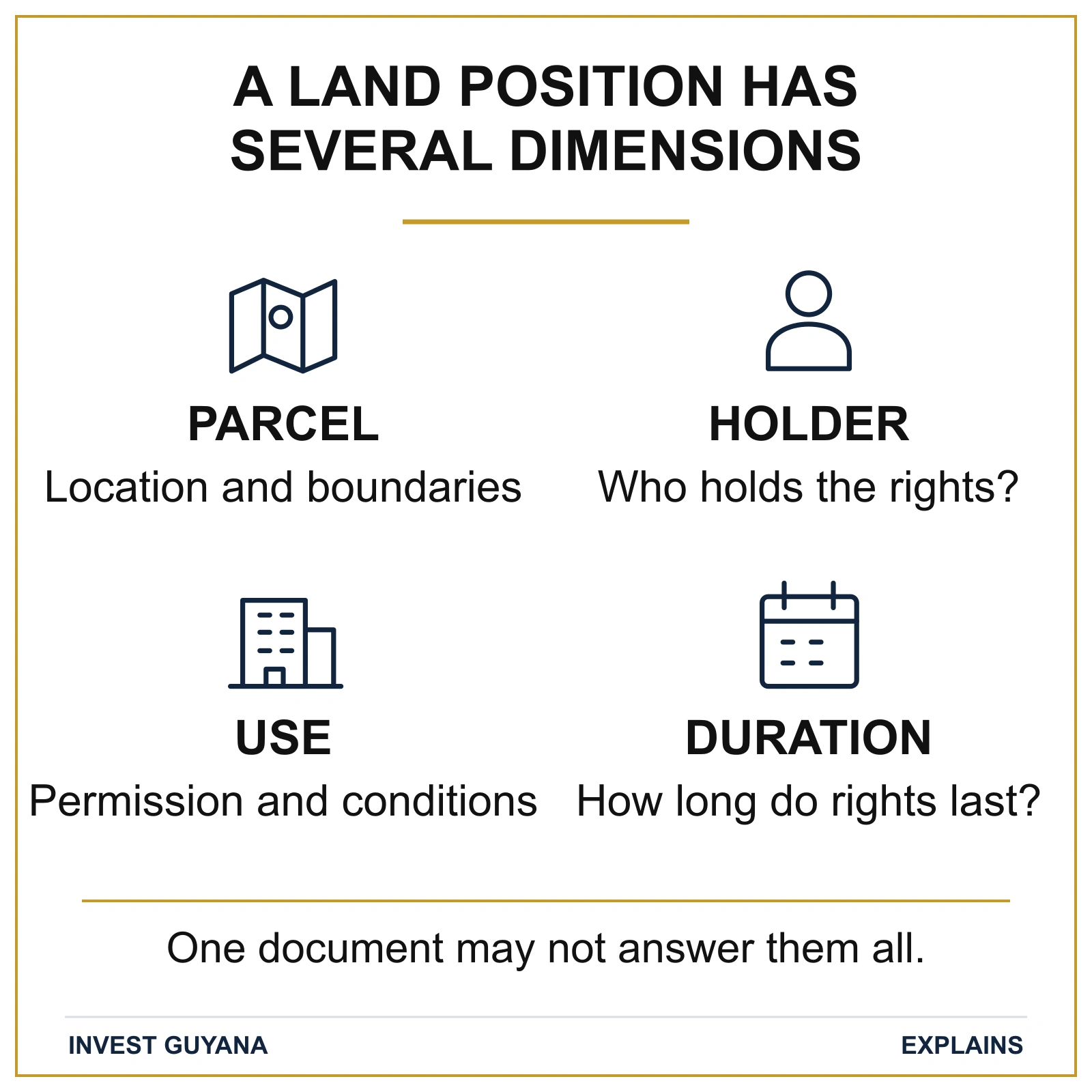
An expression of interest communicates what a person or business would like to do. The Guyana Lands and Surveys Commission’s published EOI form asks about the approximate area, location and proposed use of the land. Crucially, the form expressly distinguishes itself from an application form. It should therefore not be read as an instrument granting possession or ownership. GL&SC’s published EOI form.
For our hypothetical manufacturer, the submission establishes that the company has expressed interest in a particular opportunity. It may help communicate the project’s requirements, but the company cannot safely turn that communication into a claim that the parcel has been reserved, approved or made available for construction. Those conclusions would require their own supporting authority and documents.
This is easy to overlook because commercial planning naturally encourages a more definite vocabulary. A management team needs a location for its financial model, an architect needs a site for preliminary drawings, and a potential customer wants to know where production will take place. Each conversation can make a possible location feel increasingly settled without changing the underlying land position.
The sensible distinction is between using a proposed site as a planning assumption and presenting it as an acquired right. A feasibility study can explore whether the factory would work there while clearly identifying the land assumption as unresolved. That preserves useful planning without disguising uncertainty as an approval.
Different documents answer different questions
A land file can contain correspondence, survey material, decisions and legal instruments. Their importance lies in what each one actually does, rather than how official the file looks when assembled. A letter acknowledging receipt answers a different question from a document recording a decision, and a decision must itself be read for its precise scope and conditions.
Guyana’s State Lands Act provides for different arrangements, including grants, leases and occupation permissions. It also makes clear that its provisions do not oblige the State to dispose of land to an interested party. The existence of a process does not create an automatic entitlement to its desired outcome. State Lands Act, sections 3, 9 and 10.
That does not make preliminary correspondence unimportant. It means its value should be described accurately. A request for additional information may show that a matter is being considered, for example, while leaving both the decision and its possible terms unresolved. An encouraging discussion cannot tell a lender exactly what rights it could rely upon.
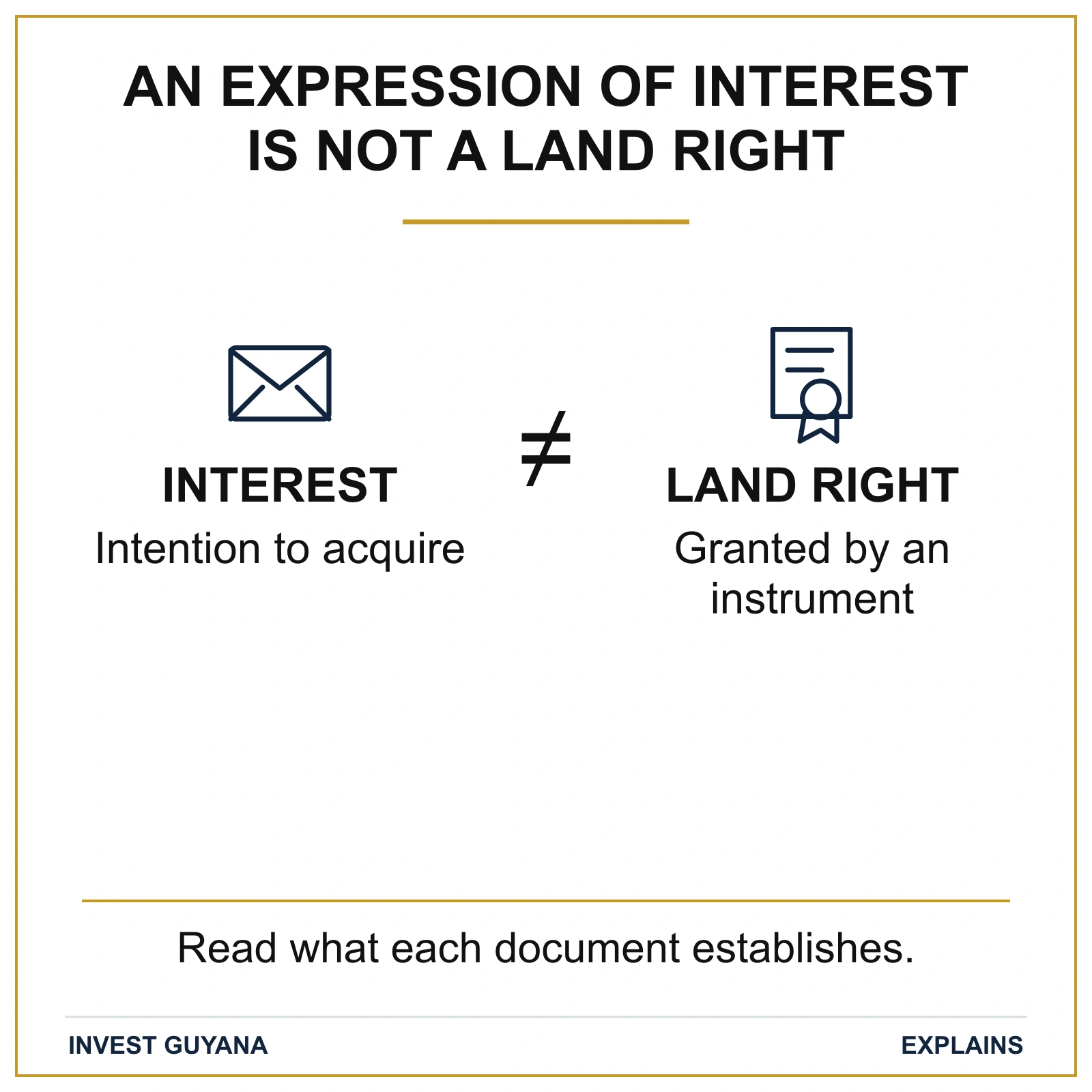
In our factory example, the financier is interested in more than whether someone in the company has spoken to the relevant office. It needs to understand the proposed borrower’s actual position. The identity of the holder, the land concerned, the authorised use and the duration and conditions of any rights can all affect the commercial assessment.
Identifying land is different from holding rights
A survey can make the physical subject of a proposal much clearer. Boundaries, area and location matter because an investment cannot be designed responsibly around an ambiguous parcel. However, identifying land and granting rights over it remain different functions; a precise drawing does not by itself answer who may occupy or develop the site.
GL&SC’s land-administration information describes boundary definition and an approved application as part of the basis for issuing a long-term lease. Its separate discussion of lease rights illustrates why the resulting instrument matters beyond the initial description of a location. GL&SC land administration services.
Suppose our manufacturer receives survey information showing that the proposed factory layout fits comfortably within the area under discussion. That resolves a design question, but it does not establish that the business has obtained the rights assumed by the layout. The engineering team and the land adviser are examining related matters, not producing interchangeable answers.
This distinction also explains why a project can become more technically developed while its land position remains conditional. Drawings, cost estimates and discussions with suppliers may all improve. The company still needs to separate expenditure made to investigate an opportunity from expenditure made in reliance on a legally established right.
A project file is therefore most useful when it records status as carefully as location. The same parcel can remain under discussion through several planning revisions, without those revisions changing the applicant’s legal position.
Conditions continue to matter
When rights are eventually granted, their conditions deserve the same attention as the favourable decision itself. A lease is not simply a more impressive acknowledgement letter. It establishes a relationship concerning a particular parcel, and the terms of that relationship can shape how the investment is financed, used and later transferred.
The practical implications become clearer if the factory’s plans change. Perhaps the company wants to add a distribution yard, introduce a new partner or use its interest in the land as security for finance. Whether the land arrangements accommodate those intentions cannot be answered merely by saying that a lease exists; the relevant instrument and applicable requirements must be examined.
This is why “we have land” can conceal several different commercial situations. One business may still be expressing interest, another may be awaiting the completion of conditions, and a third may hold an issued instrument with continuing obligations. Treating those positions as identical makes conversations between owners, lenders and contractors less reliable.
The article on property rights, IGE-023, introduced the wider differences between allocation, lease, transport and certificate of title. The narrower lesson here concerns the transition from an intention to an established position. It is a transition that must be evidenced, rather than assumed from the amount of planning already completed.
Land rights do not settle every project question
Even an established land interest does not answer every question about the proposed development. Planning considers the development itself, while environmental requirements concern its potential effects and applicable authorisations. These questions remain distinct from whether a company has expressed interest in, or acquired rights over, a site.
CHPA’s planning information, for example, asks for evidence relating to the property or permission to develop it as part of a separate planning assessment. This illustrates the relationship between the two subjects without making one approval a substitute for the other. CHPA planning information.
For the manufacturer, that means a realistic project discussion can acknowledge several different states of readiness at once. Its commercial concept may be promising, its site position unresolved and its development permissions still to be assessed. Presenting these separately helps everyone understand which assumptions could change the investment timetable.
It also protects the usefulness of professional advice. A land specialist, planner and financier may each need different evidence before reaching a conclusion. Their requests are not necessarily repetitions of the same question; they may be testing different risks that happen to concern the same factory.
Readers ready to make a submission can use the companion Guide on submitting a GL&SC expression of interest. It addresses the practical task; this explainer supplies the interpretation needed to describe its outcome accurately. The separate Guide on approval, survey and lease issuance follows later administrative work without making an EOI and a lease interchangeable.
Returning to the proposed factory
The directors can now revise their presentation without abandoning their ambition. They describe the parcel as a proposed location, identify the correspondence actually received and distinguish any outstanding decision from the rights an eventual instrument might grant. The project remains an opportunity, but its status is no longer overstated.
This is the real value of understanding an expression of interest. It allows a business to move forward with a more accurate account of what is known, what is conditional and what still requires evidence. It does not promise approval or replace advice on a particular parcel.
Our earlier property explainers followed the different documents and decisions surrounding land. With that foundation established, the series can turn to another assumption that often shapes an investment before it is tested: what strong national economic growth actually tells a business about its own opportunity.