
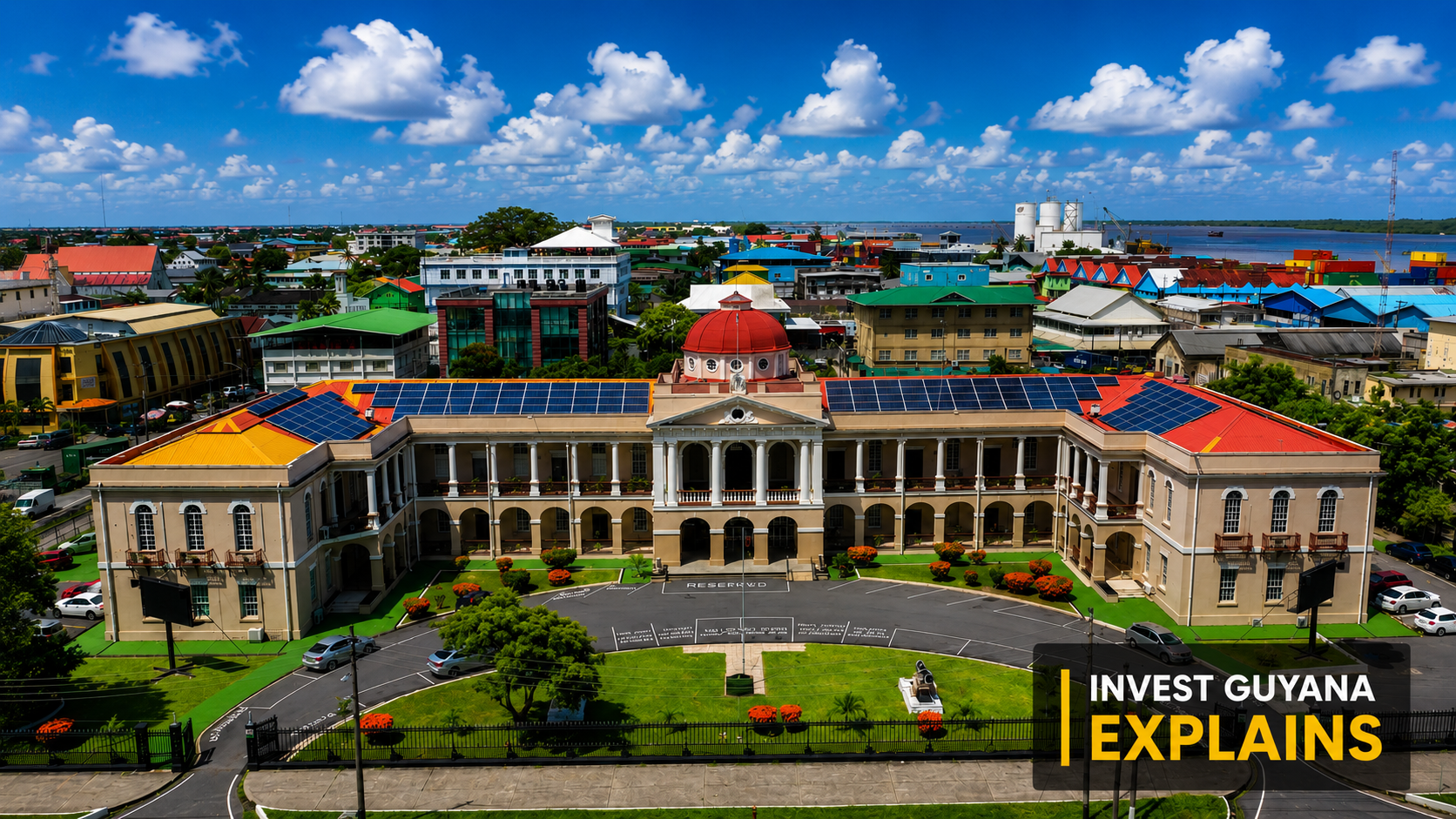
Imagine you’re planning to build a hotel in Guyana.
You’ve identified a promising location, spoken with local partners and started exploring the approvals you’ll need. As you begin your research, you come across a Cabinet announcement about tourism, a debate in Parliament on new legislation, environmental requirements from the Environmental Protection Agency, tax obligations administered by the Guyana Revenue Authority and investment services offered through the Guyana Office for Investment.
It quickly becomes clear that “the government” is not a single office making every decision. Instead, it is a network of institutions, each with its own responsibilities, working together within a common framework.
Whether you’re an investor, entrepreneur, student or simply trying to understand the country better, knowing how Guyana’s government works helps explain where decisions come from, who makes them and how policies become reality.
You do not need to study constitutional law to understand the system. What you need is a clear picture of the main institutions and how they fit together.
THREE BRANCHES, ONE GOVERNMENT
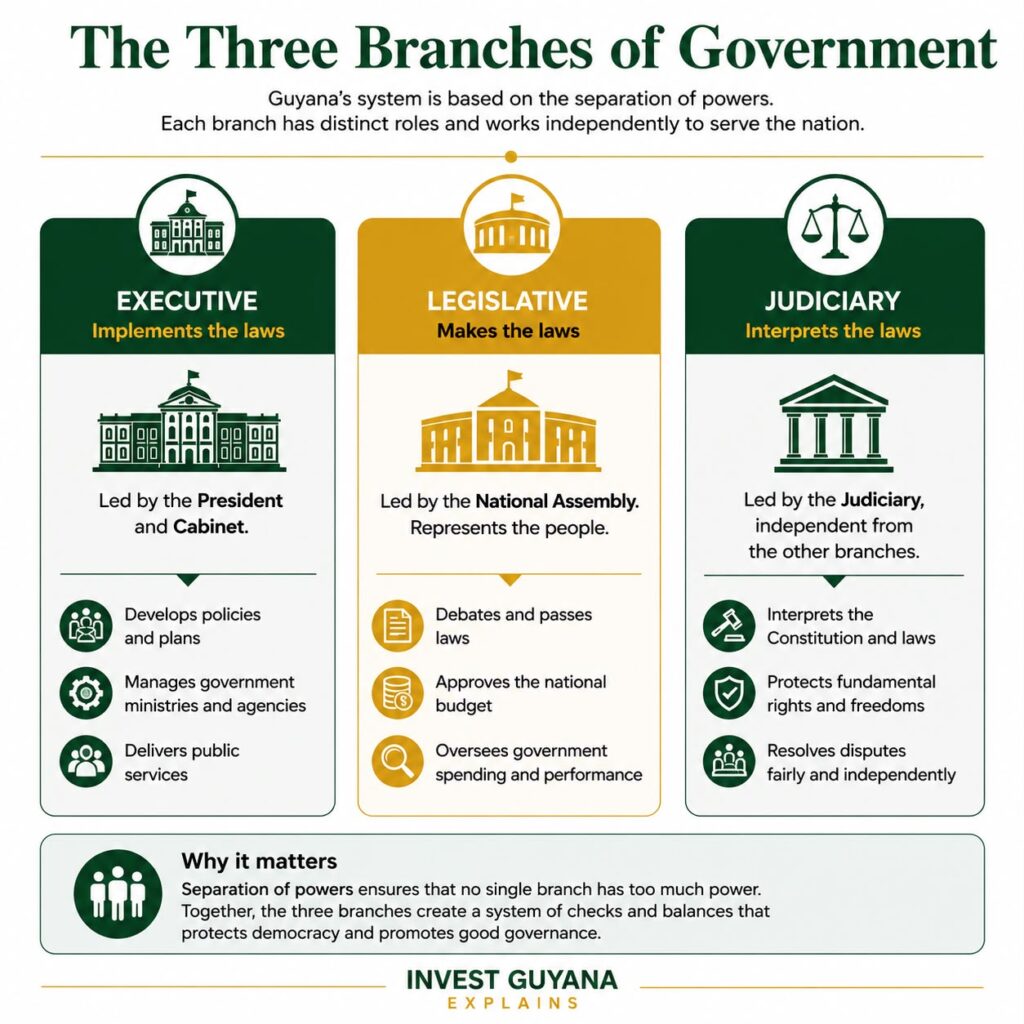
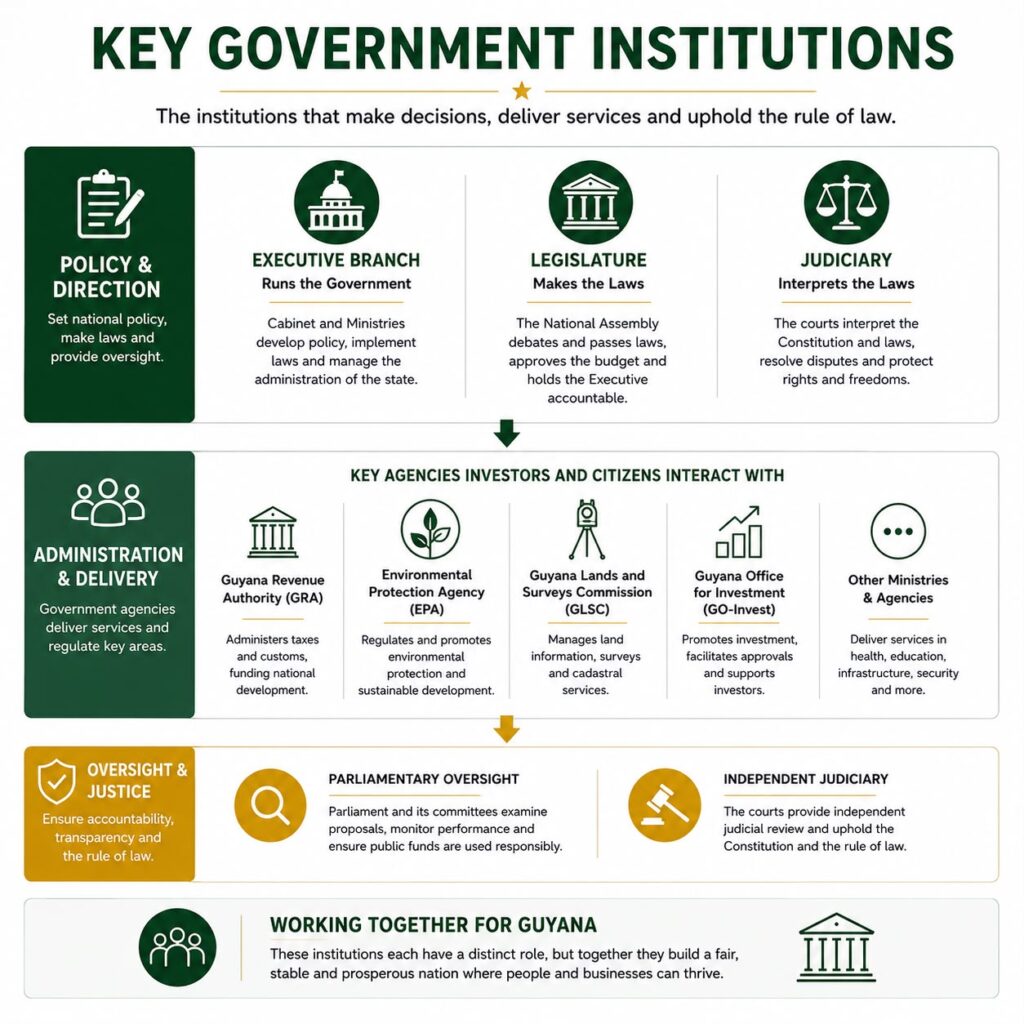
Like many democratic countries, Guyana divides the responsibilities of government among three branches: the Executive, the Legislature and the Judiciary.
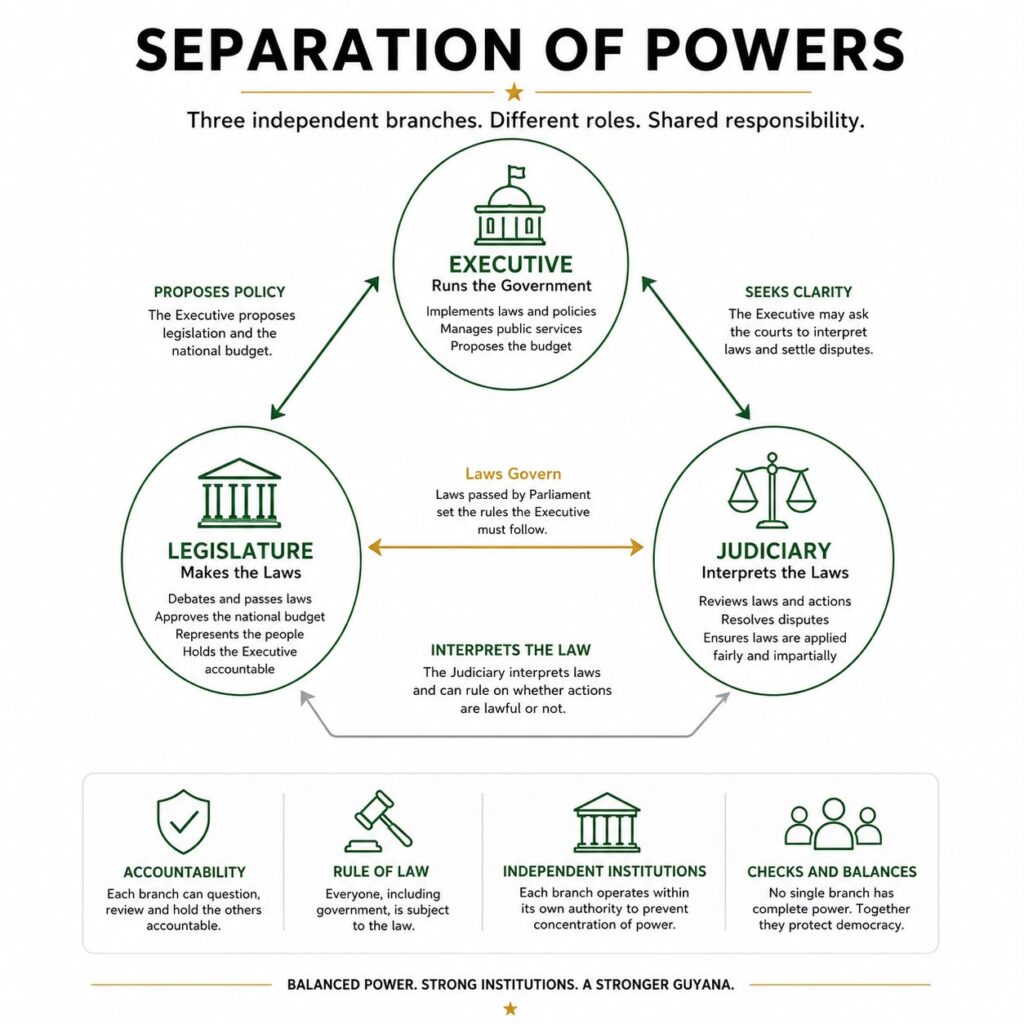
Each branch has a different role, and together they help ensure that government decisions are made, implemented and reviewed through established institutions rather than concentrated in one place.
The Executive is responsible for running the country on a day-to-day basis. It develops policies, manages public administration and oversees the delivery of government services.
The Legislature, through Parliament, debates and passes laws. It also plays an important role in approving the national budget and holding the Executive accountable for how public resources are used.
The Judiciary interprets the law and resolves disputes independently of the other branches. When disagreements arise about how laws should be applied, the courts provide a forum for impartial decisions.
Thinking about government in these three parts creates a useful mental map. Once you understand the role of each branch, it becomes much easier to understand why different institutions appear in the news and how they relate to one another.
THE EXECUTIVE: RUNNING THE COUNTRY
For most people, the Executive is the part of government they encounter most often.
It is responsible for turning policies into action, managing public services and overseeing the day-to-day administration of the country.
The President serves as Head of State and leads the Executive. Working alongside the President are the Prime Minister, Cabinet and government ministries, each responsible for different areas of national administration.
Cabinet is made up of senior ministers who collectively consider major government policies and priorities. While individual ministers oversee specific portfolios, Cabinet provides a forum where important national decisions are discussed before being implemented across government.
Each ministry focuses on a particular area of public policy. There are ministries responsible for areas such as finance, health, education, public works, agriculture, natural resources and tourism. Their responsibilities differ, but they share a common purpose: developing policy and overseeing the sectors assigned to them.
Behind every ministry is a professional public service that continues operating regardless of election cycles. One of the most important figures within each ministry is the Permanent Secretary.
Permanent Secretaries are senior public officials who manage the ministry’s administration, coordinate programmes, oversee budgets and help ensure that government policies are carried out effectively. While ministers provide political leadership, Permanent Secretaries help keep the machinery of government operating from day to day.
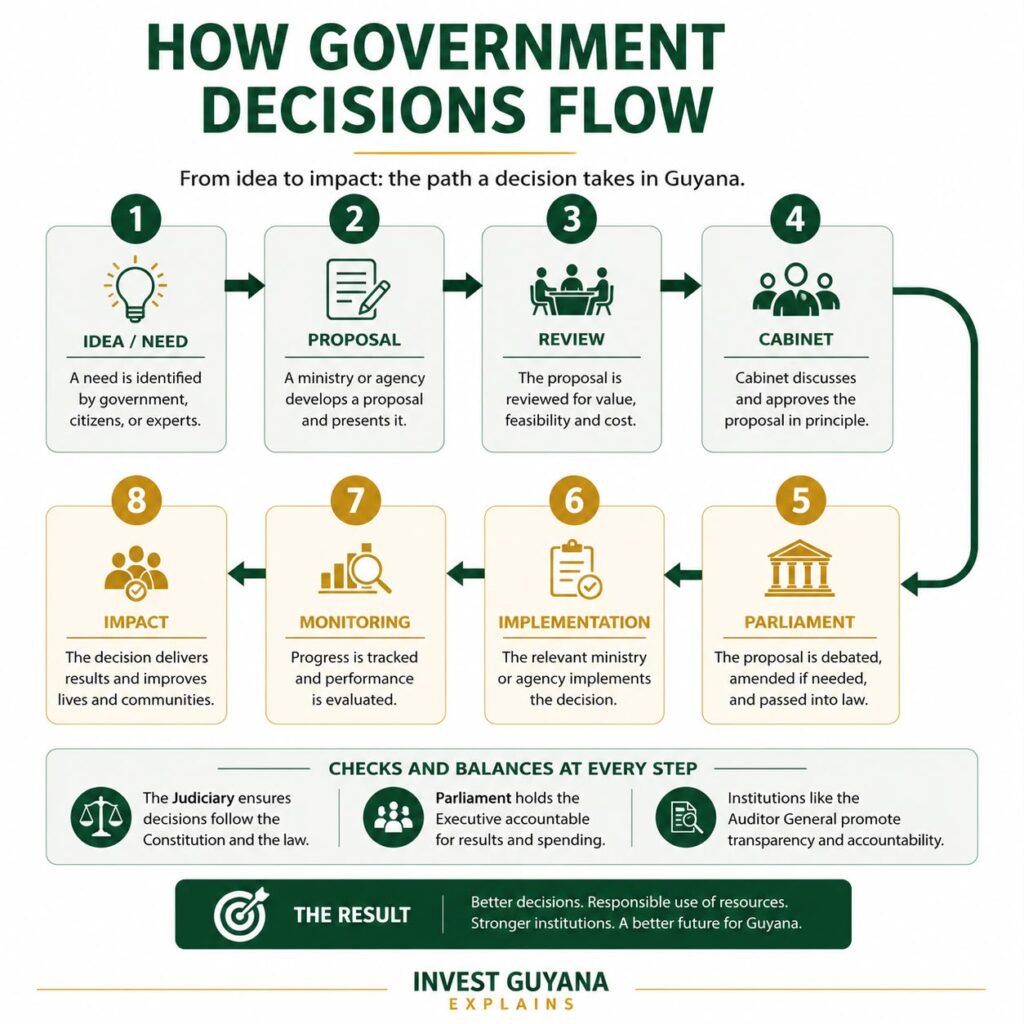
Returning to our hotel example, a tourism policy encouraging new investment may begin with government priorities discussed by Cabinet. The relevant ministry would then develop programmes or initiatives to support that objective. But the ministry is rarely the institution issuing every approval itself. That responsibility often falls to specialised government agencies.
PARLIAMENT: MAKING THE LAWS
If the Executive runs the country, Parliament creates the legal framework within which it operates.
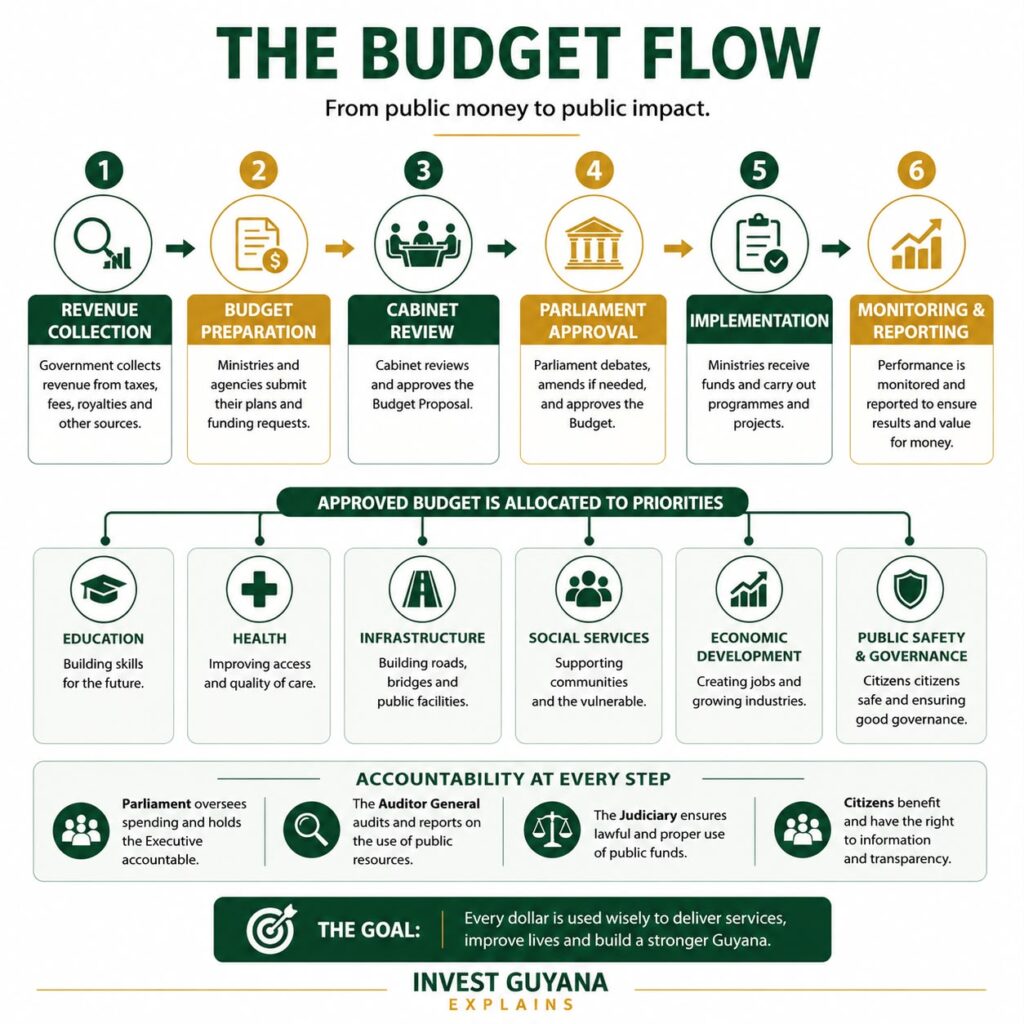
Parliament is where elected representatives debate proposed laws, examine national issues and consider matters affecting the country’s future. It is also responsible for approving the national budget, giving legal authority for government spending.
When the government wants to introduce new legislation, a proposal is brought before Parliament for debate and consideration. Members of Parliament discuss the proposal, suggest changes where appropriate and ultimately vote on whether it should become law.
This process means that significant legal changes do not simply take effect because a ministry announces them. They generally require parliamentary approval before becoming part of the country’s legal framework.
For businesses and investors, Parliament shapes many of the rules that influence commercial activity. Tax legislation, environmental laws, investment incentives and regulatory reforms all depend on legislation that has passed through the parliamentary process.
Understanding Parliament helps explain why government announcements are sometimes followed by debates, amendments and votes before new measures take effect.
GOVERNMENT AGENCIES: WHERE MOST DECISIONS HAPPEN
One of the biggest surprises for newcomers is that many day-to-day decisions are not made directly by ministers.
Instead, they are handled by specialised government agencies with responsibilities defined by law.
A ministry may set policy for a particular sector, but an agency often administers that policy, regulates activity or delivers public services.
For example, businesses register for taxes and interact with the Guyana Revenue Authority regarding tax administration. Environmental reviews are handled by the Environmental Protection Agency. Land administration involves the Guyana Lands and Surveys Commission, while investors seeking guidance on opportunities and processes may engage with the Guyana Office for Investment.
These organisations exist because modern government requires specialised expertise. Rather than expecting ministers to oversee every application, inspection or licence personally, agencies employ professionals who focus on specific areas of regulation and service delivery.
This distinction is especially important for investors.
Someone establishing a new manufacturing facility, for example, may interact with several different institutions during a single project. A ministry may establish the overall policy environment, while different agencies administer taxation, environmental approvals, land matters or sector-specific regulations.
Understanding the different roles of ministries and agencies helps explain why government processes often involve more than one institution and why coordination between them is an essential part of public administration.
THE JUDICIARY: APPLYING THE LAW
Even in the best-designed systems, disagreements can arise.
Contracts may be disputed, regulations may be challenged or questions may emerge about how laws should be interpreted.
That is where the Judiciary plays its role.
Guyana’s courts operate independently from both the Executive and Parliament. Their responsibility is not to create policy or manage government programmes but to interpret the law and resolve disputes fairly.
This independence is an important feature of democratic governance. It provides individuals, businesses and government institutions with a neutral forum where legal issues can be decided according to the law.
For investors, an independent judiciary contributes to confidence in the broader legal environment by providing established processes for resolving disputes when they occur.
Most people hope they never need to appear before a court. But knowing that an independent judicial system exists is an important part of understanding how the wider system of government functions.
WHY UNDERSTANDING GOVERNMENT MATTERS
Let’s return to the investor planning to build a hotel.
What first appeared to be a confusing collection of institutions now begins to make sense.
Government policy may be developed by the Executive. Parliament creates the legal framework that supports those policies. Ministries oversee different sectors of government. Specialised agencies administer approvals, regulations and public services. If legal disputes arise, the courts provide an independent forum for resolving them.
Each institution has a different role, yet none operates entirely on its own.
This understanding is valuable far beyond investment.
Business owners benefit from knowing which institutions they need to engage. Students gain a clearer understanding of how public decisions are made. Citizens are better equipped to interpret government announcements, budget presentations and legislative debates. International investors can navigate the country’s institutions with greater confidence and realistic expectations.
Government is often described as complex because it performs many different functions. In reality, its structure follows a straightforward principle: different institutions perform different jobs, and together they form a system designed to govern the country.
Understanding that system is one of the best starting points for understanding Guyana itself.
This article marks the beginning of the Invest Guyana Explains series, which explores the institutions, policies and systems that shape Guyana’s economy and investment environment. Future articles will take a closer look at topics such as Parliament, the national budget, government agencies and other parts of public administration, building on the foundation introduced here.
VERIFIED SOURCES
- Constitution of the Cooperative Republic of Guyana
- Parliament of Guyana
- Budget Speech 2026
- Budget Estimates 2026
- Office of the President
- Guyana Office for Investment
- Invest Guyana Enterprise Knowledge Collections
ABOUT INVEST GUYANA EXPLAINS
Invest Guyana Explains transforms verified information from official sources into clear, practical explainers for investors, businesses and the public.