

The financial model used one rate for every company
The investment team had completed its forecast. Revenue assumptions were conservative, operating costs had been stress-tested and the financing schedule was ready.
One cell in the model still worried the tax adviser. The company had applied a single corporation-tax percentage to every scenario.
“Which category of company are you modelling?” she asked.
The analyst looked surprised. “A Guyana company.”
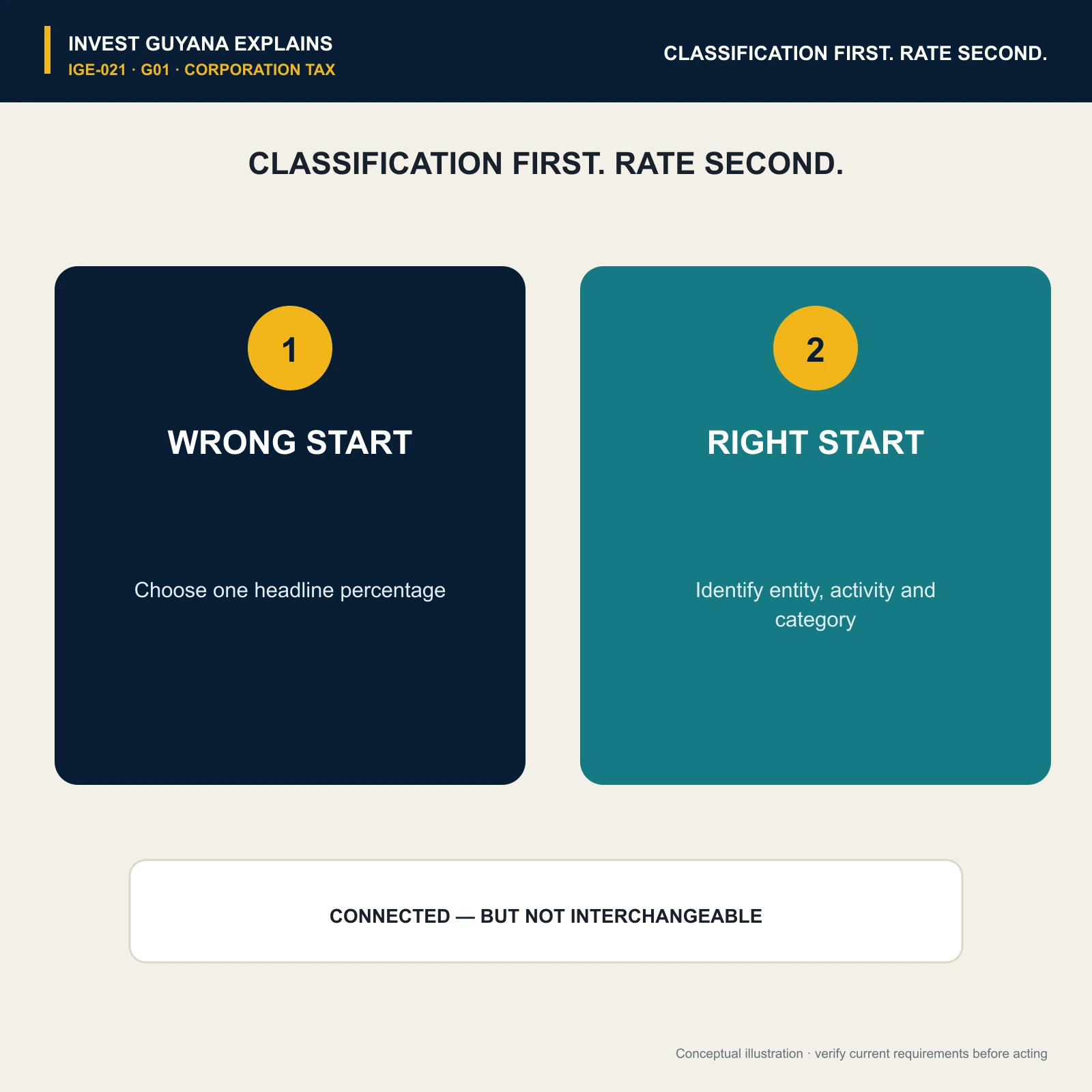
That answer identified the jurisdiction, but it did not necessarily identify the applicable tax classification.
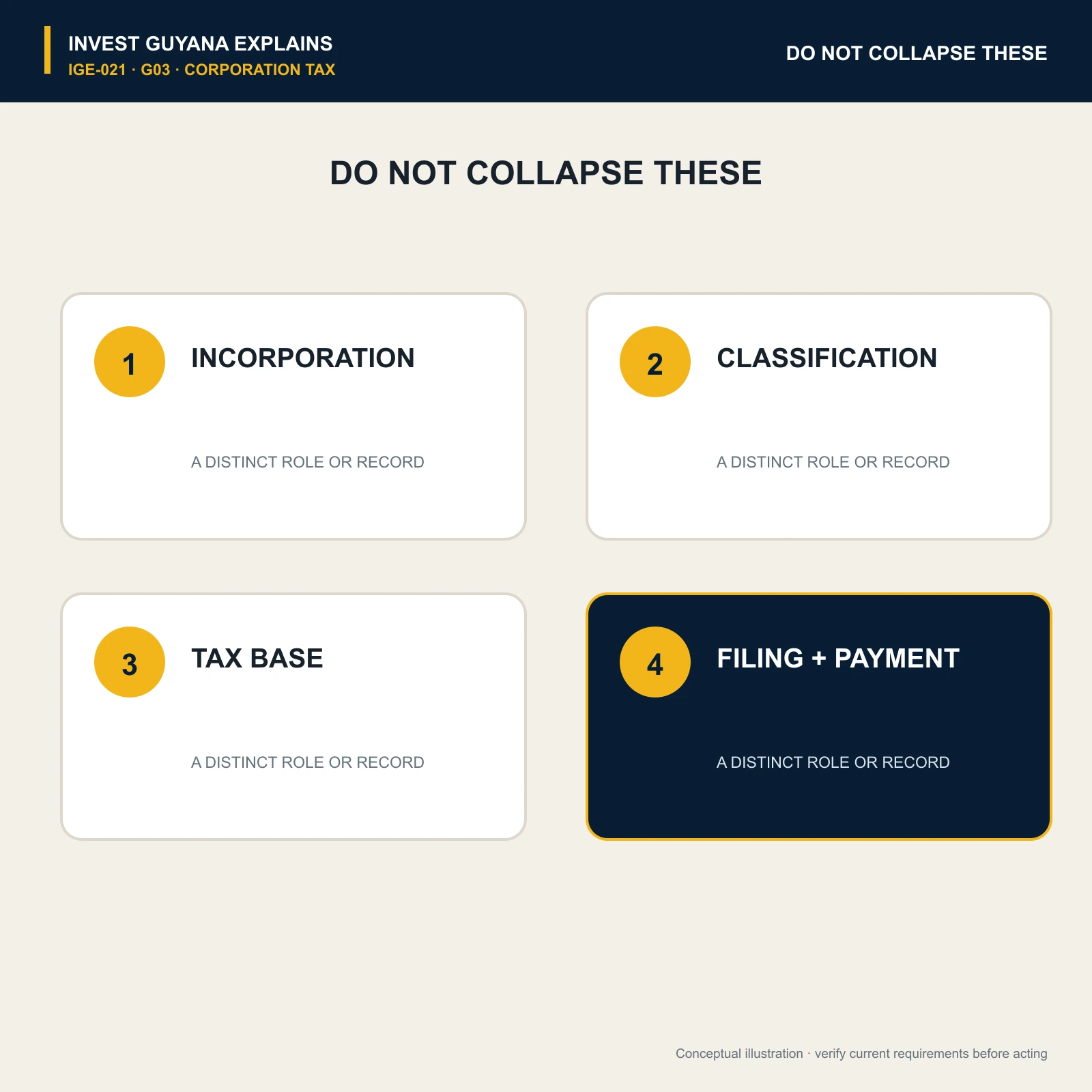
Incorporation and tax classification answer different questions
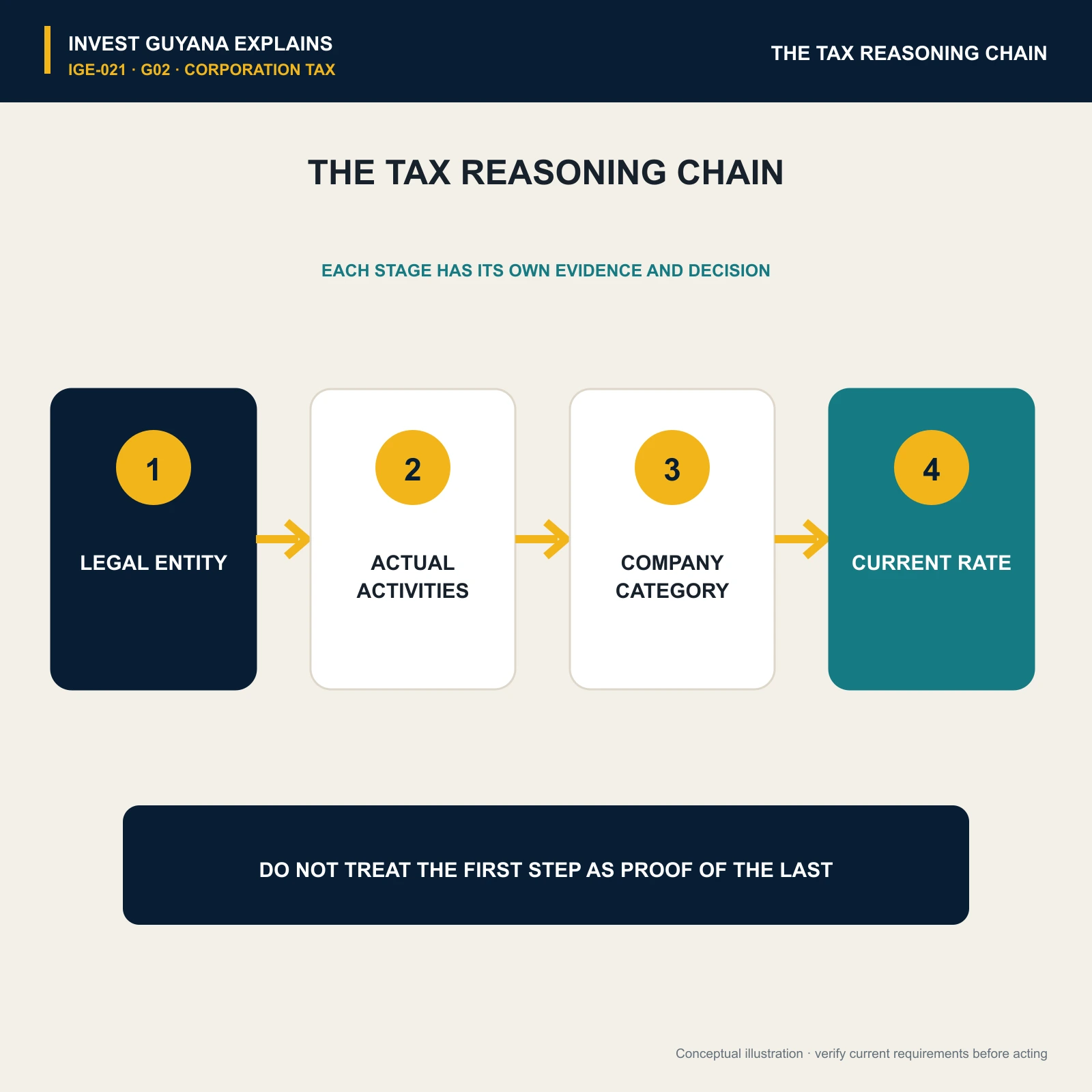
Incorporation tells us that a company has been formed as a legal person. Tax classification asks how the corporation-tax rules apply to the company’s activities and status.
The same certificate of incorporation can sit behind businesses with very different economic functions. A company may provide commercial services, hold a different type of activity or fall within a specially identified category.
Tax treatment therefore cannot be established from the company name alone. The facts and governing definitions matter.
Why headline rates can mislead
Current official material identifies the following corporation-tax rates:
- 45 percent for the controlled telephone-company category;
- 40 percent for other commercial companies;
- 25 percent for other companies.
Those figures are not an invitation to select the lowest rate. They demonstrate why the classification exercise comes before the calculation.
An older operational source has referred to 27.5 percent. That conflicts with current published official material and illustrates why an accessible webpage or old FAQ is not automatically the current legal position.
Rates should be revalidated before publication or use in a transaction, and a company should not classify itself solely from a short description in an Explainer.
Activity can matter more than the label on the door
A company’s trading name may sound like a holding company while its actual income comes from commercial operations. Another entity may conduct more than one activity. A group may place different functions in different legal entities.
The tax analysis therefore needs to follow the controlled definitions and the actual facts. It may require examining what the company does, how its income is earned and whether a specific statutory category applies.
This is also why copying a competitor’s rate is unsafe. Two businesses in the same broad sector can have different legal structures or activities.
The rate is not the tax base
Even after the applicable category and rate are established, the calculation is not simply “rate multiplied by cash received.”
Corporation tax is connected to the tax base established by the governing rules. Accounting profit, cash flow, turnover and chargeable income are related business measures, but they are not automatically the same number.
Adjustments, deductions, timing rules, advance instalments and other provisions can affect the amount reported and paid. The current framework includes annual filing and advance instalments, while payment channels, penalties and transaction-specific questions must be confirmed for the company’s actual circumstances.
An Explainer should therefore teach the structure without pretending to be a calculator.
Classification is not permanent simply because the company is old
Businesses change. A company may add a new activity, dispose of an operation, restructure a group or change how it earns income.
The tax position should be reviewed when the facts change rather than carried forward mechanically from the first return. A historic rate in the accounting system is evidence of what was previously used, not proof that it remains correct.
What a company should establish before modelling tax
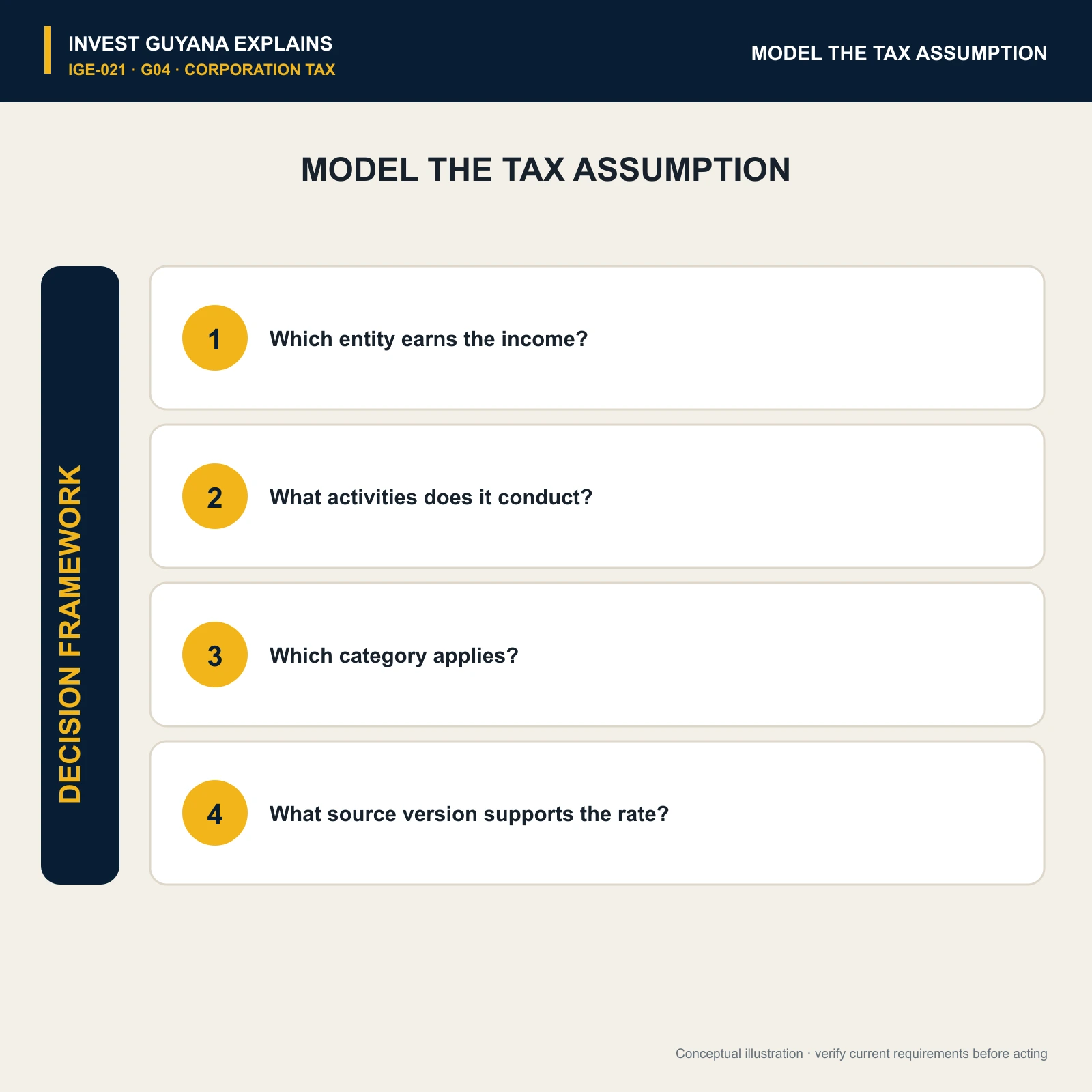
Before a rate appears in an investment model, the decision-makers should be able to answer:
- What legal entity will earn the income?
- What activities will that entity actually conduct?
- Which controlled statutory category applies to those facts?
- What tax base is the rate applied to?
- Which current official source supports the answer?
Those questions do not replace professional advice. They prevent the model from hiding an unsupported assumption.
The investor takeaway
There is no safe corporation-tax answer that begins and ends with one headline percentage.
The legal entity, its activities, the applicable company category, the tax base and the current controlling rules all matter. The rate is important, but it belongs near the end of the reasoning chain—not at the beginning.
The next article in Invest Guyana Explains will return to public procurement, explaining why registration on the NPTA Register of Bidders is a readiness step—not a government contract.