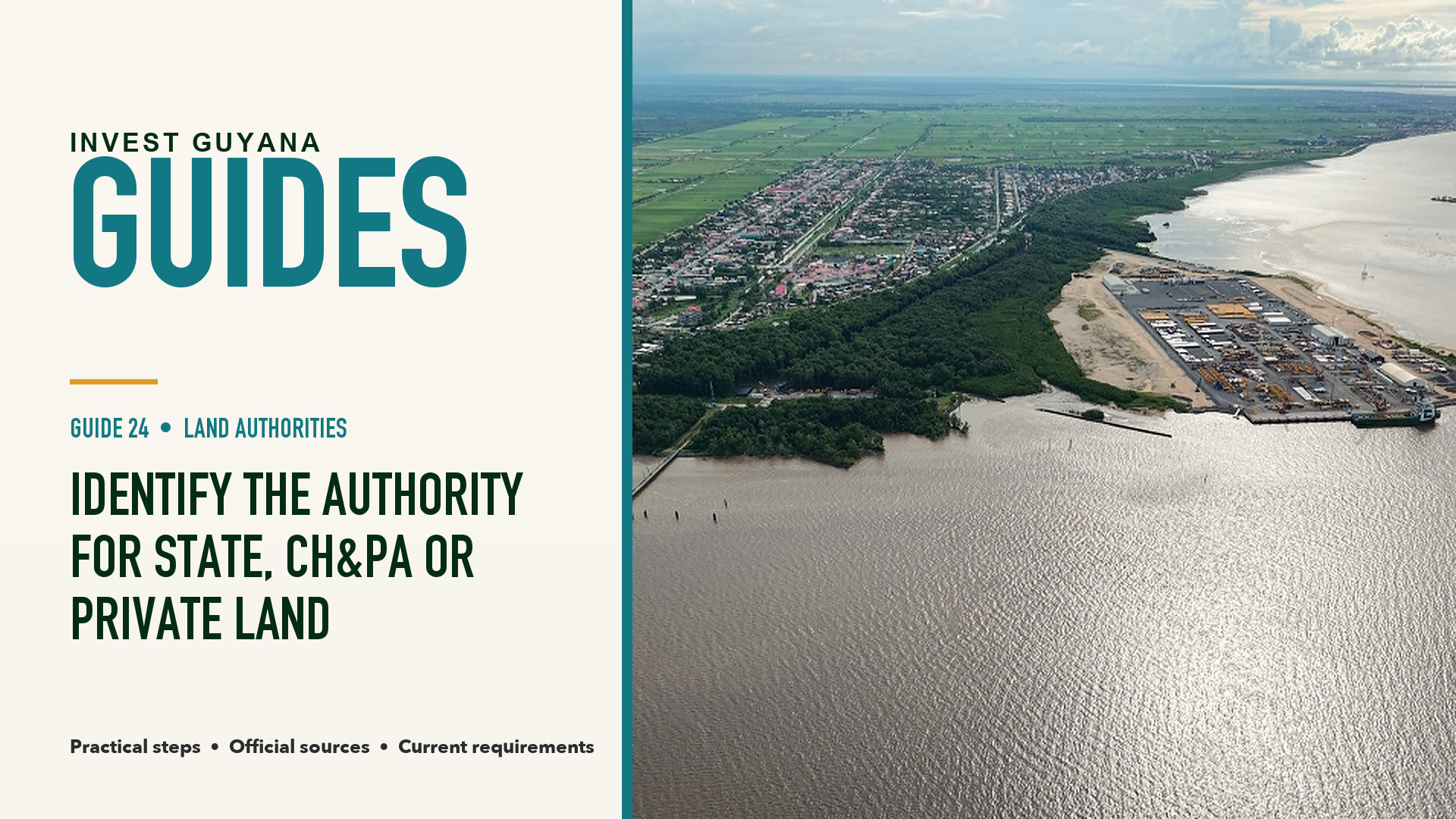
The word “Government land” is often used loosely, but Guyana’s land routes are not interchangeable. The correct authority and procedure depend on the legal and administrative category of the land.
Before submitting an application, paying an intermediary or preparing a transfer, identify whether the matter concerns private property, GL&SC-administered State or Government land, CH&PA housing land or another controlled category.
Private property
Private property is generally routed through one of two registry systems:
- a Transport points to the Deeds Registry branch; and
- a Certificate of Title points to the Land Registry branch.
Private-property searches, sales, gifts, mortgages and transfers use the applicable registry framework. They are not processed as a GL&SC public-land application or CH&PA house-lot allocation.
State land
State land is governed through the State Lands framework and administered by the Guyana Lands and Surveys Commission, subject to important exclusions and other authority boundaries.
GL&SC’s current public-land route includes an Expression of Interest, availability and inspection stages, formal application, approval, cadastral survey and lease issuance.
An EOI is not an allocation or lease.
Government land
Government land remains a distinct legal class associated with the Lands Department framework and modern GL&SC administration. The operational public-land route may involve GL&SC, but the legal classification should not be erased by calling everything State land.
Where classification affects the transaction or authority, obtain confirmation from GL&SC rather than relying on an informal label.
CH&PA land and housing
CH&PA administers residential house-lot and housing-unit applications and allocations under its housing mandate.
This pathway includes the resident or remigrant application, update and inquiry routes, allocation stages, boundary verification, Agreement-of-Sale work and later title or Transport processing.
CH&PA housing allocation is not the same as:
- GL&SC public-land leasing;
- the CH&PA Single Window planning and building-permit system; or
- buying private property from an owner.
Other land and rights that need separate routing
Do not treat every non-private parcel as available GL&SC land. Separate boundaries can apply to:
- State forest and forestry authorisations;
- minerals and mining rights;
- Amerindian or community lands;
- protected areas;
- non-private lands under another regional authority;
- agricultural or sector-specific tenures; and
- land where another statutory body controls the use or allocation.
A land lease does not automatically grant mineral or forest rights.
A routing checklist
- Obtain the available title, lease, allocation, survey or parcel documents.
- Ask whether the evidence is a Transport, Certificate of Title, registered lease, CH&PA allocation or other instrument.
- For private title, confirm the Deeds Registry or Land Registry route.
- For public-land interest, confirm the category and GL&SC’s authority before submitting an EOI.
- For a house lot or housing unit, use CH&PA’s allocation route.
- For development permission, use the applicable planning and building pathway rather than the allocation route.
- Check whether forestry, mining, community, protected-area or regional controls apply.
- Do not pay or commit based only on an informal description of the land.
Common mistakes to avoid
- Calling every non-private parcel “State land.”
- Applying to CH&PA for a GL&SC commercial or agricultural lease.
- Applying to GL&SC for a CH&PA house lot.
- Treating Single Window approval as a housing allocation.
- Assuming a lease includes mineral or forest rights.
- Inferring registry status from location.
- Treating an allocation letter, Agreement of Sale and final title as the same document.
Official sources
- GL&SC Land Management System
- GL&SC public-land services
- Central Housing and Planning Authority
- Deeds and Commercial Registries Authority
- Guyana Land Registry
Related Invest Guyana guides and explainers
Editorial note
This guide provides general routing information, not a legal classification of a particular parcel. Land status and responsible authority can be location- and document-specific. Confirm them with the controlling institution.