

The new company had a name, an office and its first clients. Its founders had registered the business, opened a bank account and started issuing invoices. From the outside, the launch looked complete.
Then the accountant asked for the company’s Taxpayer Identification Number and a calendar of its filing obligations. The founders had expected to pay tax once the business became profitable. They had not realised that tax administration begins much earlier, with registration, records and recurring responsibilities that continue throughout the life of the company.
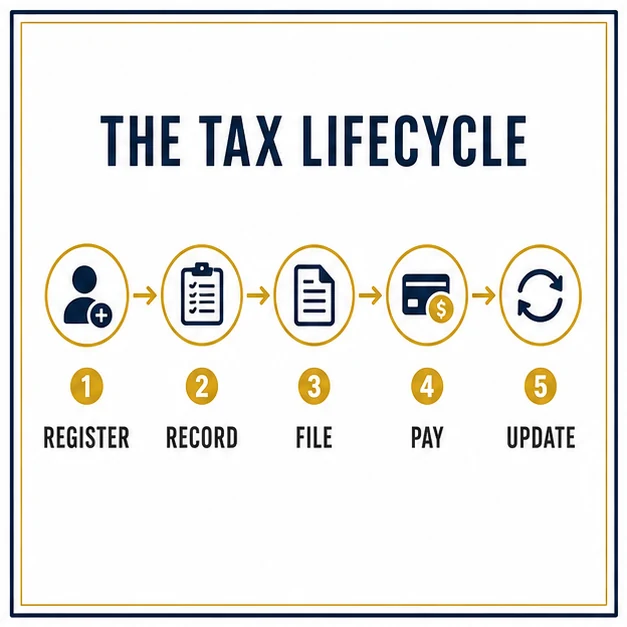
That distinction matters because paying tax is only one part of being tax-compliant. Businesses must also identify themselves to the revenue authority, understand which taxes apply, file the required returns, keep supporting records and update their information when the organisation changes.
For investors and entrepreneurs, the most useful way to understand tax administration is not as one annual payment. It is an operating system that connects everyday transactions with periodic reporting to the Guyana Revenue Authority.
The TIN Is the Starting Point
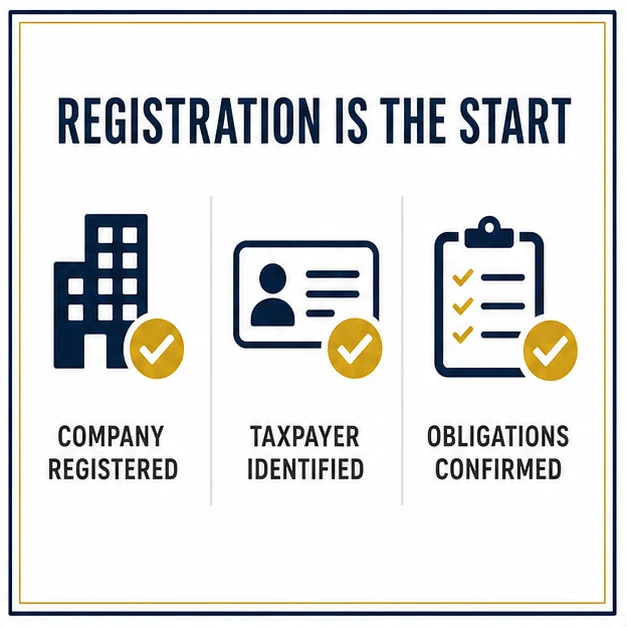
Guyana’s tax system begins by identifying the taxpayer. The Guyana Revenue Authority issues a Taxpayer Identification Number, commonly called a TIN, to individuals and organisations that fall within the registration requirements.
For an organisation, the TIN becomes a continuing identifier rather than a number obtained for one transaction and then discarded. GRA’s current guidance describes it as a unique number used throughout the organisation’s lifecycle. A company may therefore complete its commercial registration and still need to complete taxpayer registration as a separate step. GRA Taxpayer Registration—Organisation
This is the same principle explored in the earlier article on business licensing. Establishing a company, registering it for tax and obtaining permission for regulated activities answer different questions. Completing one process does not automatically complete the others.
The practical value of the TIN is that it connects the organisation to its tax records and dealings with GRA. As the business grows, the same identifier supports filings, payments, correspondence and changes to the taxpayer’s information.
Registration Does Not End With a Number
Receiving a TIN establishes the taxpayer’s identity, but it does not by itself explain every obligation the business will have. Those obligations depend on the organisation, its activities, its employees and the transactions it conducts.
A company may need to consider corporation or income tax reporting. An employer may have responsibilities connected with Pay As You Earn deductions. A business making taxable supplies may need to determine whether VAT registration and VAT reporting apply. Importers can also encounter customs duties and taxes when goods enter Guyana.
These responsibilities should not be treated as a universal checklist for every enterprise. The correct combination depends on current law and the facts of the business. What matters is the method: identify the activities and relationships first, then determine which tax systems those activities engage.
That activity-based approach prevents a common error. New businesses sometimes copy the tax routine of another company in the same broad industry, even though the two organisations have different turnover, employees, transactions or legal structures. Tax administration begins with the actual business, not with a borrowed template.
Returns Turn Business Records Into Tax Information
Taxes are administered through returns because the revenue authority does not observe every transaction inside a company. The business records its income, expenditure, payroll and taxable supplies, then reports the required information for the relevant period.
The timing varies according to the obligation. GRA states that every company or organisation registered or doing business in Guyana must submit an annual income tax return by April 30 for the preceding year of income. VAT operates on a different cycle: registered persons charging VAT submit returns for monthly tax periods, generally by the twenty-first day of the following month. GRA Income Tax Returns GRA VAT Returns
The important lesson is not to memorise one date and assume it applies to everything. A business can have several reporting calendars running at the same time. Annual, monthly and employer-related obligations may coexist, which is why tax deadlines belong in the company’s operating calendar rather than in someone’s memory.
Electronic services can make submission easier, but they do not replace accurate underlying records. A return is only as reliable as the information used to prepare it.

Good Tax Administration Begins in Daily Operations
Tax problems often appear at filing time but begin much earlier. An invoice may be incomplete, a payment may be recorded in the wrong period or a transaction may lack the documents needed to support its treatment. Months later, the accountant is expected to reconstruct what happened.
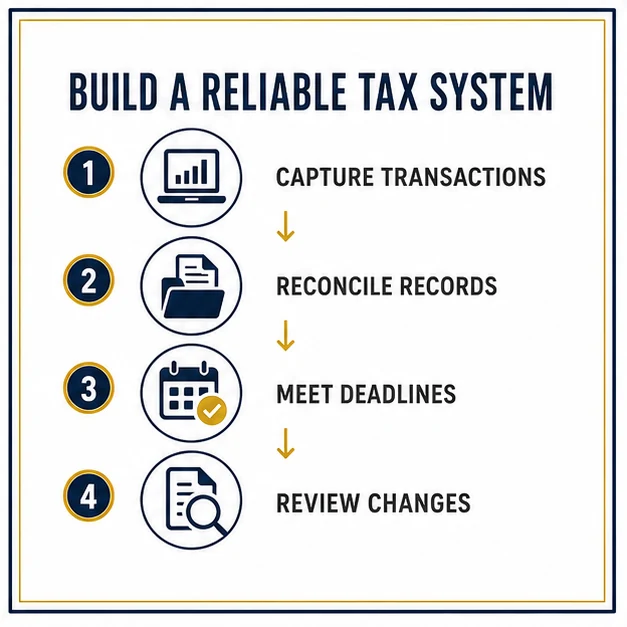
A stronger system captures information when the transaction occurs. Sales, purchases, payroll, imports and asset acquisitions should flow into records that can be reviewed and reconciled. For VAT-registered businesses, invoice content is especially important because the tax system relies on properly documented taxable supplies. GRA’s current guidance sets out information that VAT tax invoices must contain. GRA VAT and Invoices
This is why tax compliance cannot belong only to the accountant. Sales teams create invoices, purchasing teams receive supplier documents, human-resources teams manage payroll information and operations teams may handle imports. Each department creates part of the record that later supports the tax return.
When tax is designed into those workflows, filing becomes the final reporting step rather than an emergency search for missing information.
A Business Changes, and Its Tax Record Must Follow
Companies rarely remain exactly as they were on registration day. They change addresses, add trading names, appoint new officers, open locations and expand into new activities.
GRA provides procedures for amending TIN information when organisational details change. Its guidance identifies changes such as business names, addresses and principal officers as matters that may require the taxpayer’s records to be updated. GRA—Update Your TIN
Keeping those records current is more than administrative housekeeping. Mismatched names or addresses can create delays when the company applies for other services, imports goods, seeks a clearance or corresponds with the authority. The organisation’s internal records and its official taxpayer profile should describe the same business.
The same principle applies when operations change materially. A company entering a new line of business should not assume that its existing tax routine automatically covers the new activity. Expansion is an appropriate point to review the wider compliance map.
Compliance Includes Questions and Corrections
Even well-run businesses encounter uncertainty. A transaction may not fit the company’s usual pattern, a filing may contain an error or GRA may request clarification.
Tax administration therefore includes communication, review and, where the law provides, objection or appeal procedures. The sensible response to uncertainty is not to ignore it until a deadline passes. It is to identify the question, preserve the supporting records and seek authoritative guidance or qualified professional advice early enough to act properly.
This approach also helps companies distinguish between tax planning and guesswork. A commercial decision can have tax consequences without tax being its only purpose. Understanding those consequences before signing a contract is usually easier than attempting to repair the structure afterward.
For international investors, early advice is particularly valuable when transactions involve non-residents, cross-border services, imports, related companies or investment incentives. The general framework remains understandable, but the treatment of a particular transaction may require specialist analysis.
Building a Reliable Tax Calendar
By the end of its first quarter, the company from our opening scene had changed the way it approached tax. The founders no longer saw the TIN as the end of registration or the annual return as the beginning of compliance.
They created a calendar of filing and payment dates, assigned responsibility for each return and connected the accounting records to the people generating invoices, payroll and purchasing documents. They also added a review point for business changes so that new activities or locations would trigger a compliance check.
None of those steps made the company’s tax disappear. They made it visible, predictable and manageable.
That is the central purpose of sound tax administration. A business identifies itself correctly, determines which obligations apply, captures reliable records, files and pays on time, and keeps its official information current as it grows.
The next article in Invest Guyana Explains will turn to another area where the correct starting point is identification: land registration, and why a buyer must understand the form of title or tenure before assuming that every property follows the same transfer process.
Editorial note: This article provides a general explanation of tax administration in Guyana and is not tax advice. Taxes, thresholds, rates, filing methods and deadlines can change or depend on specific facts. Businesses should confirm current requirements with the Guyana Revenue Authority and qualified advisers.