

By Tuesday morning, the entrepreneur believed everything was ready.
The company had been established in Guyana, its registration documents were safely stored and the first contracts were waiting to be signed. After months of planning, the business finally existed as a recognised legal entity. The owner expected operations to begin before the end of the week.
Then a local adviser asked an unexpectedly simple question.
“Have you confirmed which licences and approvals you need?”
The entrepreneur hesitated. Registering the company, he had assumed, was the licence. Why would a business that already existed need further permission to begin doing business?
The confusion is understandable because company registration and business licensing can appear to be two versions of the same process. In fact, they answer different questions. Registration concerns the establishment or recognition of the business, while a licence or approval may concern whether that business has permission to undertake a particular regulated activity.
That distinction is the starting point for understanding business licensing in Guyana.
What a Business Licence Actually Does
A business licence is best understood as permission to carry out an activity that is subject to regulation.
The important word is activity. Governments do not necessarily regulate every business in the same way because businesses do very different things. The requirements that may apply to a professional consultant will not automatically be the same as those affecting a pharmacy, hotel, manufacturer or mining operation.
Each activity creates its own circumstances. Some may affect public health or safety. Others may involve consumers, employees, buildings, imported goods, technical equipment, natural resources or the environment. Where government regulates those activities, a licence, permit, registration or other approval may form part of the operating framework.
This does not mean every business needs one universal licence before it can trade, nor does it mean that every commercial activity requires separate permission. The correct requirements depend on the nature of the business, the activities it will conduct and the rules governing those activities at the time.
A licence therefore does something different from simply proving that a company exists. It addresses whether a regulated activity may be performed and, where applicable, the conditions under which it may proceed.
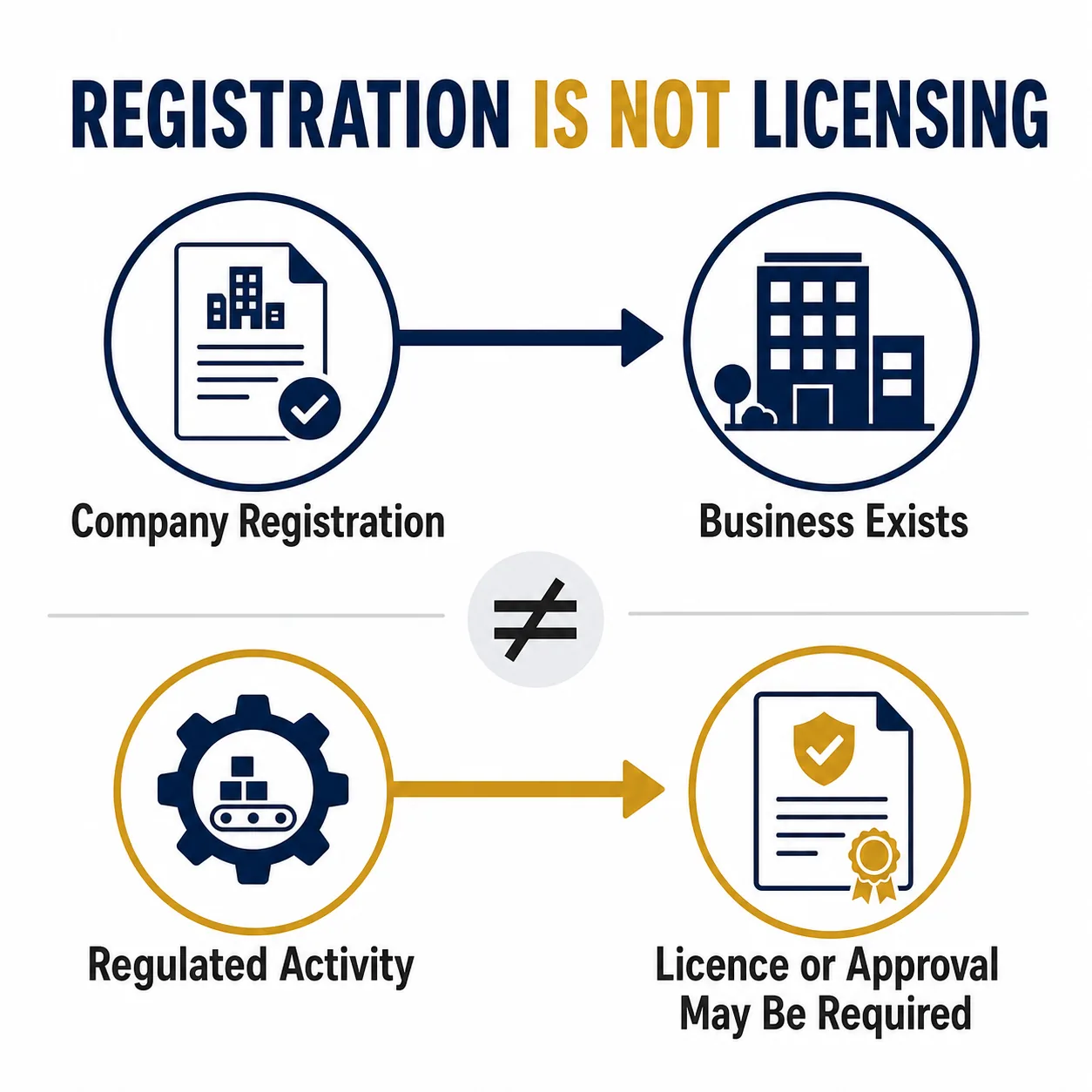
Registration Creates the Business; Licensing Permits the Activity
The distinction becomes clearer when registration and licensing are placed side by side.
Company registration establishes or records the business entity. It gives the enterprise a formal legal identity through which it can organise its affairs, enter commercial relationships and undertake the other activities permitted to it under the applicable framework.
Licensing begins with a different question: what does the business intend to do?
Consider a passport. A passport establishes the identity and nationality of its holder, but it does not automatically grant entry into every country. Depending on the destination, additional permission may be required. The passport and the permission serve related but distinct purposes.
Company registration and licensing work in a comparable way. Registration establishes the business, but it does not necessarily grant every activity-specific approval the business may require.
Current guidance from the Guyana Revenue Authority illustrates how government processes can remain distinct even after incorporation. For a company seeking a Taxpayer Identification Number, the authority lists a Certificate of Incorporation among the supporting documents. In other words, incorporation is an earlier milestone rather than a substitute for the tax-registration process that follows. Guyana Revenue Authority
This distinction matters because an entrepreneur can complete one legitimate process while still having other regulatory obligations to address. The business may exist, but some of its proposed activities may not yet be ready to begin.
Why Licensing Requirements Differ
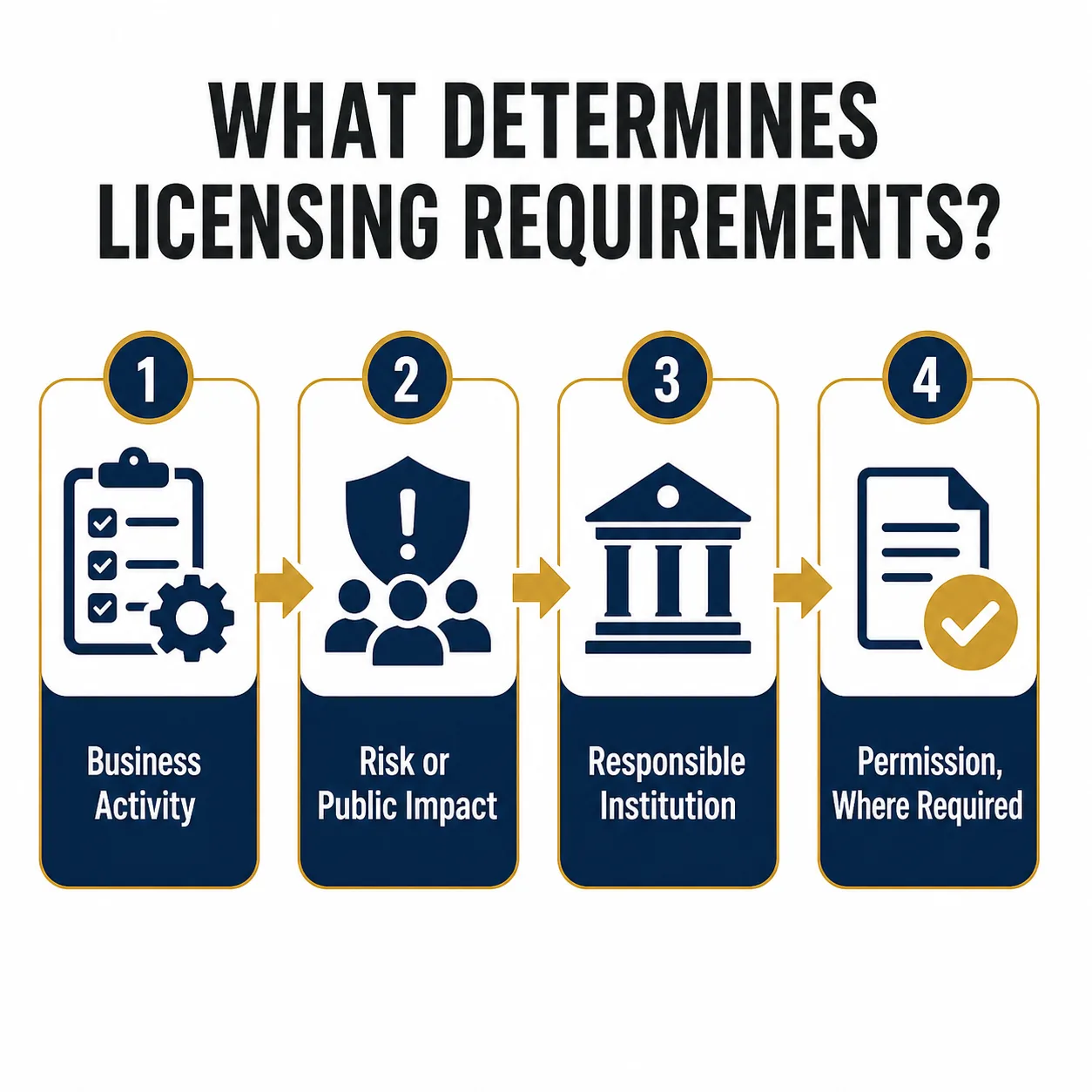
There is no single licensing path that fits every business because regulation responds to the activity being undertaken and the consequences it may create.
A consulting company providing professional advice may operate in an environment with relatively limited physical risk. A pharmacy, by contrast, handles products that can affect human health. A hotel accommodates guests and may combine food service, building safety, employment and other operational considerations. A mining project can involve land, equipment, workers, natural resources and environmental effects.
These examples do not establish the specific licences that any particular business requires. They show why requirements differ. Activities with different risks and public consequences are unlikely to be governed in exactly the same way.
Scale can also matter. A small office-based enterprise and a large industrial development may operate in the same economy while presenting completely different administrative and technical questions. Even two businesses in the same broad industry may encounter different requirements because of their locations, facilities, services or methods of operation.
This is why beginning with the company’s name or industry label is often insufficient. A better assessment starts with what the business will actually do, where it will do it and which people, resources or public interests may be affected.
The answers reveal the activities that need to be examined. Those activities, rather than the company’s existence alone, point towards the relevant regulatory framework.
Why One Business May Need Several Approvals
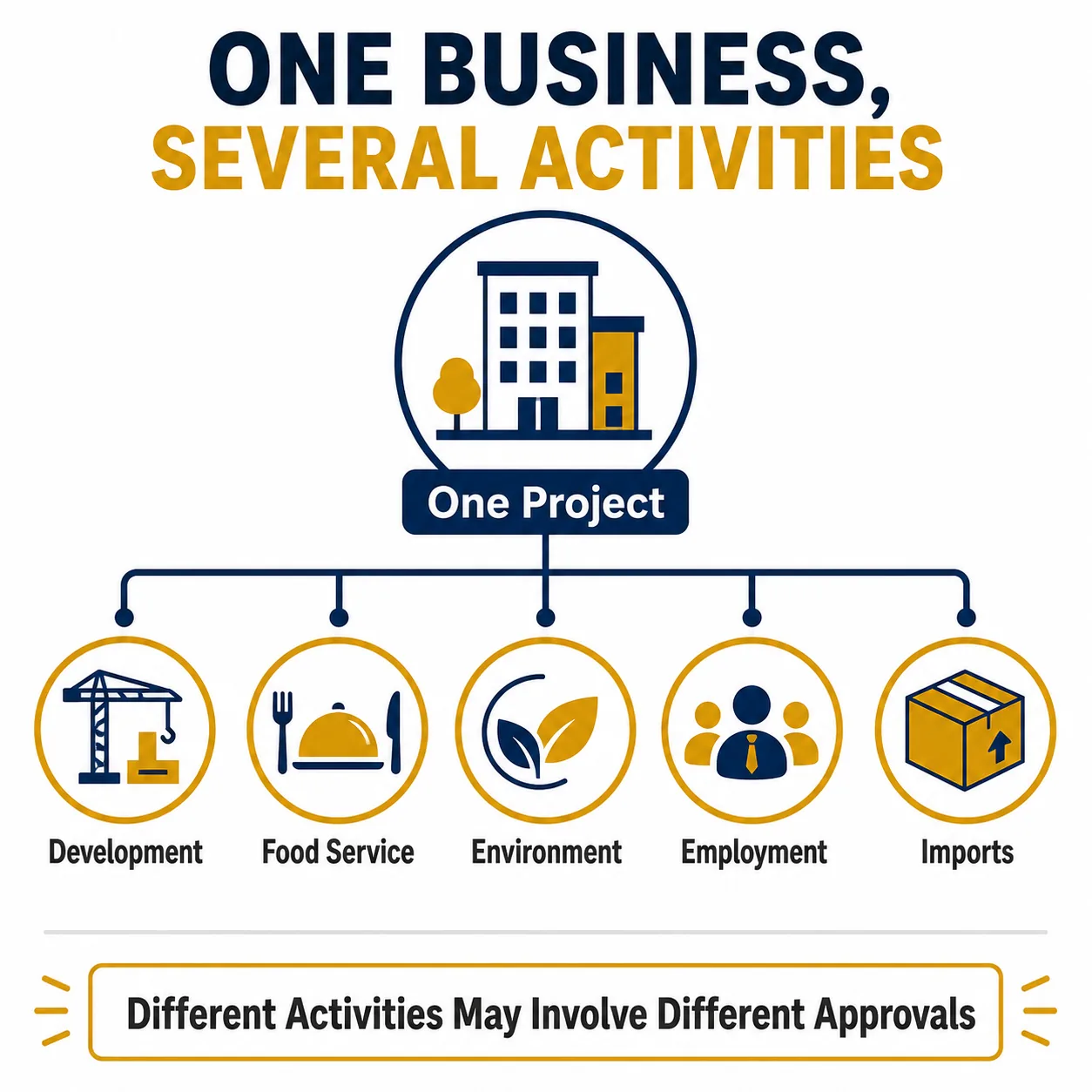
A business is usually described as one enterprise, but its operations may contain many separate activities.
Imagine a company developing a new hotel. The investor sees one project: acquire a site, construct the property, welcome guests and operate the business. Government institutions may need to consider the project through several different lenses because land, construction, environmental effects, taxation, employment, food service and imported equipment are not the same activity.
This is the principle explored in the previous article, Who Regulates What in Guyana? Regulation generally follows the different parts of a project. It does not always attach to the business as one indivisible whole.
As a result, completing one approval does not necessarily resolve every regulatory question surrounding the project. Permission relating to one activity may address only that part of the operation. Other aspects may fall within the responsibilities of different institutions operating under different rules.
For a new investor, this can initially look like duplication. Once the project is broken into its component activities, however, the logic becomes easier to see. Each approval addresses a different question, and each responsible institution contributes a particular kind of expertise.
The practical lesson is not that every business will face a long chain of licences. It is that the number and type of approvals cannot be determined solely by confirming that the business has been registered.
What Licensing Is Intended to Protect
Licensing is sometimes viewed only as an administrative hurdle between an entrepreneur and the opening day. That perspective overlooks why regulated activities require oversight in the first place.
Depending on the activity, licensing can help protect public health, workplace safety, consumers, environmental resources or technical standards. It can also establish minimum conditions that must be satisfied before an operator enters an area where mistakes could have wider consequences.
A food-related operation, for example, raises different public considerations from an office providing general administrative services. An activity involving heavy equipment presents different risks from one conducted entirely online. Regulation responds to those differences by applying oversight where the legal framework requires it.
Licensing can also support confidence. Customers, employees, investors and other businesses are more likely to trust an industry when operators are expected to meet recognised standards. That does not make every licensing system simple, nor does it guarantee that every process will move at the same speed. It does explain the public purpose behind requiring permission for certain activities.
Seen this way, a licence is not merely another certificate to place in a company file. It forms part of the framework through which government manages activities that may affect people beyond the business itself.
Where Businesses Should Begin
The entrepreneur from our opening scene began with the wrong assumption but arrived at a much more useful question.
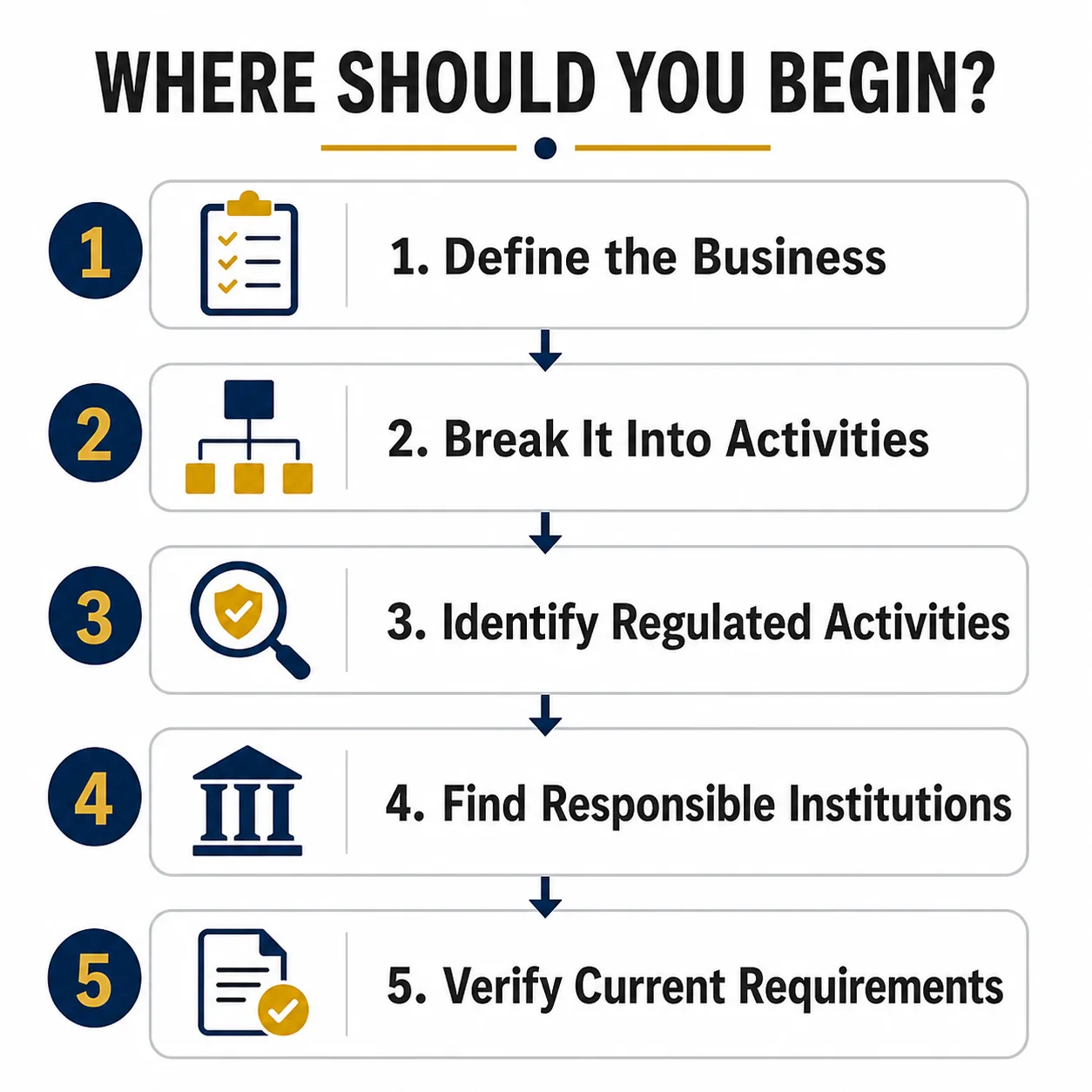
Instead of asking whether the company needed “a business licence,” the owner needed to identify what the company planned to do. The process begins by defining the project, separating it into its principal activities, identifying which of those activities may be regulated and determining which institutions administer the relevant requirements.
Only then should the business confirm the current applications, documents, fees, standards and timelines that may apply.
This activity-first approach is more reliable than copying another company’s approval list. Two businesses that appear similar may have different operations, premises or regulatory circumstances. Requirements may also change as laws, regulations and administrative systems evolve.
For that reason, an article can explain the licensing framework but cannot replace current confirmation from the responsible authorities. Before committing capital, signing construction contracts or beginning operations, investors should verify the requirements applying to their particular activities through authoritative government sources and, where appropriate, qualified professional advice.
Official guidance should be treated as the operational reference. Assumptions based on a company’s registration status, another operator’s experience or an outdated checklist can create delays precisely when a business expects to begin moving fastest.
Permission to Do What?
By the end of the week, the entrepreneur had not abandoned the launch. The company was still registered, its commercial plans remained intact and the opening date was still within reach. What had changed was the owner’s understanding of what company registration had accomplished.
Registration answered the question, “Does the business exist?”
Licensing raised a second question: “Does it have the permissions required for the activities it intends to conduct?”
The difference between those questions can determine whether an entrepreneur begins operations with confidence or discovers an overlooked requirement at the last moment. It also explains why no universal licensing answer can sensibly apply to every company.
The right starting point is not the search for one document called a business licence. It is a careful examination of the business itself—what it will do, where it will operate and which regulated activities form part of its plans.
Once those activities are clear, the regulatory path becomes much easier to identify. In the next article in the Invest Guyana Explains series, we will follow one part of that path by examining environmental approvals and why some projects must address environmental questions before development can proceed.