
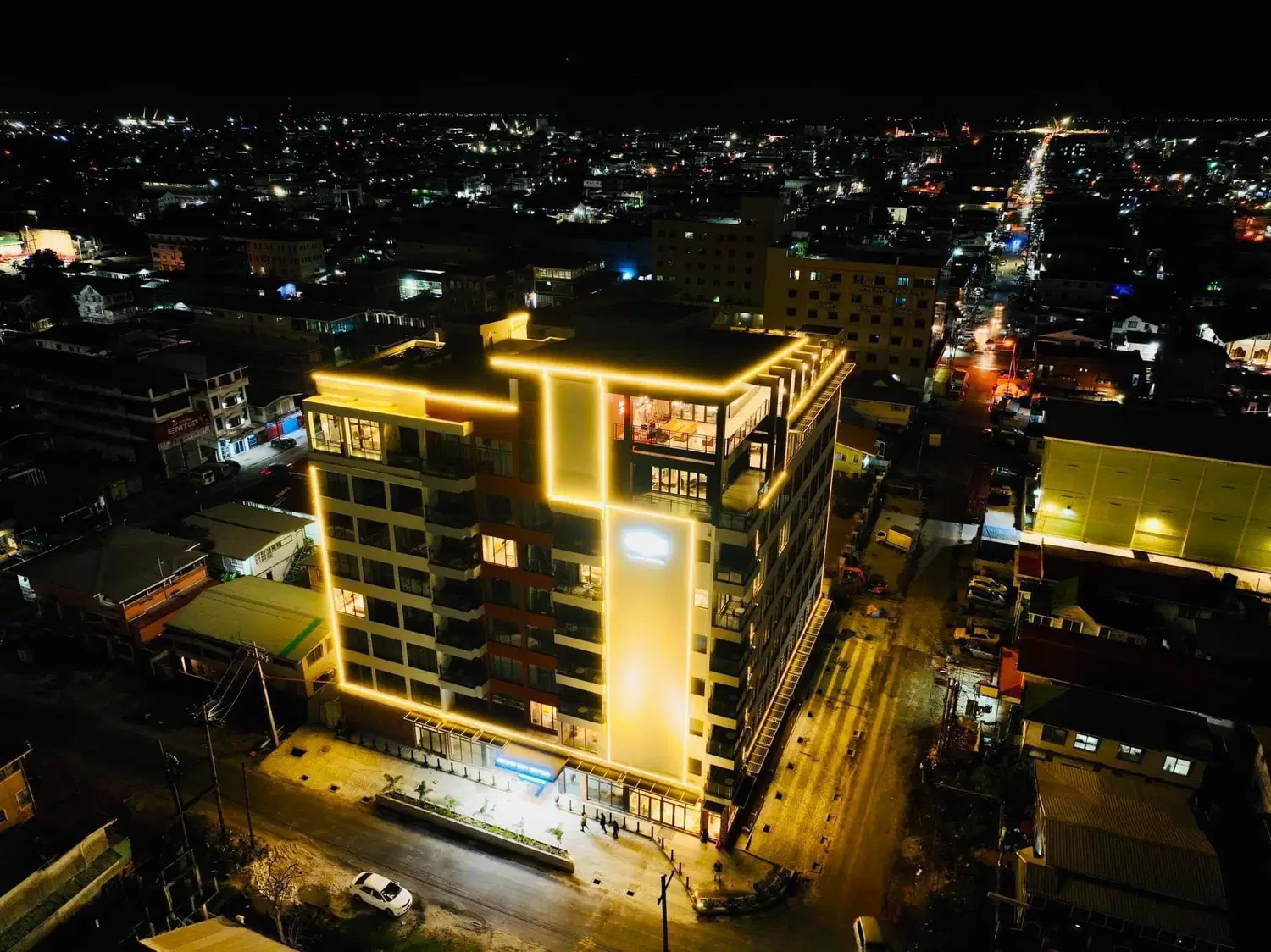
Behind every new hotel is a much bigger story about where Guyana’s economy is heading.
If there is one visible symbol of Guyana’s economic transformation, it may be the number of hotels now rising across the country.
Across Georgetown and other rapidly developing communities, international hotel brands and local developers continue investing in new accommodation. Construction cranes have become a familiar part of the skyline, reflecting a hospitality sector that is expanding alongside the country’s broader economy.
Many people assume the explanation is simple: more tourists are visiting Guyana, so naturally the country needs more hotel rooms.
Tourism is certainly contributing to this growth. But it is not the whole story.
The rapid expansion of Guyana’s hospitality sector reflects an economy that is becoming increasingly connected to international business, investment, infrastructure development and regional commerce. Hotels are no longer serving only holiday travellers. They are becoming an essential part of the infrastructure supporting one of the world’s fastest-growing economies.
Accommodation Capacity Continues to Expand
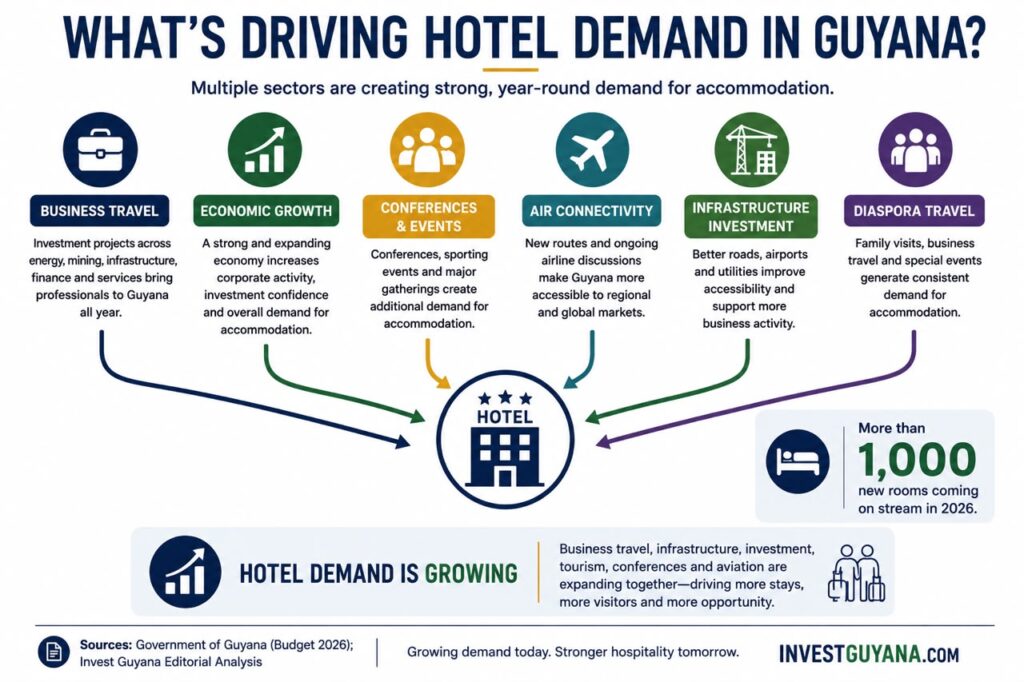
The scale of investment is significant. According to Budget 2026, Guyana’s accommodation capacity is expected to increase from approximately 3,280 rooms in 2020 to more than 5,600 rooms by the end of 2026, representing an increase of roughly 42 percent in six years. More than 1,000 additional rooms are expected to enter the market during 2026 alone.
Government is also targeting 553,257 visitor arrivals, increasing tourism employment to 30,000 people, expanding accommodation capacity to 5,692 rooms, and improving average room occupancy to 55 percent. These figures demonstrate confidence in the long-term growth of Guyana’s hospitality industry.
Business Travel Is Becoming a Major Driver
While leisure tourism remains important, business travel has become an increasingly important source of demand.
Every major investment project creates demand for accommodation long before tourists arrive. International energy companies, engineering firms, construction contractors, mining companies, financial institutions, consultants, government delegations and investors all require places to stay while conducting business in Guyana.
Unlike seasonal leisure tourism, business travel often generates more consistent demand throughout the year. For hotel developers, this creates a stronger and more predictable investment environment.
Better Air Connectivity Is Expanding Opportunities
Accessibility remains one of the foundations of every successful hospitality market.
Recent years have seen Guyana strengthen its international air connectivity through new direct services, including KLM’s Amsterdam route and Air Transat’s Toronto service. Government has also confirmed that discussions continue with additional international airlines. Improved connectivity benefits far more than tourism.
It supports business travel, foreign investment, conferences, trade and the Guyanese diaspora while making the country increasingly accessible to international markets.
Conferences and Events Are Creating New Demand
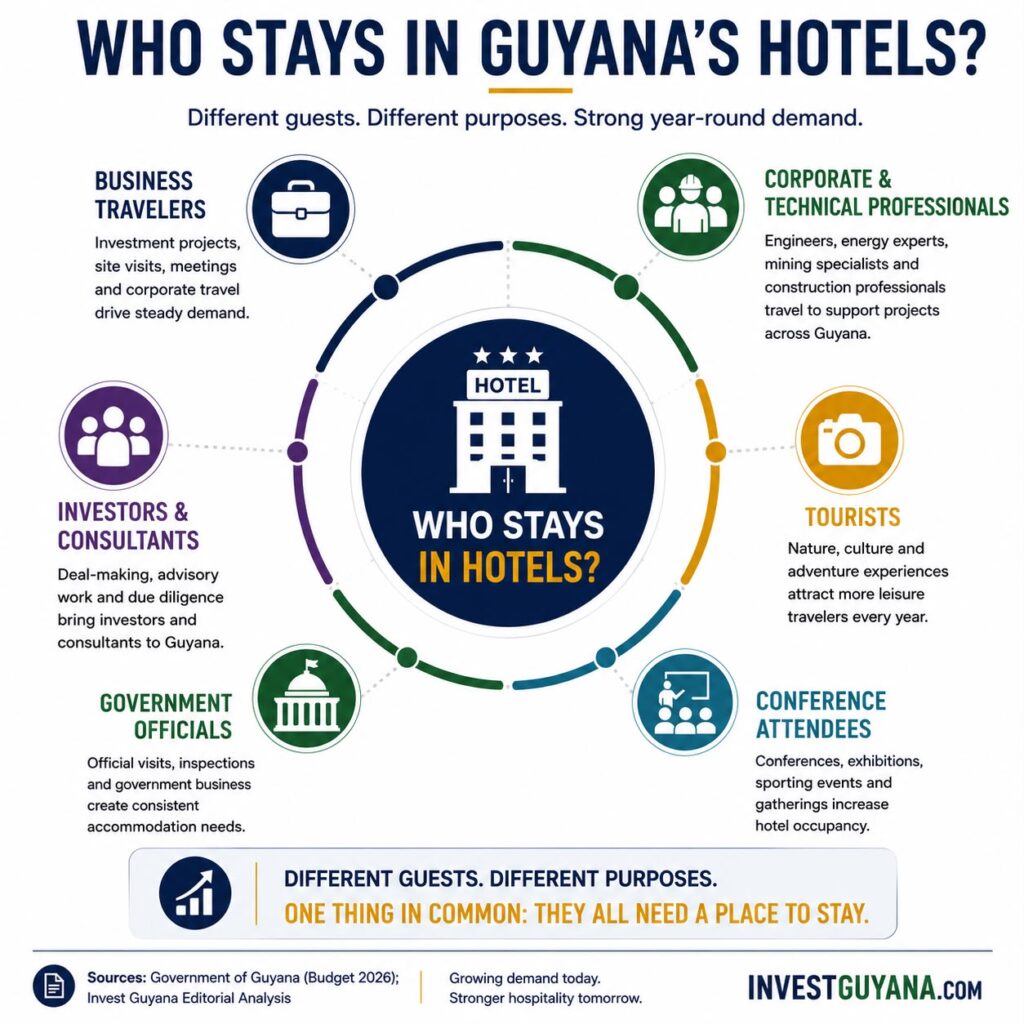
Government is also working to diversify the type of visitors coming to Guyana. Budget 2026 outlines initiatives to position Guyana as a destination for conferences, destination weddings, reunions, sporting events and cultural festivals. Guyana is also expected to host the Caribbean Tourism Organisation’s State of the Industry Conference, bringing regional tourism leaders together to discuss the future of the sector.
These initiatives broaden demand beyond traditional holiday travel and contribute to more consistent occupancy throughout the year.
Investing in Hospitality Means Investing in People
Hotels require more than buildings. They require skilled professionals capable of delivering high-quality guest experiences.
To support this growth, Government has allocated approximately G$2.225 billion in Budget 2026 to complete the Hospitality Training Institute, which is expected to train more than 700 hospitality professionals.
As accommodation capacity expands, investment in people will become just as important as investment in physical infrastructure.
Confidence Is the Bigger Story
Perhaps the most important message behind Guyana’s expanding hospitality sector is confidence. Hotels require substantial upfront investment and typically generate returns over many years.
Developers do not build hundreds of new rooms because they expect a short-term increase in visitors. They invest because they believe Guyana’s economy will continue attracting businesses, conferences, investors, international organisations and travellers well into the future.
That confidence extends far beyond tourism. It reflects expectations about Guyana’s broader economic trajectory.
Invest Guyana Insight
It is easy to see a new hotel and assume it exists simply because more tourists are arriving. The evidence suggests something much broader.
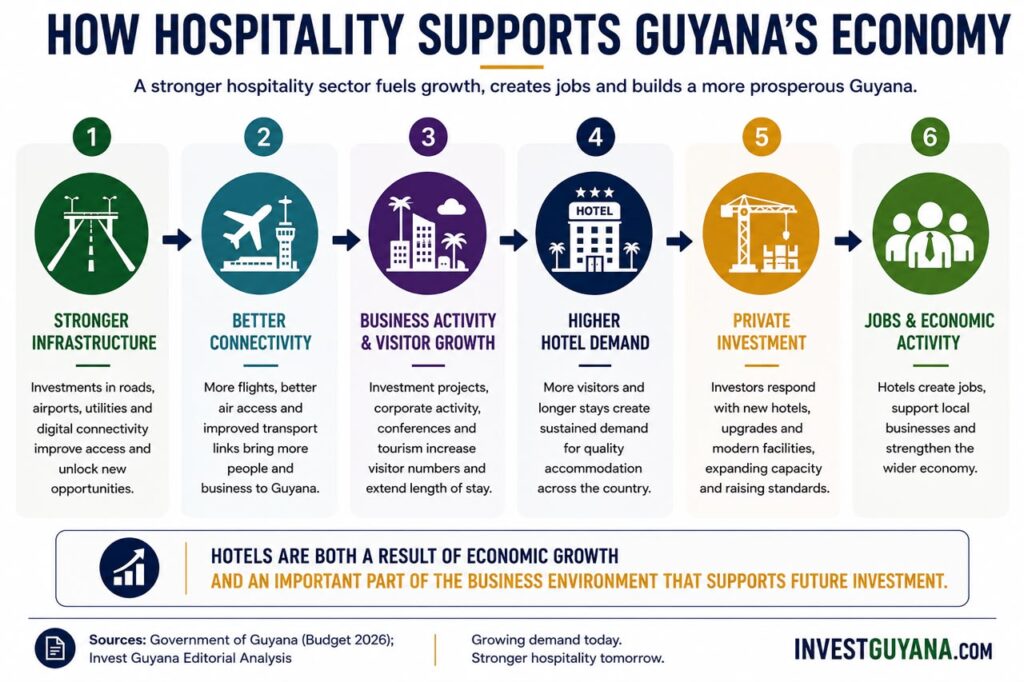
Hotels are becoming part of the commercial infrastructure supporting Guyana’s emergence as a regional business destination. Business travel, infrastructure development, aviation, conferences, investment and tourism are increasingly working together to reshape the country’s hospitality industry.
Understanding these structural drivers provides a more complete picture of why hotel development continues to accelerate.
Investor Takeaway
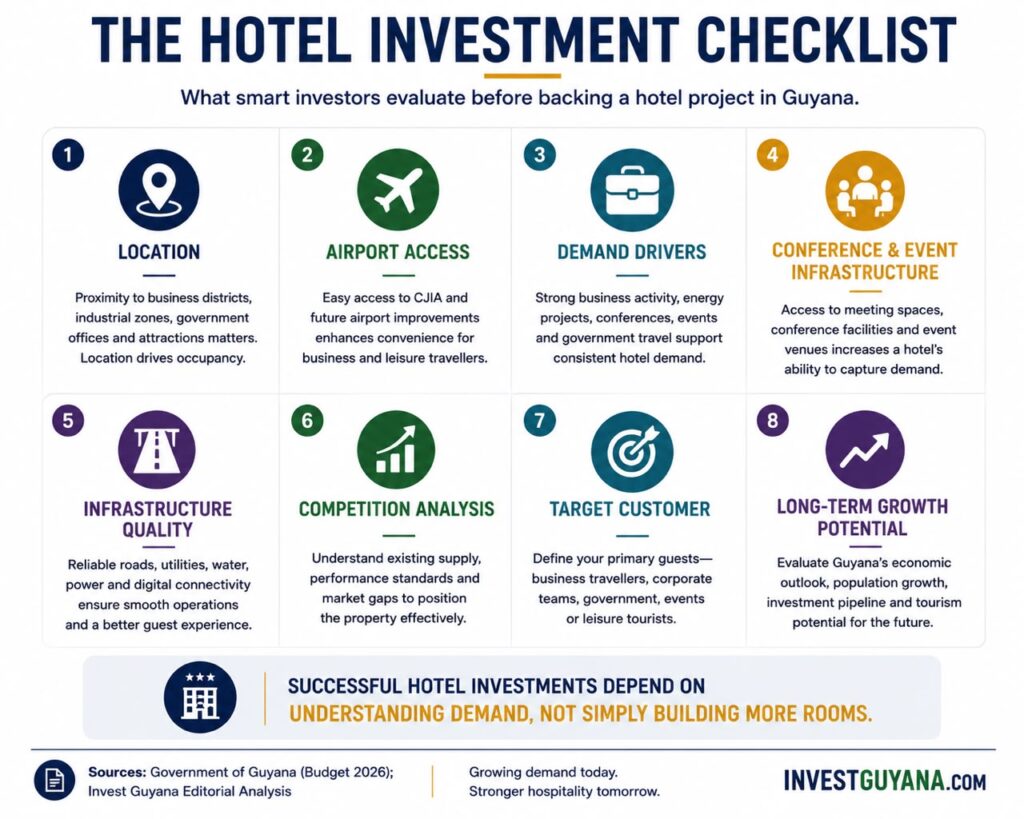
The question is no longer whether Guyana needs more hotel rooms. The more important question is where future demand will be strongest.
Location, airport connectivity, surrounding commercial activity, conference facilities, infrastructure and market positioning are all likely to influence long-term success.
Hotels are often among the earliest private investments made when investors believe an economy is entering a new phase of growth.
In Guyana, the cranes reshaping the skyline are not simply building places for visitors to stay. They are helping build the infrastructure that supports a more connected, internationally engaged and diversified economy.