

The certificate felt like an award
The supplier had completed its bidder-registration application and proudly added the record to its company profile.
The sales team began telling clients that the business was now an approved government contractor.
The description went too far.
Registration on the National Procurement and Tender Administration’s Register of Bidders can be an important readiness step. It does not mean that a procuring entity has evaluated the company for every tender, selected it as the successful bidder or entered a contract with it.
The Register is an entry layer
The Procurement Regulations establish a Register of Bidders and organise registration around categories including construction, consulting services, goods and services.
The registration framework gathers prescribed information and supporting evidence so that bidders can enter the procurement system in an organised way. The general Register is continuously open.
That general Register must not be confused with a separate operational programme for works below GYD 15 million. The 2026 portal for that programme has its own boundary and has shown a closed-registration state. The closure of that portal does not prove that the statutory general Register is closed.
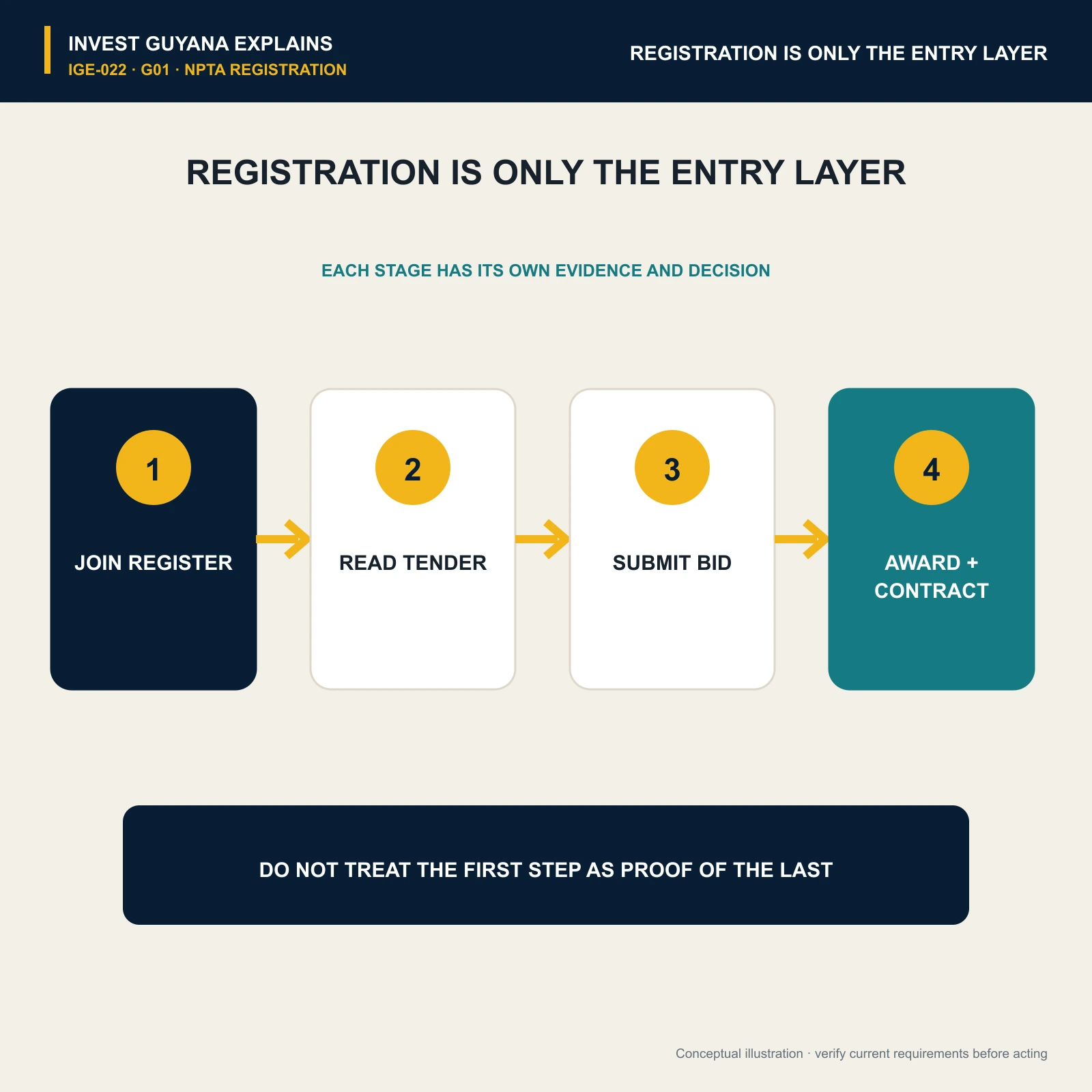
Registration does not establish tender-specific eligibility
Every procurement opportunity has its own subject, specifications and qualification requirements.
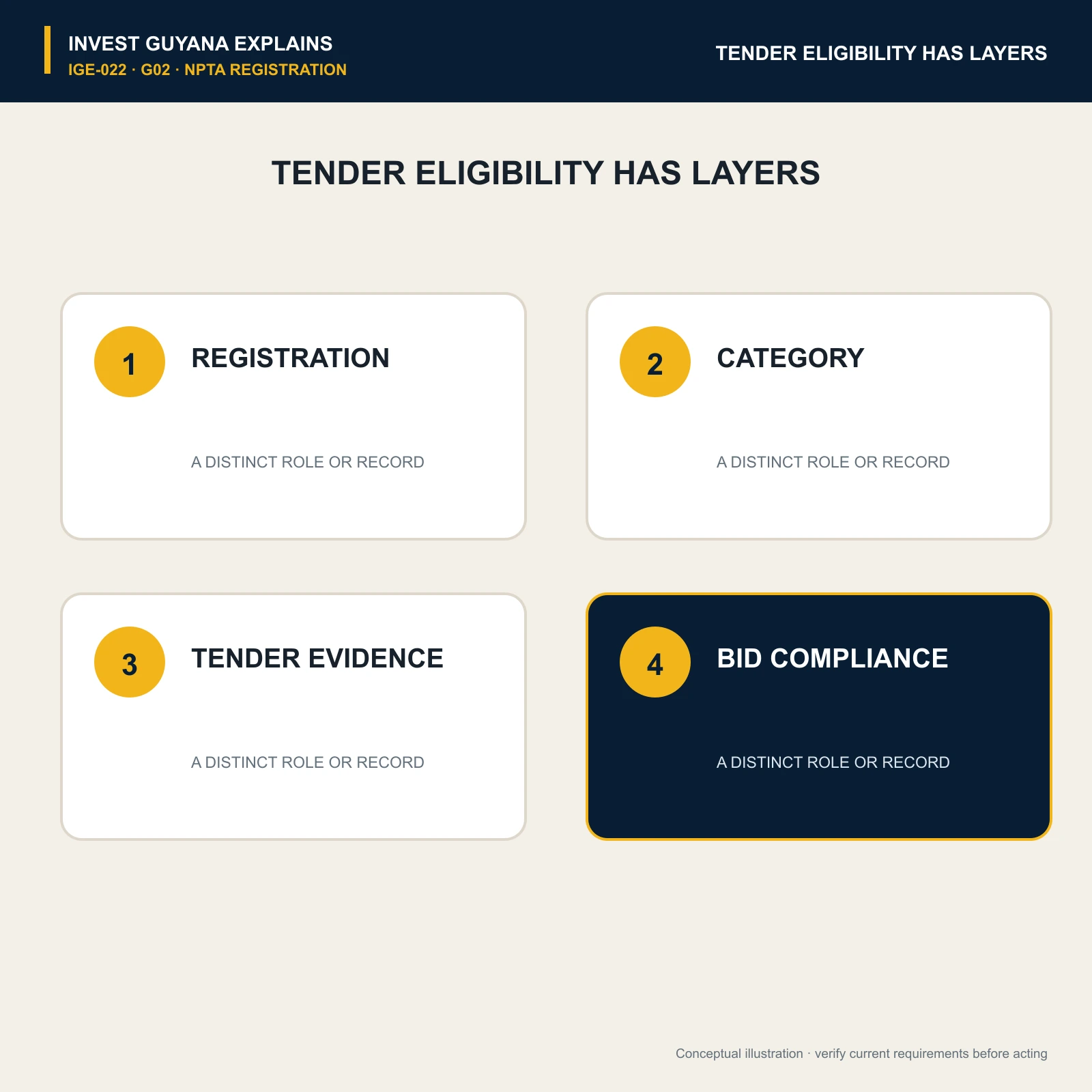
A bidder registered under an appropriate category may still need to demonstrate the experience, financial capacity, technical personnel, licences, tax compliance, NIS compliance or other evidence required by the particular tender.
The registration record and the tender document therefore answer different questions:
- registration asks whether the bidder has entered the applicable bidder-registration framework;
- the tender asks whether the bidder satisfies the requirements of this procurement.
A business should not promise that registration makes it eligible for every opportunity in the category.
An application interval is not an approval time
The governing framework includes a seven-day rule connected to applying before participation. It is a minimum pre-participation application interval.
It is not a promise that approval will be completed within seven days. It is not a processing-time guarantee. It is not evidence that a late application will be cured by submitting a bid.
This distinction matters because businesses often convert every number in an official rule into a service standard. A filing interval and an authority’s processing time are not the same thing.
A submitted bid is still not an award
Once a tender is identified, the bidder prepares and submits its response under the applicable instructions. The procuring system then moves through opening, evaluation, recommendation, approval and award steps according to the governing framework.
The bidder may be registered and compliant but still not offer the evaluated response selected under the tender. Another bidder may better satisfy the criteria, or the procurement may change or be cancelled within the lawful process.
Award is a later decision. Contract formation and performance obligations come later still.
Why the distinction protects the bidder
Treating registration as a contract can cause a business to spend too early. It may purchase equipment, hire staff or commit to suppliers before it has a tender, an award or a signed agreement.
A stronger readiness model separates:
- registration readiness;
- tender-specific qualification;
- bid preparation and submission;
- evaluation and award;
- contract execution and performance.
Each stage has different evidence and different commercial risk.
What registration does communicate
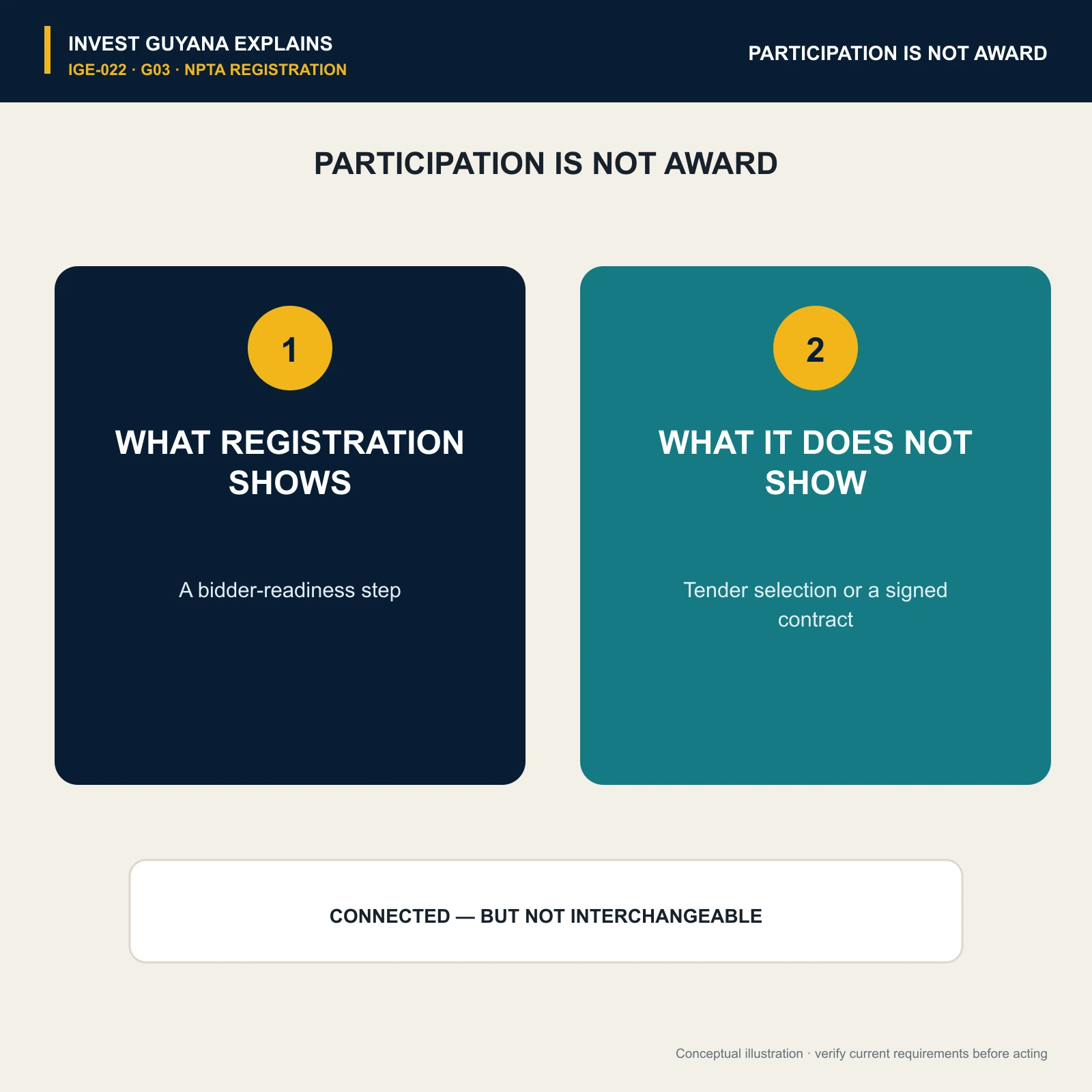
Registration is still valuable. It can show that the bidder has taken a recognised step into the procurement framework and has organised prescribed information for the relevant category.
It can also expose gaps before a tender deadline: missing company records, outdated compliance evidence, incomplete project history or unclear category selection.
The right message is not “we have a government contract.” It is “we have completed an applicable bidder-readiness step and must now assess each opportunity on its own terms.”
Four questions before pursuing a tender
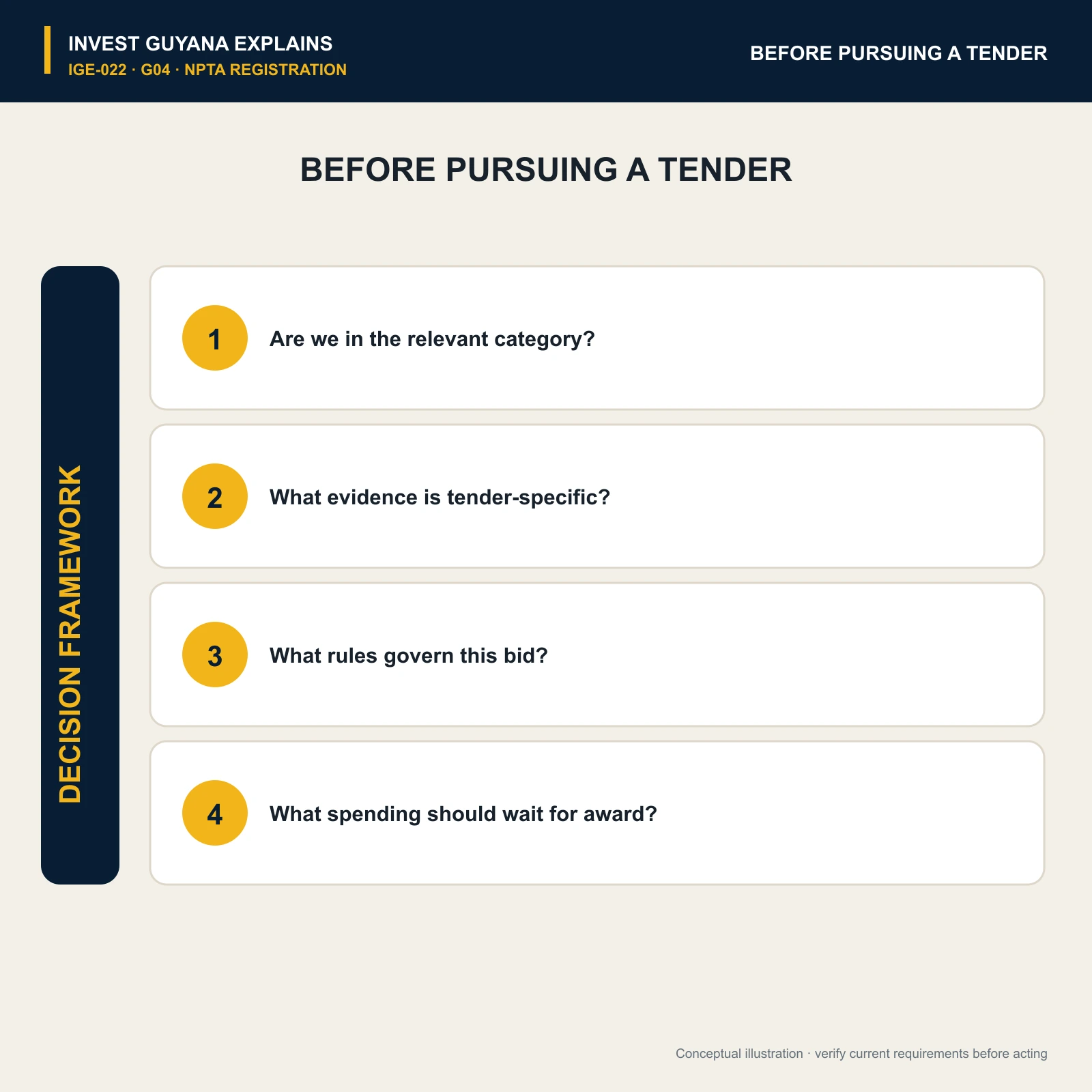
The business should ask:
- Are we registered in the category relevant to the opportunity?
- What tender-specific evidence is required beyond registration?
- What deadline and submission rules govern this bid?
- What commitments should wait until an award and contract exist?
The investor takeaway
NPTA registration is a gateway, not a government contract.
It does not guarantee eligibility for a specific procurement, acceptance of a bid, an award, contract signature or payment. Businesses should celebrate registration as progress while keeping every later procurement stage visible.
The next article in Invest Guyana Explains will begin a property sequence by distinguishing an allocation, lease, transport and certificate of title, and showing why each points to a different legal position and authority.