
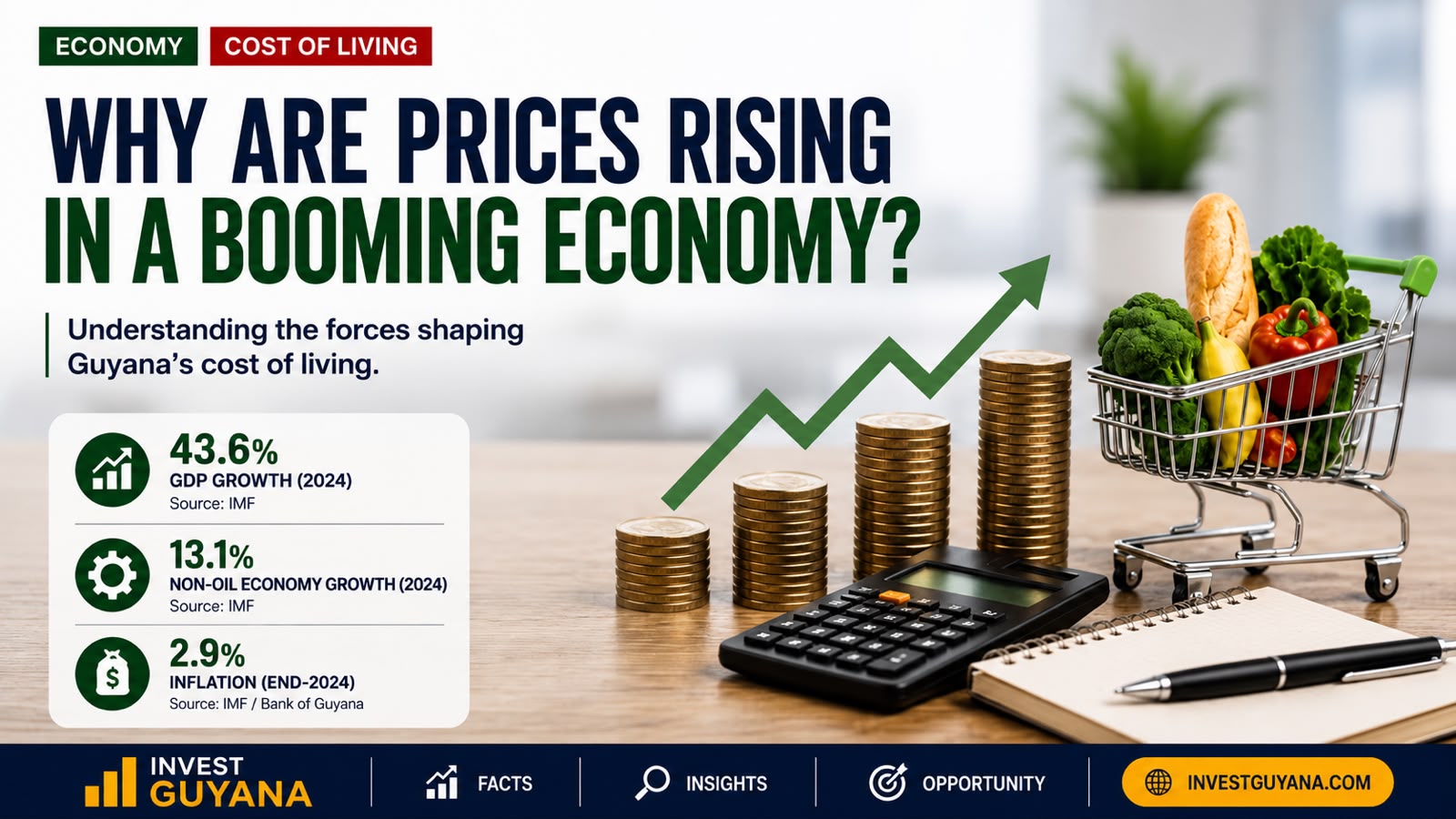
Guyana is experiencing one of the most remarkable economic expansions in the world. According to the International Monetary Fund (IMF), the country’s economy grew by approximately 43.6 per cent in 2024, while the non-oil economy expanded by approximately 13.1 per cent.
New roads are being built, housing developments are expanding, businesses are investing, and construction activity is accelerating. Yet despite these impressive numbers, many Guyanese continue to ask: if the economy is booming, why does everything feel more expensive?
The answer is more complicated than many people realize. The evidence suggests that rising prices are not being driven by a single factor. Instead, several economic forces are working simultaneously, affecting households, businesses and consumers in different ways. Understanding those forces is critical for both investors and policymakers.
INFLATION IS RISING, BUT NOT DRAMATICALLY
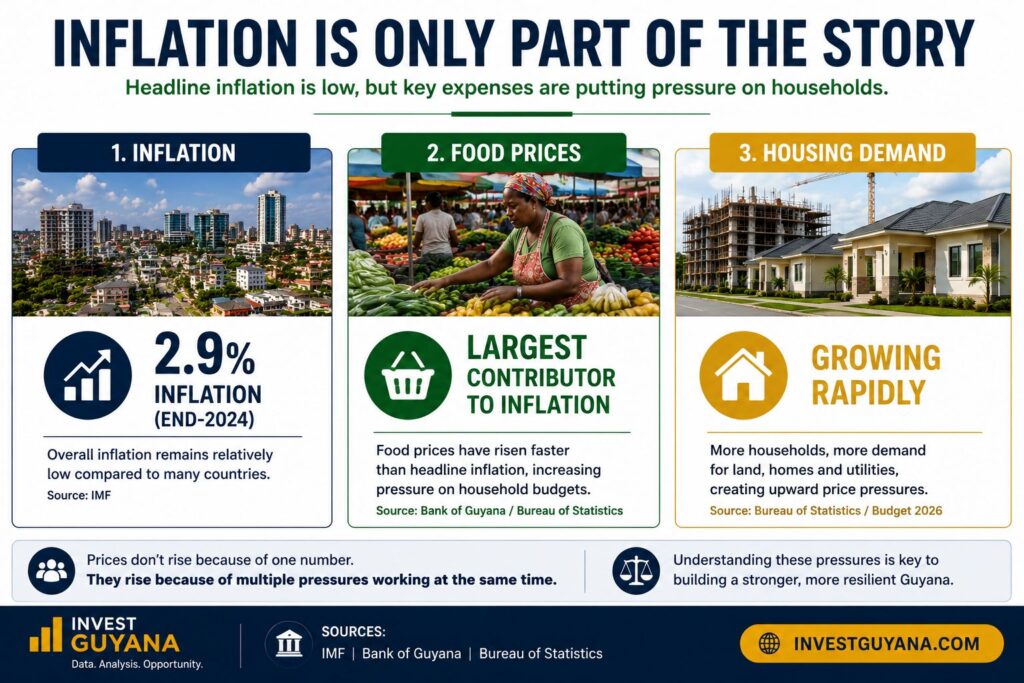
The first surprise is that Guyana’s headline inflation rate is relatively modest compared with many countries worldwide.
According to the IMF, inflation reached approximately 2.9 per cent at the end of 2024. Bank of Guyana data shows year-to-date inflation also stood at approximately 2.9 per cent at the end of June 2025.
These figures are significantly lower than the double-digit inflation experienced by many countries in recent years. Based on headline inflation alone, Guyana does not appear to be facing a severe inflation problem.
However, headline inflation does not always reflect how households experience rising costs. People do not buy inflation. They buy food, transportation, housing, utilities and everyday necessities. And that is where the story becomes more interesting.
FOOD PRICES ARE RISING FASTER THAN OVERALL INFLATION
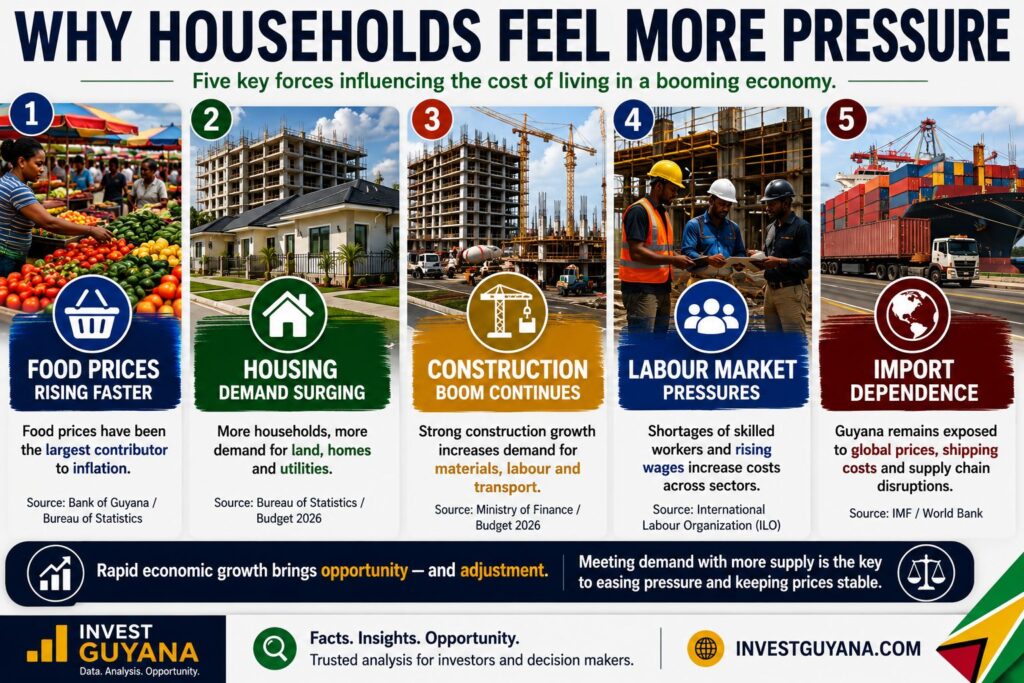
Official reports from the IMF, the Bank of Guyana, and the Bureau of Statistics indicate that food prices have been among the largest contributors to inflation in recent years.
Food prices have generally risen faster than headline inflation, making food one of the most important sources of cost-of-living pressure for many households.
For many families, groceries are among the largest monthly expenses. As a result, food inflation often feels more significant than the broader inflation rate suggests.
A household may hear that inflation is approximately 2.9 per cent, yet still experience financial pressure if food costs are rising faster than overall prices. This helps explain why public perceptions of inflation sometimes differ from official statistics. Both can be correct.
A HOUSING BOOM IS CREATING NEW PRESSURES
Housing is another important part of the story. As discussed in our previous analysis, Guyana’s housing market is experiencing significant expansion. Mortgage lending has grown rapidly, while the government has allocated approximately GY$159.1 billion (approximately US$760 million) for housing initiatives in the 2026 national budget.
Thousands of additional house lots and housing units are planned. At the same time, the country’s population and household structure are changing. The 2022 Population and Housing Census showed that the number of households increased significantly over the previous decade while average household size declined.
This means more households require homes, land, utilities, and supporting infrastructure. When demand grows rapidly, supply often needs time to catch up. Even when housing investment is increasing, prices and costs can rise during periods of adjustment.
CONSTRUCTION IS EXPANDING RAPIDLY
Construction has become one of the fastest-growing sectors in the economy. According to the 2026 Budget speech, construction activity is estimated to have expanded by approximately 31 per cent in 2025.
That growth is being driven by public infrastructure projects, private housing developments, commercial construction, hotels and hospitality projects, and industrial developments.
Construction growth generates jobs and economic activity. But it also increases demand for workers, materials, transportation, and equipment. When multiple projects compete for the same resources at the same time, costs can increase.
This is not unique to Guyana. Many rapidly growing economies experience similar pressures when investment accelerates faster than local capacity can expand.
LABOUR MARKET PRESSURES ARE EMERGING
One of the less visible effects of economic growth is increased competition for workers. The International Labour Organization has identified labour shortages and skills mismatches among the challenges facing Guyana’s labour market.
Employers in construction, technical trades and other growth sectors are increasingly seeking skilled labour. From an economic perspective, higher wages are generally positive. Workers benefit when their skills become more valuable.
However, rising labour costs can also increase the costs of construction projects, business operations and service delivery. Those higher costs can eventually filter through to consumers.
This does not mean labour market pressures are causing inflation on their own. It does suggest they are part of a broader set of economic adjustments associated with rapid growth.
IMPORT DEPENDENCE STILL MATTERS
Another important factor is import dependence. Despite growing domestic production, Guyana continues to rely on imported food, consumer products, machinery and industrial goods. This means local consumers remain exposed to international price movements.
If shipping costs rise, global food prices increase or supply chains become disrupted, local prices can also be affected. In other words, not every increase in the cost of living originates within Guyana. Some price pressures are imported from abroad.
This is a common challenge for many small and developing economies.
IS THE ECONOMY OVERHEATING?
This is perhaps the most important question for investors. When economies grow very rapidly, demand can sometimes outpace supply. This can lead to inflation, labour shortages, housing pressures and infrastructure bottlenecks.
Economists often describe this as overheating. At present, the evidence does not clearly indicate that Guyana is experiencing severe overheating. Headline inflation remains relatively moderate.
However, there are signs of pressure in specific areas of the economy, particularly food, housing, construction and labour availability. These are indicators worth monitoring closely over the coming years.
WHAT INVESTORS SHOULD WATCH
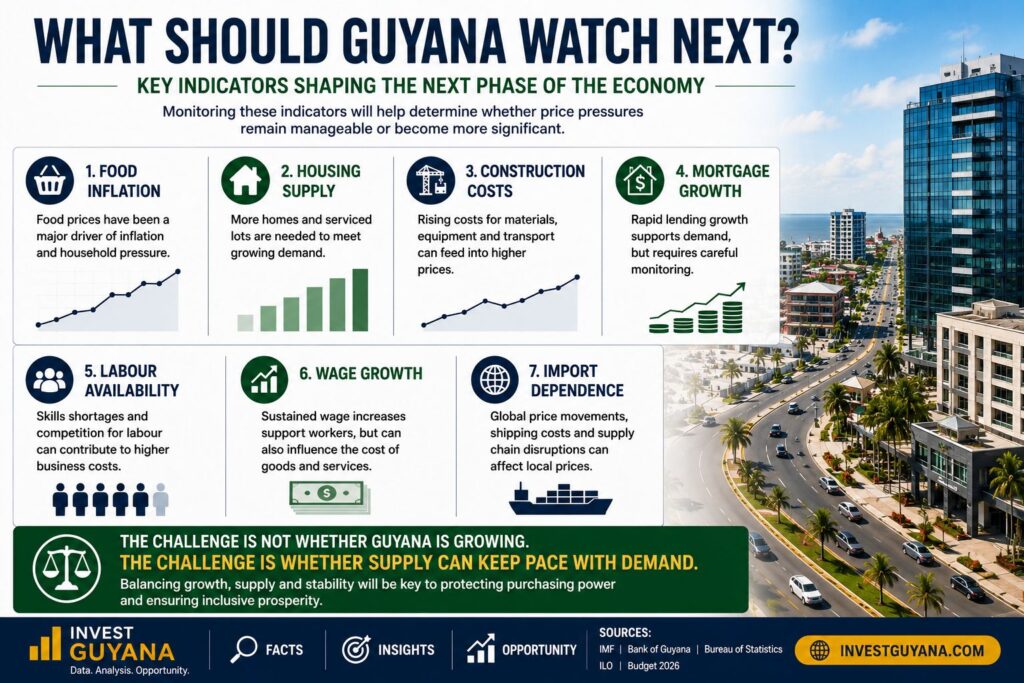
Several indicators will help determine whether current price pressures remain manageable or become more significant:
* Food inflation
* Housing supply
* Mortgage growth
* Construction costs
* Labour availability
* Wage growth
* Import dependence
* Overall inflation
Monitoring these indicators will provide important insight into the sustainability of Guyana’s economic expansion.
INVESTOR TAKEAWAY
The perception that life is becoming more expensive in Guyana is not without foundation.
Food prices have been among the largest contributors to inflation. Housing demand continues to grow. Construction activity is expanding rapidly. Labour market pressures are emerging in key sectors. The country remains exposed to imported price movements.
At the same time, headline inflation remains relatively modest by international standards. The evidence suggests that Guyana is not facing a classic inflation crisis. Rather, it is experiencing some of the adjustment pressures commonly associated with rapid economic growth.
For investors, that distinction matters. The key challenge may not be whether Guyana is growing. The key challenge may be whether housing, infrastructure, labour supply and domestic production can expand quickly enough to keep pace with that growth.