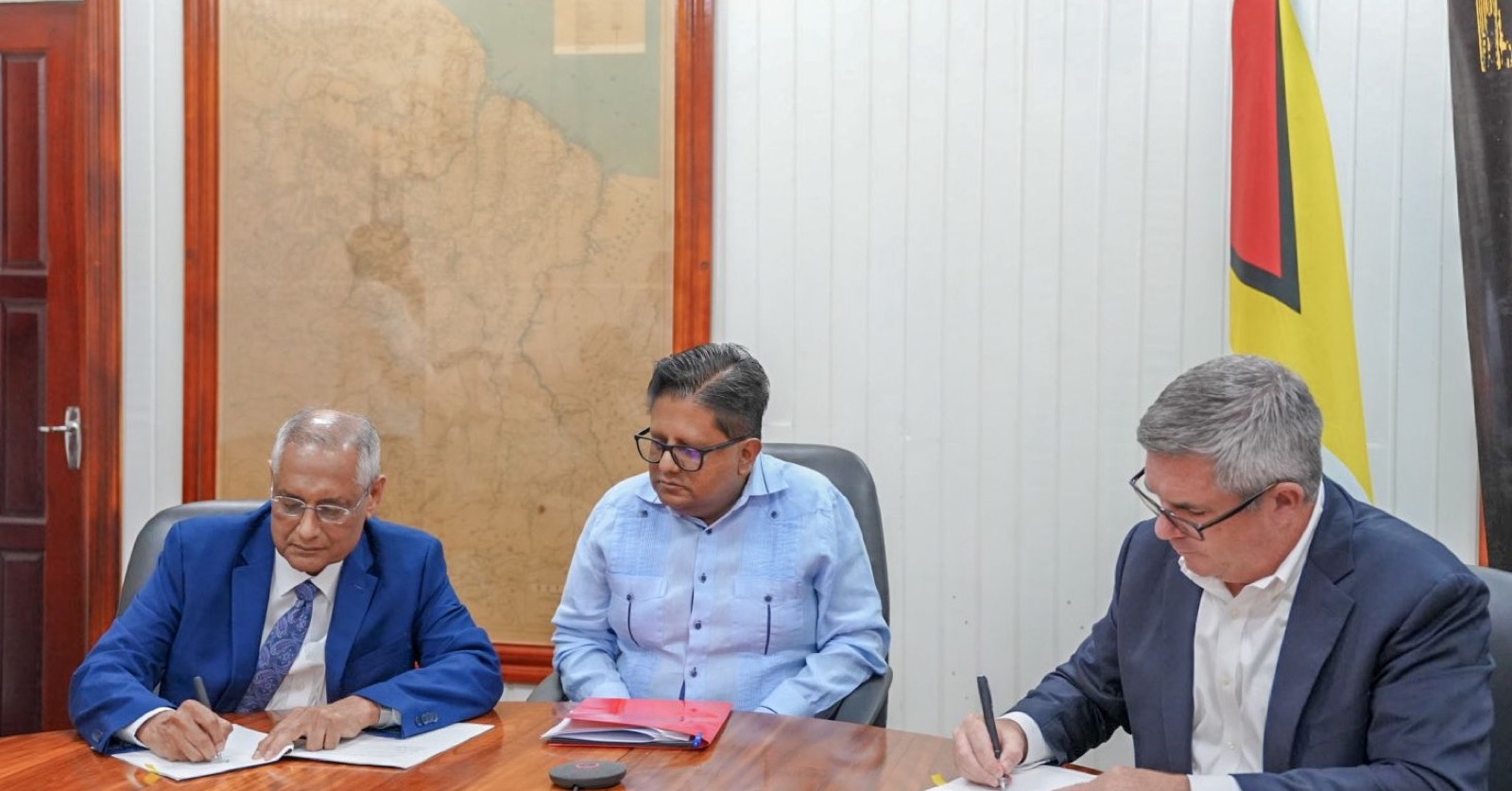

President Irfaan Ali addresses a Guyanese diaspora forum in New York on 24 September 2026. Photo: Department of Public Information.
Guyanese living abroad may eventually be offered a direct way to invest in industrial projects at home. President Irfaan Ali said at a diaspora gathering in New York on 24 September that the government intends to launch a special investment vehicle to mobilise overseas Guyanese capital, naming a fertiliser project and a gas-bottling project among the opportunities.
The announcement is potentially significant for a diaspora that has long contributed to Guyana through family support, property purchases and business formation. It also raises questions that cannot yet be answered from the information made public: what investors would own, how returns would be calculated, what exactly the government would guarantee, and when applications could begin.
That difference between contributing money to family, opening a private business and buying into a structured project is more than a matter of terminology. In each case the person providing capital has a different relationship to the asset and a different ability to recover funds. A government-sponsored vehicle would need to explain that relationship plainly, especially to people making a decision from another country.
The Department of Public Information’s account of the President’s remarks says he described a vehicle to be launched “very soon” and spoke of government-guaranteed returns. No prospectus, term sheet, subscription process, guarantee instrument or launch date accompanied that report. The announcement should therefore be understood as a proposal, not as an investment offer that can currently be assessed or purchased.
A proposed route into national projects
An investment vehicle is a structure through which money can be collected and directed toward assets or projects. The form matters. A person buying a bond holds a different claim from one acquiring shares in a project company or contributing to a pooled fund. Those arrangements differ in how investors are paid, whether capital can be withdrawn, and what happens if a project is delayed or underperforms.
The President’s remarks, as reported by DPI, do not identify which of those structures is contemplated. Nor do they specify whether one vehicle would cover several projects or whether each project would have a separate offering. Without those details, the phrase diaspora investment vehicle describes an intention rather than a defined financial product.
The announcement also needs to be read alongside an earlier promise. Invest Guyana reported in May that the President had proposed a diaspora bond. The materials reviewed for this report do not establish whether the September vehicle is that same initiative, a revised structure or a separate offering. It would be premature to treat them as two products—or to assume the earlier bond was launched—without formal documents.
The two industrial projects named in the announcement have a documented place in Guyana’s public investment pipeline, but they should not be presented as operating assets. The Ministry of Finance’s 2026 Mid-Year Report, paragraph 3.73, says the government was evaluating proposals for the design, engineering, construction and operation of the Guyana Gas Bottling and Logistics Company and the Guyana Ammonia and Urea Plant. The report anticipated awards during the second half of 2026. It does not establish that awards had occurred when it was prepared.
The report discusses those ventures as proposed industrial developments within a wider plan to use Guyana’s gas resources. It does not establish the ownership structure of either plant or say how much investment would be sought from individuals. The President’s later remarks make the connection to the diaspora, but the public record has not yet joined the two into a documented financing transaction.
That project-stage distinction affects the investment story. A planned plant can create an opportunity, but its costs, construction schedule, operator, supply arrangements and eventual revenues depend on decisions that may still be ahead. Before citizens abroad are asked to invest, they would need to see how their money would connect to those projects and whether it would finance construction, ownership, debt or another component.
What would a guarantee cover?
The President’s reference to guaranteed returns deserves particular care. It is not enough to know that a guarantee was mentioned; an investor needs to know what the undertaking would legally protect. Would it cover a stated rate of return, repayment of principal, payments due from a project company, or some narrower obligation? Who would issue it, and from which public resources would it be honoured? The public account does not answer those questions.
Neither the scale of the proposed vehicle nor an expected return has been published in the material reviewed for this article. It would be misleading to convert the President’s statement into an advertised yield, a sovereign bond, a government-backed savings product or an assurance that an individual investment cannot lose value. Those descriptions require formal documentation that has not yet been identified.
For Guyanese living outside the country, other practical matters will also be important. The currency in which contributions are made and returns paid could change an investor’s exposure to exchange-rate movements. Tax treatment may differ by country of residence. Transfer rules, minimum amounts, eligibility criteria and the identity of the entity administering subscriptions would all need to be clear before a family or business could make an informed decision.
An investor would also need to know how information will be provided after money is committed. Will accounts be published for each project? Will participants receive periodic operating reports? Who checks that funds are used for the purpose described in the offer? None of these oversight arrangements has been identified in the announcement. They are ordinary questions for a vehicle intended to connect many individuals to large, long-lived assets.
These are not defects established in the proposed programme. They are the information normally needed to understand any cross-border investment, especially one described as guaranteed.
Why the structure matters beyond the diaspora
If developed with clear terms and credible oversight, a diaspora-focused vehicle could give overseas Guyanese a more direct relationship with productive projects than a general appeal to return or invest. It might also widen the sources of capital available for industrial development. Those are potential effects, not outcomes already demonstrated by the announcement.
The design will determine whether the programme serves that purpose. An instrument that offers fixed repayments needs a different financing and risk framework from one whose returns rise and fall with a plant’s performance. Investors would need to know how project decisions are made, who reports results, how funds are segregated and what independent accounts will be available. Project developers, in turn, would need certainty about how the diaspora capital fits alongside their own equity, lenders and government participation.
That is why a published offer document would be more informative than a headline about guaranteed returns. It would allow prospective participants to compare the programme with other uses for their money and to judge the trade-offs in time, liquidity and risk.
The next test is publication of the terms
For now, the verified development is a presidential announcement reported by a government news service. The Ministry of Finance’s mid-year report independently confirms that the named industrial ventures were being evaluated, but it does not describe a diaspora vehicle or its financing terms.
The next meaningful milestone will be a formal launch with clear documentation: the legal issuer, the projects covered, the use of proceeds, investor rights, risk disclosures and the exact scope of any state guarantee. Until that appears, the appropriate conclusion is neither that the programme is already available nor that it will necessarily fail. It is that an important idea has been placed in public view, while the information required for an investment decision remains to be published.