
Photo: Kiara Worth / UN Climate Change, COP31 Leaders’ Summit, Antalya, 11 November 2026.
Guyana has already sold forest carbon credits. At COP31 in Antalya, it put a different question to governments: will more of them let eligible forest credits count towards regulated emissions obligations?
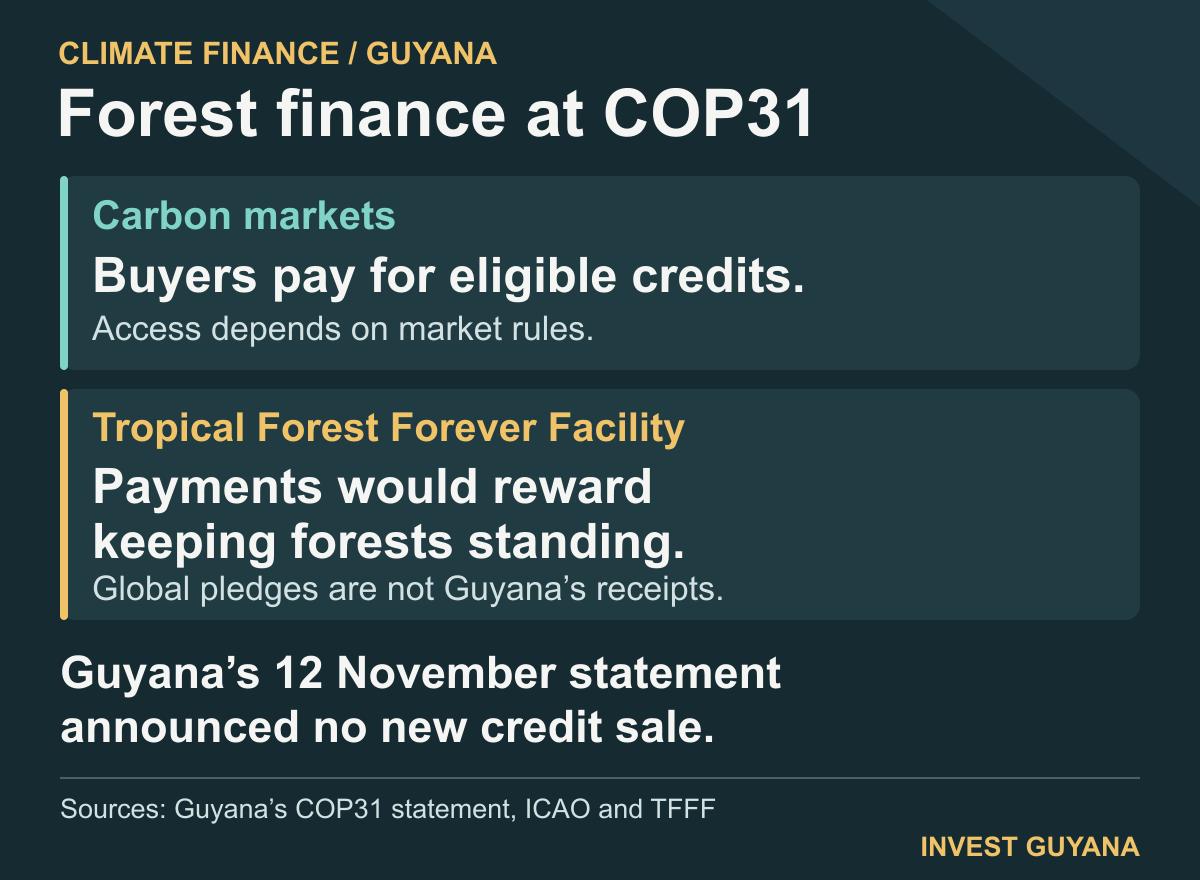
Delivering Guyana’s national statement on 12 November, Vice President Bharrat Jagdeo said the country sees credits issued under national or large regional forest programmes as its main route to financing conservation. He called on partner countries to implement rules for the international aviation offset scheme, open compliance markets to forest credits and put Article 6 of the Paris Agreement into practice. Those are policy requests, not new sales or changes to eligibility.
What wider access would change
A company can buy credits voluntarily. A buyer meeting a regulatory requirement can use only credits that the relevant scheme accepts. That distinction matters: eligibility under one programme does not make every Guyanese credit usable in every market. Rules can limit the issuing programme, the period the credits cover and the purposes for which they can be used.
Guyana has already cleared that hurdle for a defined set of aviation units. The International Civil Aviation Organization previously confirmed that 4.64 million eligible units issued under the Architecture for REDD+ Transactions programme had been authorised by Guyana for the 2024–2026 compliance period. The authorisation helps prevent the same emissions reduction from being claimed twice. The COP31 statement was about expanding access beyond what is already available; it did not announce another issuance.
The global forest fund is a separate route
The Tropical Forest Forever Facility said on 11 November that the Netherlands announced an investment of up to US$500 million over ten years and philanthropies announced US$88 million in contributions. The Netherlands had signalled its plan before COP31. Neither sum was pledged to Guyana. The facility is designed to reward independently monitored forest-cover performance, while carbon-credit buyers pay for eligible units.
The facility and carbon markets sit alongside other options in the Forest Finance Roadmap. Guyana backs the facility but put carbon markets first in its national statement. Progress on one route does not automatically open the other.
What to watch after COP31
The next evidence will come from rules and transactions rather than another pledge. Watch for a regulator naming eligible units and compliance periods, a registry recording an authorisation or issuance, and a buyer confirming a purchase. For Guyana, those are distinct steps between broader policy support and money that can finance forest conservation.