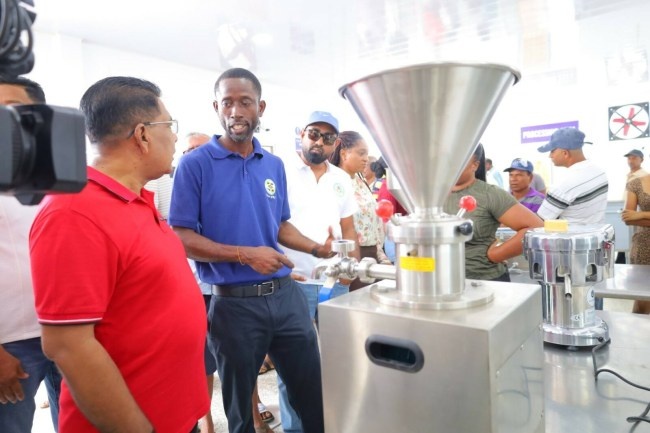
Minister Zulfikar Mustapha viewing equipment at the Canal Number One Polder agro-processing plant (photo: Ministry of Agriculture, Guyana).
Guyana spent G$462.5 million on agro-processing during the first six months of 2026, as the government expanded processing facilities, cold storage and market-access support for local producers. The figure represents about 62% of the G$745 million budgeted for the sector for the year, according to the Ministry of Finance’s 2026 Mid-Year Report.
The report gives a more useful picture than the spending total alone. It identifies facilities that are operating, projects still being built and plans that have yet to begin. Those stages are not interchangeable for farmers and agro-processors deciding where they can already take produce or obtain processing services.
The agri-business hub at Bartica, completed at the end of 2025, became fully operational in the first half of this year. A Guyana Shop and cold-storage facility complement it. At Canal Number One Polder, a dehydrating facility was commissioned in April, adding capacity to preserve agricultural produce and create value-added products. The Ministry of Agriculture has also described the Canal Number One facility as part of its effort to reduce post-harvest losses.
Facilities at different stages
Not every project named in the mid-year review is ready for use. The Regional Food Hub at Yarrowkabra was expected to be substantially completed by the end of 2026, while construction of a fruit-pulping facility at Lethem was expected to commence during the year. Those are government targets, not completed facilities.
This distinction matters because processing infrastructure can change what producers are able to sell. Dehydration, pulping, cold storage and product packaging each address a different constraint between harvest and market. A commissioned plant offers capacity now; a planned facility represents a future opportunity whose delivery still has to be demonstrated.
The report also records training for more than 240 agro-business operators in the first half of the year. Subjects included packaging and labelling, food safety, business development, contract negotiations and the use of preservatives. A further 300 people were expected to receive training in the second half, but the mid-year document does not present that future target as an achieved result.
Getting products to buyers
Infrastructure is only one side of agro-processing. Producers also need routes to customers. The finance report says 152 additional products became available through the Guyana Shop during the review period, including sauces, seasonings, condiments, jellies, marinades and personal-care products.
Five new Guyana Shop corners were established in Regions Four and Six, bringing the reported local total to 101. The report says the network covered every administrative region except Region Eight at mid-year and notes two regional corners in Bridgetown, Barbados. These figures describe distribution points and product listings; they do not, on their own, measure sales or profitability for the producers involved.
For investors and food businesses, the mid-year figures point to a public effort to build the facilities, skills and retail channels needed for more value-added production. The clearest questions for the rest of 2026 are whether the projects still under construction reach their stated milestones and whether producers can use the new capacity to reach paying markets consistently.