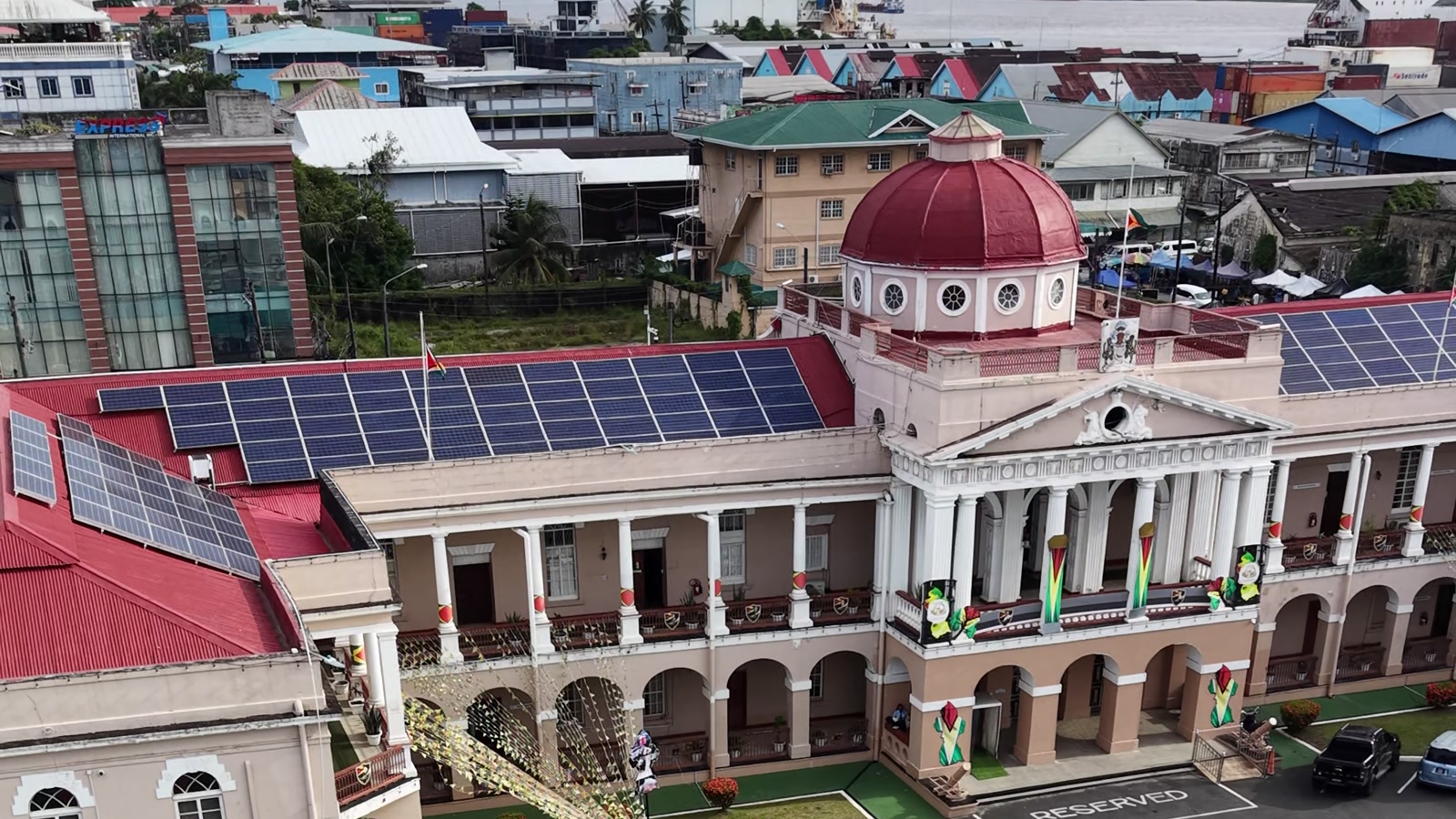
File image: Parliament Buildings, Georgetown.
Finance Minister Ashni Singh has put G$89.8 billion in supplementary financial papers before the National Assembly, with electricity costs and major infrastructure among the main items. The Finance Ministry’s 18 November release identifies two papers: Number 2, covering Contingencies Fund advances, and Number 3, seeking additional current and capital provision.
The requests include G$27.4 billion for Public Works, G$24.7 billion for Gas-to-Energy and G$1.6 billion for an expanded work programme at Cheddi Jagan International Airport. Public Works’ programme includes public and hinterland roads, the Linden–Mabura Road, Kurupukari Bridge and sea and river defences. These are spending provisions, not a list of newly awarded contracts.
Keeping fuel costs out of electricity tariffs
In its 18 November release, Government sought G$11.3 billion for electricity companies, including G$8 billion for GPL. The GPL amount is part of that total, not an additional request. The ministry also identified power entities in Linden, Mabaruma, Mahdia, Port Kaituma, Moruca and Matthews Ridge. Finance said the support was intended to absorb elevated fuel costs rather than pass them to consumers through higher tariffs.
For a baker, cold-storage operator or hotel buying power from GPL, keeping higher fuel costs off the tariff can help preserve the assumptions behind its own prices. It is a measure intended to hold down a cost increase, not a newly announced tariff reduction or support for diesel bought separately for a standby generator.
Gas-to-Energy is a separate G$24.7 billion item alongside that immediate fuel-cost support. The request concerns the project’s funding; the release does not provide a new commissioning date or a tariff schedule. It should not be confused with the amendments to the project’s EXIM financing agreement, which the minister also tabled on 18 November.
Earlier advances sit alongside new requests
Paper 2 covers advances for 31 July to 10 November, including emergency Guyana School of Agriculture repairs and additional Education Ministry security costs. That is different from Paper 3’s requests for further provision. Reading the combined total as an entirely new round of work would count money without first asking when it was advanced and what it paid for.
The Fiscal Management and Accountability Act, section 41, provides for Contingencies Fund advances where urgent expenditure cannot wait, subject to the Act’s conditions. It requires the minister to report the amounts, recipients and purposes to the Assembly. Parliamentary consideration therefore provides a record against which those advances can be checked; it does not mean every item first starts when the paper is tabled.
There is also a step between presenting a request and obtaining the spending authority sought. Under Article 219(2) of the Constitution, the Assembly’s approval of a supplementary estimate by resolution authorises the sums concerned, with those amounts subsequently included in a supplementary Appropriation Bill. The minister’s announcement should not be read as confirmation that the Assembly has completed that process.
Household payments account for further requests: G$10 billion for pensions and public assistance and G$1 billion for the existing G$100,000 cash-grant programme. A separate Finance Ministry cash-grant update says registrations exceeded the number budgeted for and that supplementary funding is sought for outstanding applications submitted by 31 October. Neither announcement launches another grant or sets out a new pension rate.
The figures highlighted in the ministry’s release are selected components, not a full reconciliation of the G$89.8 billion. Contractors and suppliers will need the detailed schedules to connect a provision to the agency and programme buying the work. Tender notices, contract awards and payment terms then establish whether that provision supports a new procurement or work already underway.