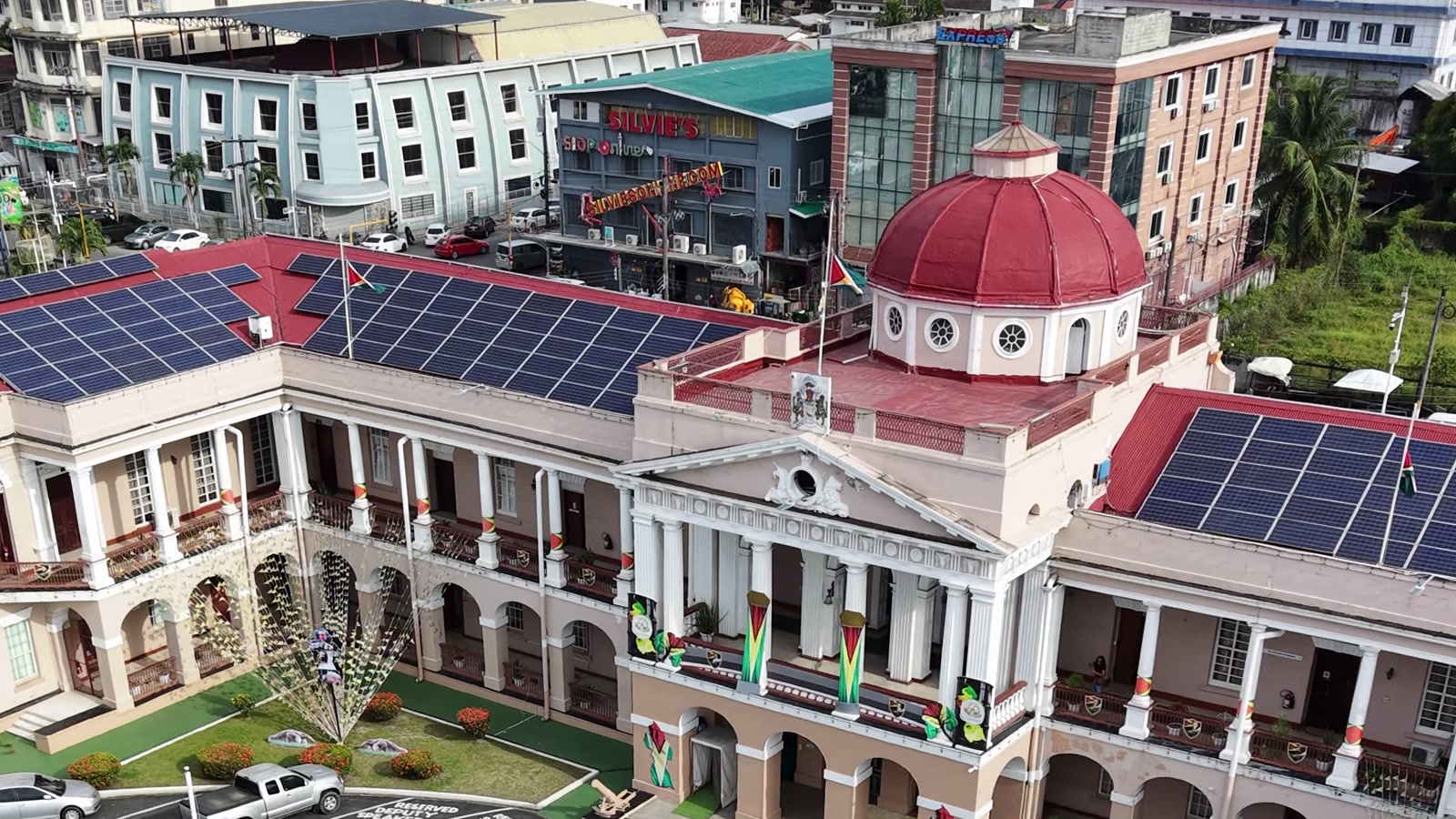
File image: Parliament Buildings, Georgetown; the Wales energy project is not pictured.
The Committee of Supply has approved G$24.7 billion for Gas-to-Energy, while Prime Minister Mark Phillips has put the revised project cost at US$956 million and said all four Phase 1 turbines should be running by the end of the fourth quarter of 2027.
In DPI’s account of the 23 November sitting, Phillips compared the cost with US$759 million previously. He said Government agreed to a contractor request for another US$200 million, of which US$130 million had been paid. The provision covers Phase 1 completion and Phase 2 turbines. He reiterated the commitment to 300 megawatts of additional power and halving electricity costs.
The published account gives no detailed cost schedule or contract variation identifying the components within the revised total. The figure remains the Prime Minister’s reported project cost, rather than a reconciled price for the whole offshore-to-grid development. The promised electricity-cost reduction also remains ahead, not a tariff customers can use today.
The spending request itself is not new. The Finance Ministry’s 18 November release already included the same Wales provision within the G$89.8 billion financial papers reported by Invest Guyana last week. The latest development is committee approval, accompanied by the Prime Minister’s cost and operating-target disclosures—not a second allocation of the same amount.
Budget provision and EXIM finance do different jobs
The project also has an existing external financing arrangement. EXIM’s December 2024 board record identifies Guyana’s Finance Ministry as borrower and an approved financed amount of US$526,873,240, commonly rounded to US$527 million. It lists steam generators, separation and conditioning equipment, engineering and project-management services.
EXIM’s original announcement describes a gas-separation plant, a 300-megawatt combined-cycle power plant and pipeline-related services. That is a description of what the financing supports, not a statement that every part of the wider development is covered by the loan or has been paid for.
On 18 November, the Government disclosed amendments simplifying reimbursement requests and extending the facility’s final disbursement date. That release did not give the replacement deadline or the amount drawn. The new budget provision and the availability of loan funds therefore cannot be added together and called the project’s expenditure to date.
For suppliers, the useful financial record is more specific: which certified work has been paid, which costs remain, and which source will meet each payment. For a manufacturer considering an expansion, the operating programme is just as important. Funding availability does not tell it when a usable connection and dependable supply will be ready.
Fuel support keeps existing systems in the picture
The same sitting approved an approximately G$12.9 billion utilities-and-aviation package, of which G$11.33 billion is for electricity services. DPI reports that G$8 billion within the electricity amount supports GPL fuel purchases. Public Utilities Minister Deodat Indar described nightly grid demand of 250–260 megawatts.
The broader package also includes airport works and a separate hinterland-electrification item. GPL’s fuel provision sits inside the electricity total, with other power entities also receiving support. In the earlier financial-paper release, Finance described that support as a way to absorb higher fuel costs rather than pass them through to consumers.
There is also more to reliable supply than generating capacity. In an August network briefing, GPL said some interruptions were caused by distribution equipment reaching its limits, rather than insufficient generation alone. That earlier account places distribution bottlenecks alongside the need for more power.
GPL’s September project account sets out a practical link to Wales: Goedverwagting Substation is intended to receive bulk power from the new plant, with high-voltage lines extending towards Williamsburg in Region Six. Those works were described as being developed, not as an already completed route for the new output.
A mill or cold store has to plan against both sides of this programme: the electricity it can buy while construction continues and the new supply it expects later. The next useful Wales disclosures will connect payments and physical progress to testing, grid readiness and the operating milestones now set out by the Prime Minister.