
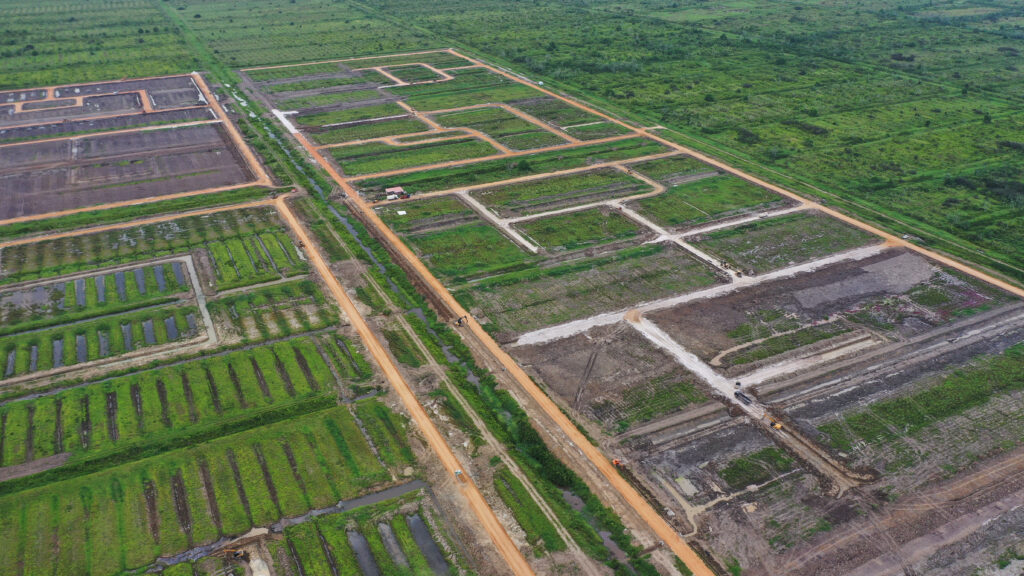
Infrastructure works in Phase Three of the Wales Housing Development in March 2026. Contextual image; it does not depict the newly tendered seven lots. Photo and drone: Sydel Thomas, Central Housing & Planning Authority Public Relations Department.
Guyana’s Central Housing and Planning Authority has opened three international civil-works solicitations covering 26 lots at Moleson Creek, Overwinning and Wales, with an aggregate road scope of approximately 90.1 kilometres.
The three CHPA procurement notices cover aggregate-surface roads together with earthen drains, reinforced-concrete culverts and bridges at two locations in Region Six and one in Region Three. They were published online on 27 October and are dated 22 October.
Moleson Creek and Overwinning bids are due by 9:00 a.m. on Wednesday, 6 January 2027. Wales has a separate 9:00 a.m. deadline on Thursday, 7 January. These are three different solicitations with separate contract numbers and bidding packages—not one combined 26-lot tender.
The opportunities form part of the Saudi Fund for Development’s Infrastructure Development Works for the Housing Sector Project. Each notice says Guyana received US$100 million in SFD financing for the wider programme and intends to use part of the proceeds for the relevant works.
US$100 million is not the disclosed value of any individual solicitation or the combined value of the three. CHPA has not published contract estimates or lot-by-lot budgets in the notices.
Three sites and three separate submissions
The largest disclosed road scope is at Moleson Creek, where the 11-lot solicitation covers approximately 39.3 kilometres of aggregate-surface roads. The Overwinning notice covers eight lots and approximately 22.7 kilometres, while the Wales solicitation covers seven lots and approximately 28.1 kilometres.
The approximate 90.1-kilometre total is Invest Guyana’s arithmetic sum of the three road figures published by CHPA. It is useful for understanding the visible scale of the procurement batch, but it is not an official consolidated project quantity.
All three notices describe the associated scope as earthen drains and reinforced-concrete culverts and bridges. They do not disclose the drainage length, number of structures, quantities or estimated value attached to each lot. The full technical schedules and bills of quantities must be obtained from the individual bidding packages.
- Moleson Creek, Region Six: 11 lots; approximately 39.3 km; deadline 9:00 a.m. on 6 January 2027.
- Overwinning, Region Six: eight lots; approximately 22.7 km; deadline 9:00 a.m. on 6 January 2027.
- Wales, Region Three: seven lots; approximately 28.1 km; deadline 9:00 a.m. on 7 January 2027.
The lot structures may allow the works to be divided into manageable packages, but the public notices do not state how many contractors may be selected, whether one bidder may receive multiple lots or whether award capacity will be assessed across the three procurements. Bidders should not infer those rules from the number of lots.
What the US$100 million represents
The notices identify SFD Loan Financing No. 1/796 and say part of the US$100 million financing will be applied to the site-specific contracts.
The Saudi Fund for Development Annual Report 2023, page 54 describes the broader initiative as housing-sector infrastructure intended to support development across three administrative regions. The reported programme includes a wider range of enabling infrastructure and social facilities than the road-and-drainage scopes listed in the current notices.
That programme context should not be collapsed into the three tenders. The notices do not disclose how much of the SFD loan is allocated to Moleson Creek, Overwinning or Wales, and they do not establish that every element of the wider SFD project will be delivered through these contracts.
For contractors, the commercially relevant value will come from the priced quantities and contract terms for the lots they select—not from the headline size of the financing programme.
International competition and joint-venture strategy
All three procurements use International Competitive Bidding under SFD guidelines and are open to eligible firms. Each notice allows bidders to associate with other companies through a joint venture or subcontracting arrangement to strengthen their qualifications, provided the intended structure and lead firm are clearly identified and supported by an agreement.
The notices grant a 10 per cent margin of preference to Saudi companies bidding individually and to joint ventures between Saudi and Guyanese companies. This is an evaluation preference, not an automatic award and not a 10 per cent reduction in the price paid under a contract.
For a Guyanese contractor, a Saudi–Guyanese joint venture may affect competitiveness, but the preference should not be the only reason for partnering. The parties need a credible operating model covering responsibility for design interpretation, equipment, personnel, finance, procurement, quality, safety, reporting, liability and decision-making.
Other eligible bidders are not excluded. They should examine the precise evaluation mechanism in the SFD guidelines and each bidding document before deciding how to structure a bid.
These solicitations should also not be confused with ordinary low-value domestic registration categories. Eligibility and qualification must be established from the SFD-governed bidding documents themselves.
Common submission requirements
Each public notice lists a non-refundable document fee of G$25,000 or US$120 using the official payment instructions. Because there are three separate solicitations, an interested company should confirm the package and payment required for each site it intends to pursue.
The submission process is physical. Each bid requires one paper original and three electronic copies on separate flash drives and must be hand-delivered to NPTAB in Georgetown. Late bids will be rejected unopened.
Bid security must equal 2.5 per cent of the submitted bid for every lot bid upon. A company pursuing multiple lots—or participating in more than one solicitation—should model the combined security exposure and confirm the acceptable form, issuing institution, wording and validity period.
Administrative control will be critical. Bidders should create a compliance matrix for every solicitation covering mandatory forms, signatures, powers of attorney, joint-venture documents, financial records, experience, equipment, personnel, bid security, packaging, labelling and the correct deadline.
The public notices do not publish all qualification thresholds or the current execution periods. The purchased packages, official clarifications and addenda are the authority.
Selecting the right lots
Ninety kilometres of aggregate roads across three developments does not represent one uniform construction environment. A contractor should examine the specific quantities and site conditions of each lot before deciding where its capacity is strongest.
The technical assessment should include ground and drainage conditions, rainfall exposure, site access, haulage routes, aggregate supply, concrete-product availability, equipment mobilisation, fuel, labour, testing, surveying, utility interfaces and the need for storage or temporary facilities.
The financial review should cover mobilisation costs, advance-payment provisions, interim certificates, retention, performance securities, insurance, taxes, price-adjustment rules and the interval between expenditure and payment. If a bidder pursues several lots, it should test whether its equipment, working capital and management team can deliver overlapping programmes.
Contractors should also verify environmental, traffic, community-access and worker-safety obligations. Housing developments remain active places where residents, allottees and other contractors may need continued access while civil works proceed.
An attractively sized lot can still be commercially unsuitable if the bidder underestimates haulage, drainage risk, finance costs or the time needed to certify and collect payment.
What the procurement may mean for suppliers
The three solicitations indicate potential downstream demand for aggregate, concrete products, culverts, equipment, transport, fuel, surveying, geotechnical and materials testing, safety services and skilled labour.
Those are market implications, not announced subcontracts. Suppliers should not treat the CHPA notices as confirmation that they have been selected or that a prime contractor is authorised to place orders before award.
The best preparation is to identify which bidders and joint ventures are actively pursuing the relevant lots, document product specifications and capacity, and be ready to demonstrate delivery reliability, quality control and commercial terms if a procurement discussion begins.
The broader housing programme may also support later demand in utilities, building materials, transport and community services as sites are developed and occupied. The timing of those effects will depend on awards, construction progress, utility connections, house-lot development and private building activity.
What bidders should monitor next
Companies should obtain the official documents promptly and direct questions through the CHPA contacts named in each notice. They should monitor CHPA and the applicable procurement channels for addenda, clarification responses, deadline changes and updated submission instructions.
Invest Guyana’s October Procurement Watch provides wider pipeline context, while the Invest Guyana Explainer on Guyana’s eProcure portal explains why businesses must follow official documents and updates rather than rely on summaries alone. Neither article replaces the three SFD bidding packages.
The new batch gives contractors a defined view of scale: 26 lots across three sites and approximately 90.1 kilometres of aggregate roads, together with drainage and structures. The decisive work now is lot-level—matching technical and financial capacity to the right scope, complying with three separate processes and pricing the risks realistically.