

A manufacturing company has spent months planning a major expansion in Guyana.The business case is strong, financing has been arranged and construction is expected to begin within the year. Then one morning, the company’s directors read a headline announcing that Parliament is debating a new investment bill.
Almost immediately, questions begin to circulate around the boardroom.
“Has the law already changed?”
“Will this affect our project?”
“Do we need to change our plans?”
These are sensible questions, but they reveal a common misunderstanding. News reports often describe bills being introduced, debated or approved, leading many people to assume that the law has already changed. In reality, a bill is only the beginning of the legislative journey. Before it becomes part of Guyana’s legal framework, it must pass through a recognised constitutional process.
Understanding that process helps businesses make better decisions, helps investors interpret government announcements more accurately and gives citizens a clearer picture of how national decisions become law.
A Bill Is a Proposal, Not a Law
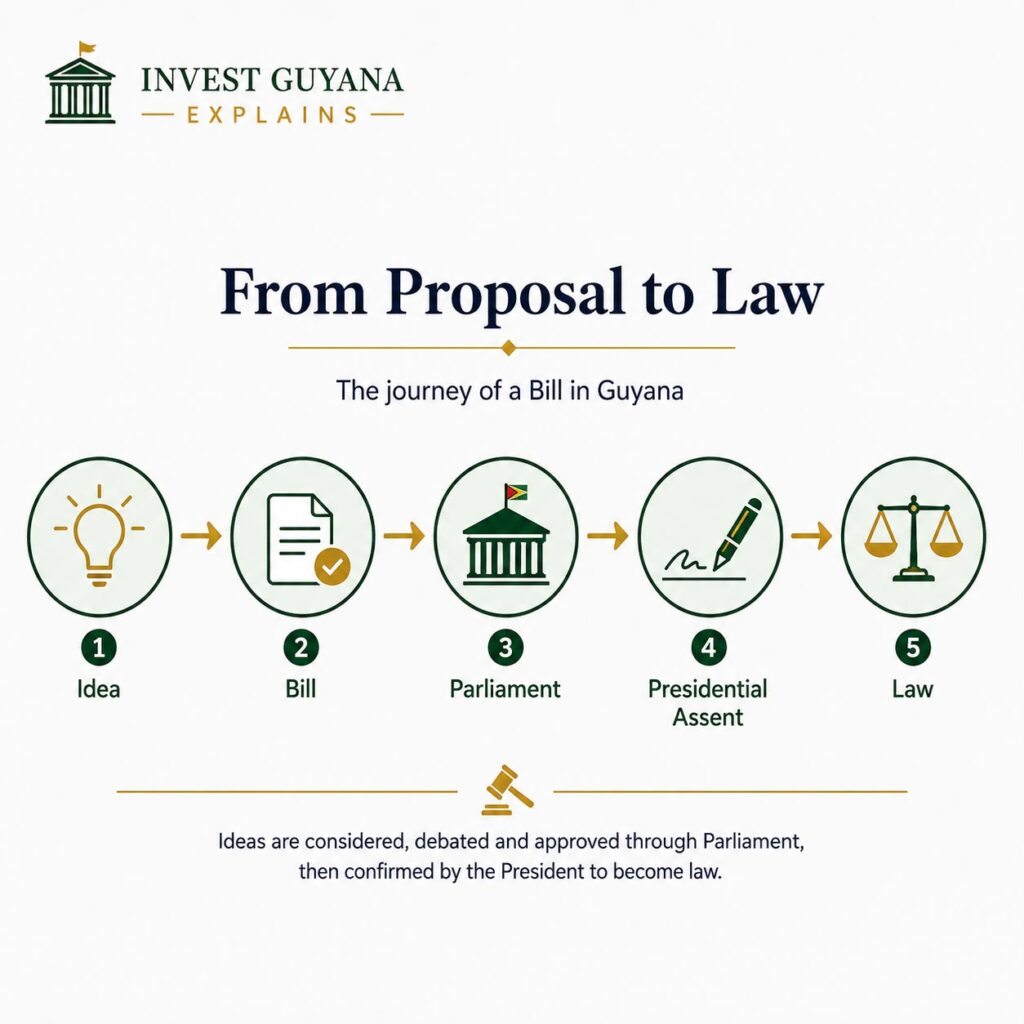
Every law begins as an idea. Sometimes that idea is driven by changing economic conditions. Sometimes it responds to new technologies, emerging industries or the need to update older legislation. Whatever the reason, the first formal step is usually the introduction of a bill.
A bill is simply a proposal for a new law or for changes to an existing one. At this stage, nothing has changed legally. The proposal has entered Parliament for consideration, but it has not yet become part of the country’s laws.
An easy way to think about it is to imagine a company introducing a new workplace policy. Management may prepare a draft, circulate it for discussion and make revisions before formally approving it. Until that approval takes place, employees continue operating under the existing policy.
The same principle applies to legislation. A bill represents what may become law, not what already is law.
Understanding this distinction immediately changes the way legislative news is interpreted. A headline announcing the introduction of a bill is reporting the beginning of a process rather than its conclusion.
Why Parliament Debates Bills
If a bill is only a proposal, why doesn’t Parliament simply vote on it immediately? Because laws have consequences.
New legislation can influence businesses, workers, investors, government agencies and the wider public. Before those changes become legally binding, Parliament provides an opportunity for elected representatives to examine the proposal, discuss its likely impact and determine whether it should proceed.
Debate is therefore much more than a formality. It allows different viewpoints to be considered before decisions are made that may affect the country for years to come.
Some bills move through Parliament with broad agreement because they address matters on which there is little disagreement. Others receive far more discussion because they involve complex policy questions or significant national interest.
Regardless of the subject, the purpose remains the same: proposals should be examined before they become law. For businesses, this stage can be particularly valuable. Parliamentary debate often provides an early indication of the direction legislation may take, allowing organisations to begin assessing possible implications while recognising that the proposal has not yet become law.
From Bill to Law
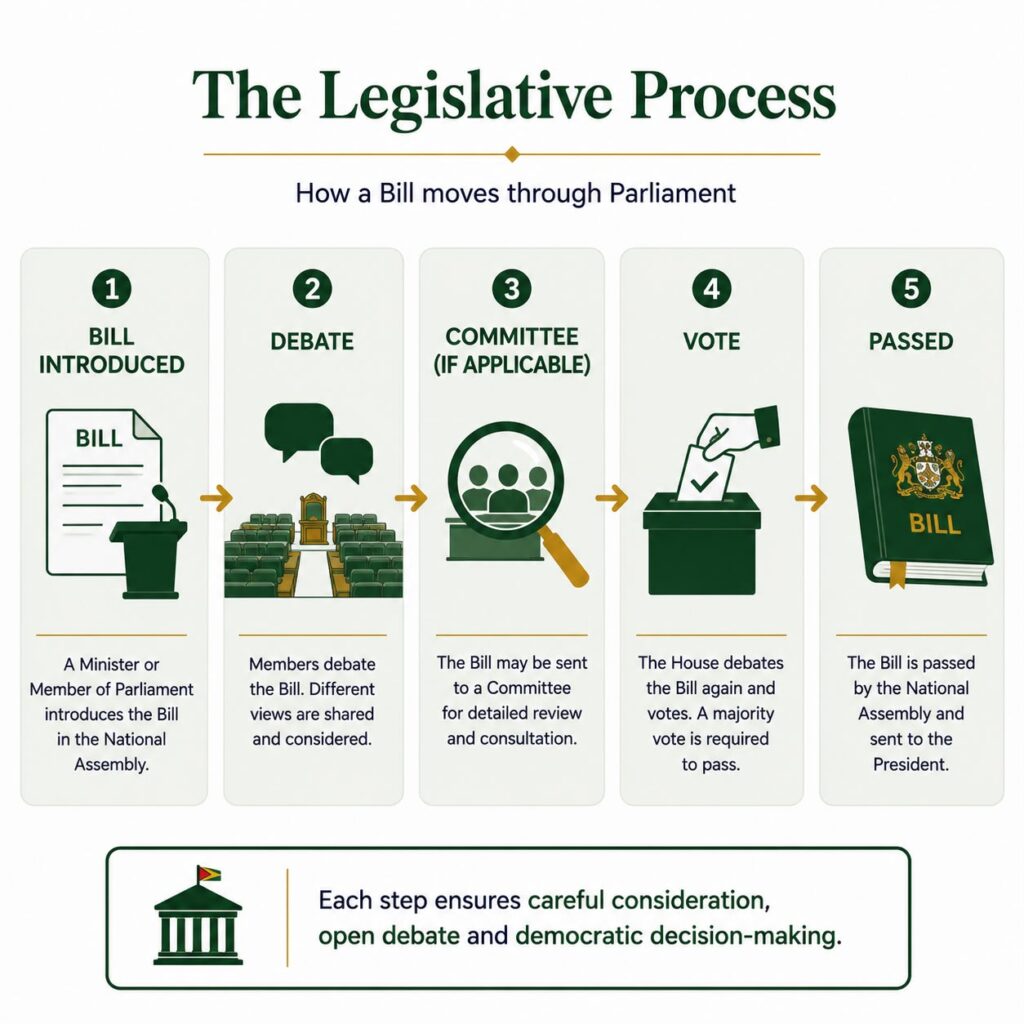
Although the formal legislative process contains several procedural steps, the overall journey is easier to understand than many people expect. It begins when a proposal is introduced as a bill.
The bill is then considered by Parliament, where Members of Parliament debate its contents and decide whether it should move forward. During this stage, the proposal is examined before Parliament reaches a decision on whether to approve it.
If Parliament approves the bill, it does not immediately become law simply because the vote has taken place. The constitutional process continues until the bill receives Presidential assent. Once that process has been completed, the proposal becomes law and forms part of Guyana’s legal framework.
This sequence is important because it demonstrates that legislation follows recognised constitutional procedures rather than appearing overnight. For most readers, remembering every parliamentary step is unnecessary. What matters is understanding the overall journey:
A proposal becomes a bill. Parliament debates the bill. The constitutional process is completed. The bill becomes law. That simple framework is enough to interpret most legislative news accurately.
When Does the Law Actually Change?
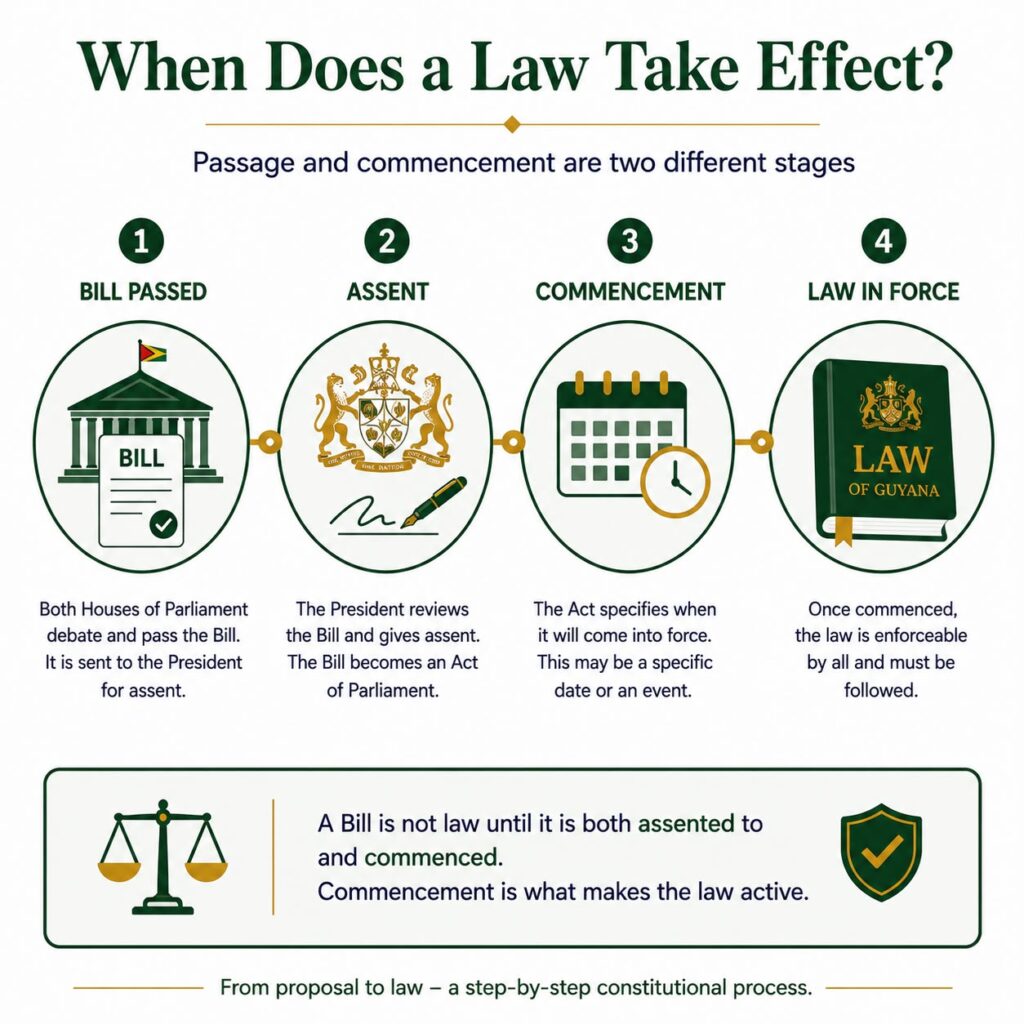
This is perhaps the most useful question for businesses and investors. Governments regularly announce new initiatives. Ministers discuss proposed reforms. Parliament debates bills.
None of these events necessarily means the law has changed. Legal change occurs only after the legislative process has been completed and the bill has become law.
Returning to our manufacturing company, the directors now have a much clearer understanding of the situation. The headline announcing that Parliament is debating a new investment bill does not require an immediate change to the company’s operations. Instead, it tells management that proposed legislation is moving through the legislative process.
That gives the business an opportunity to monitor developments, understand what is being proposed and prepare for possible future changes without assuming those changes have already taken legal effect. The same principle applies to citizens following news about taxation, education, environmental regulation or public services.
Understanding the stage a bill has reached makes it much easier to separate political discussion from actual legal change.
Why This Matters
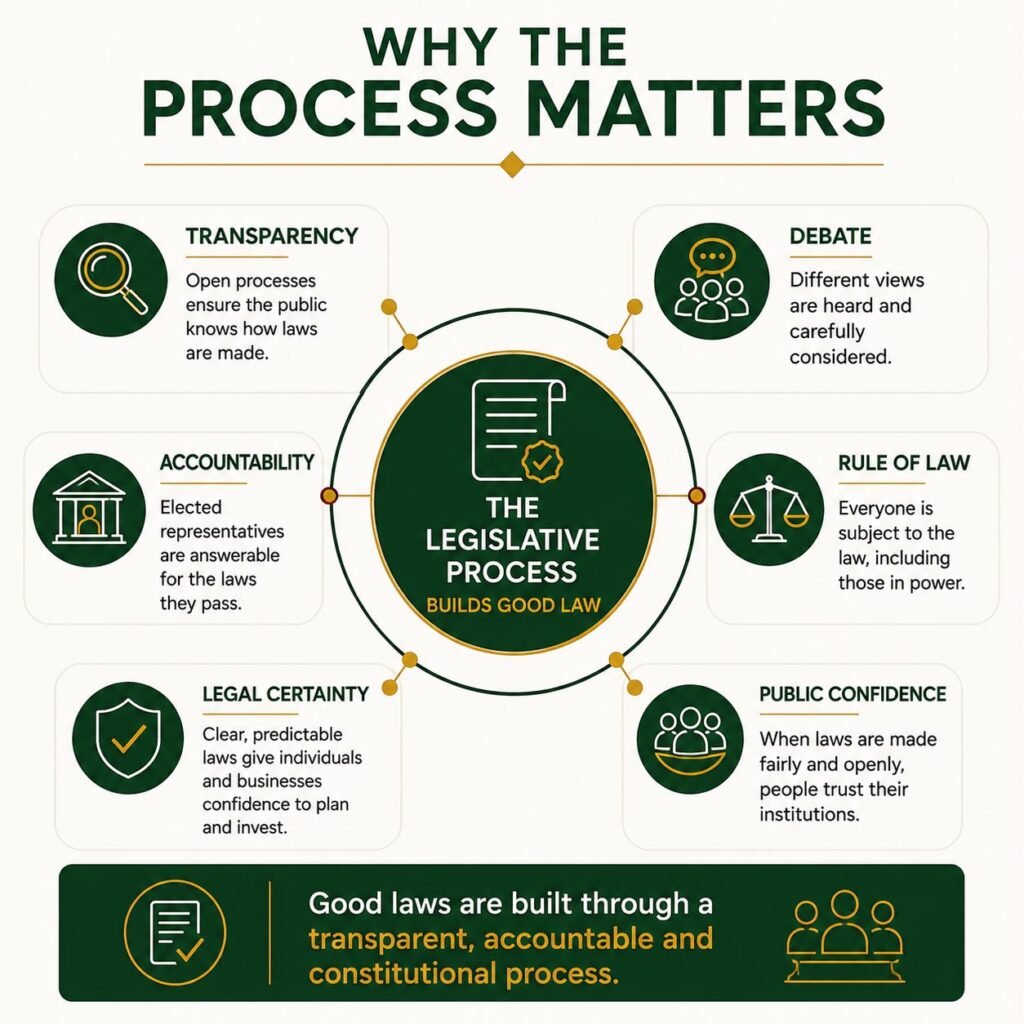
The journey from bill to law affects far more than constitutional lawyers or Members of Parliament. Many of the rules that shape everyday life begin as proposed legislation before eventually becoming law. Changes affecting taxation, customs procedures, employment standards, environmental protection, investment incentives and public procurement all pass through the legislative process before taking legal effect.
For investors, understanding this process reduces uncertainty. It helps distinguish between proposals that are still under consideration and laws that must already be followed.
For businesses, it supports better planning. Companies can monitor proposed legislation, assess possible impacts and prepare for future changes without reacting prematurely to every headline.
For citizens, it provides a clearer understanding of how democratic government works. Laws do not simply appear. They are developed through a process designed to encourage discussion, scrutiny and accountability before they become legally binding.
Understanding this process also strengthens confidence in public institutions. It demonstrates that significant legal changes generally move through established constitutional procedures rather than being introduced without parliamentary consideration.
From Headlines to Understanding
Let’s return to the manufacturing company. At the beginning of this article, its directors believed that a headline about Parliament debating a bill might mean the law had already changed.
Now they understand the bigger picture. A bill is a proposal, not a law.
Parliament debates that proposal before deciding whether it should proceed. Only after the constitutional process has been completed does the proposal become part of Guyana’s legal framework.
This understanding changes the way legislative news is interpreted. Instead of reacting immediately to every announcement, businesses can better assess where proposed legislation stands and what it may mean for future planning. Investors gain greater confidence in understanding how significant legal changes occur, while citizens develop a clearer appreciation of the institutions that shape national life.
Knowing how a bill becomes law is another step towards understanding how Guyana’s system of government operates. In the next stage of the Invest Guyana Explains series, we’ll explore what happens after a law has been passed, examining how regulations, government agencies and public administration transform legislation into the policies and services that people